
Understanding the calsavers withdrawal process is essential for California employees who participate in this state-sponsored retirement program. As a Roth IRA-based retirement savings plan, CalSavers offers specific withdrawal rules that differ from traditional 401(k) plans and require careful consideration of tax implications, penalties, and timing strategies. Whether you're facing a financial emergency, planning for retirement, or simply evaluating your options, knowing how to navigate the withdrawal process can help you make informed decisions that align with your long-term financial goals.
Understanding CalSavers Account Structure
CalSavers operates as a Roth IRA program, which fundamentally shapes how withdrawals work. Unlike traditional retirement accounts where contributions are made pre-tax, CalSavers uses after-tax dollars. This structure creates distinct advantages and considerations when accessing your funds.
The Roth IRA framework means you've already paid income taxes on your contributions. This characteristic influences the withdrawal rules and tax treatment you'll encounter when accessing your money. Your account contains two types of funds: contributions (the money you deposited) and earnings (the investment growth on those contributions).
Contribution vs. Earnings Withdrawals
The distinction between contributions and earnings is critical for calsavers withdrawal planning:
- Contributions: Can be withdrawn anytime without taxes or penalties
- Earnings: Subject to specific rules based on your age and account duration
- Five-Year Rule: Account must be open for five years for qualified earnings withdrawals
- Age Requirements: Specific conditions apply for penalty-free earnings access

| Withdrawal Type | Tax Implications | Penalty Risk | Timing Restrictions |
|---|---|---|---|
| Contributions | None | None | Anytime |
| Qualified Earnings | None | None | After age 59½ + 5-year rule |
| Non-Qualified Earnings | Income tax applies | 10% penalty (exceptions exist) | Before meeting requirements |
Eligibility Requirements for CalSavers Withdrawal
Before initiating a calsavers withdrawal, you should understand when you can access your funds and under what circumstances. The program provides flexibility for contributions but imposes restrictions on earnings to encourage long-term retirement saving.
You can withdraw your contributions at any time for any reason. This flexibility serves as a safety net for emergencies while maintaining the retirement-focused nature of the account. However, accessing earnings requires meeting specific criteria to avoid taxes and penalties.
Qualified Distribution Criteria
For earnings to be withdrawn as a qualified distribution:
- Account Age: Your first Roth IRA contribution must have occurred at least five years ago
- Age Requirement: You must be at least 59½ years old
- Alternative Qualifications: Disability, first-time home purchase (up to $10,000), or death of account holder
The detailed withdrawal information from CalSavers outlines these requirements comprehensively. Meeting both the five-year rule and age requirement ensures your earnings withdraw tax-free and penalty-free.
Early Withdrawal Penalties and Exceptions
Withdrawing earnings before meeting qualified distribution criteria typically triggers a 10% early withdrawal penalty plus income taxes on the earnings portion. However, the IRS provides several exceptions to this penalty.
Penalty-Free Early Withdrawal Exceptions:
- Qualified higher education expenses for you, spouse, children, or grandchildren
- Unreimbursed medical expenses exceeding 7.5% of adjusted gross income
- Health insurance premiums while unemployed
- Birth or adoption expenses (up to $5,000 per child)
- Substantially equal periodic payments based on life expectancy
- IRS levy on the retirement account
- Qualified reservist distributions
Working with professionals who understand fiduciary financial advice can help you determine whether your situation qualifies for an exception and whether withdrawal is your best option.
How to Initiate a CalSavers Withdrawal
The calsavers withdrawal process involves several straightforward steps, though planning ahead is advisable due to processing timelines. Understanding the procedure helps set appropriate expectations and ensures you receive your funds when needed.
Step-by-Step Withdrawal Process
The complete withdrawal steps and requirements provide a framework for accessing your account:
- Access Your Account: Log into your CalSavers account through the official portal
- Navigate to Withdrawals: Locate the withdrawal section in your account dashboard
- Select Withdrawal Type: Choose between partial or full distribution
- Specify Amount: Indicate how much you want to withdraw
- Choose Distribution Method: Select check by mail or direct deposit
- Review Tax Withholding: Decide on federal and state tax withholding preferences
- Submit Request: Complete and submit your withdrawal request
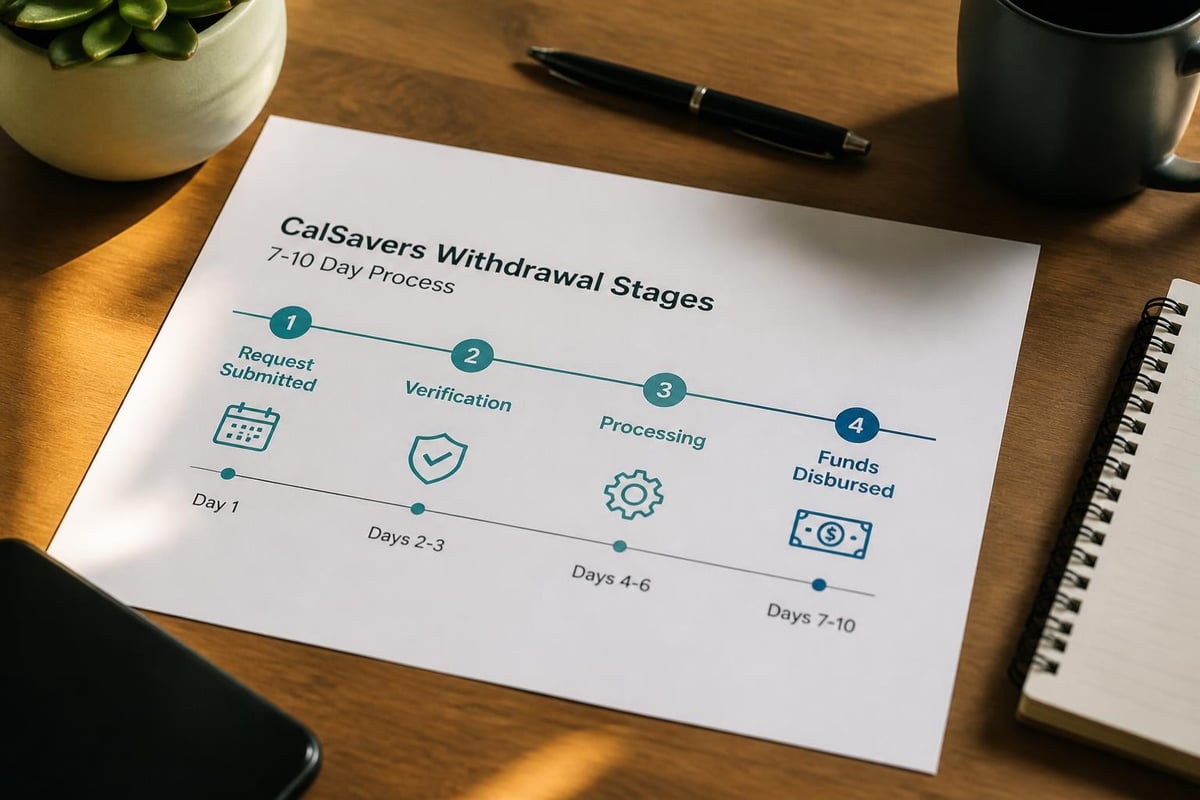
- Await Processing: Expect 7-10 business days for processing and fund delivery
Distribution Methods and Timing
CalSavers offers two primary methods for receiving your withdrawal:
Direct Deposit: Funds transfer electronically to your designated bank account. This method typically completes faster than physical checks and reduces the risk of lost mail. You'll need to provide your bank's routing number and your account number.
Check by Mail: CalSavers mails a physical check to your address on file. This option works well if you haven't set up direct deposit or prefer a paper check for record-keeping purposes.
Processing typically takes between seven and ten business days from request submission to fund availability. During high-volume periods or if additional verification is required, processing may extend slightly longer.
Tax Implications and Reporting Requirements
Understanding the tax consequences of a calsavers withdrawal is essential for accurate financial planning and tax preparation. The tax treatment varies significantly based on what portion of your account you're withdrawing and whether the distribution qualifies as penalty-free.
Since CalSavers functions as a Roth IRA, you've already paid taxes on contributions. These funds withdraw completely tax-free at any time. Earnings, however, face different tax treatment depending on whether your withdrawal qualifies.
Tax Forms and Reporting
After completing a withdrawal, you'll receive specific tax documentation. The tax forms for CalSavers accounts include Form 1099-R, which reports distributions from retirement accounts.
Key Information on Form 1099-R:
- Total distribution amount
- Taxable amount (if any)
- Distribution code indicating the type of withdrawal
- Federal income tax withheld
- State income tax withheld
This form is critical for your tax return preparation. You'll report the distribution on your Form 1040, and the distribution code helps determine whether taxes or penalties apply. Consulting with professionals who provide retirement planning services can help ensure proper reporting and minimize tax liability.
Withholding Considerations
When initiating a calsavers withdrawal, you'll decide whether to have taxes withheld from your distribution. For qualified distributions of contributions only, no withholding is necessary since you owe no taxes. For non-qualified distributions of earnings, consider your total tax picture.
| Withholding Option | Advantages | Considerations |
|---|---|---|
| No Withholding | Receive full distribution amount | May owe taxes when filing return |
| 10% Withholding | Standard withholding rate | May not cover full tax liability |
| Custom Withholding | Align with specific tax situation | Requires accurate tax projection |
If you don't specify withholding, CalSavers applies no automatic withholding. This differs from some retirement accounts that mandate 20% withholding. Planning your withholding strategy prevents unwanted tax surprises and potential underpayment penalties.
Strategic Considerations Before Withdrawing
Before initiating a calsavers withdrawal, evaluate whether accessing these retirement funds aligns with your broader financial strategy. Retirement accounts offer unique tax advantages and long-term growth potential that, once disrupted, cannot be easily replaced.
Alternative Funding Sources
Consider these options before tapping retirement savings:
- Emergency Fund: Access liquid savings designated for unexpected expenses
- Personal Loans: Explore borrowing options that don't impact retirement savings
- Payment Plans: Negotiate extended payment arrangements with creditors
- Side Income: Generate additional income through temporary work or asset sales
- Family Assistance: Consider loans from family members with clear repayment terms
Preserving retirement accounts allows your investments to continue growing tax-free. The compound growth over decades can significantly impact your retirement security. Professionals offering investment management services can help model the long-term impact of early withdrawals.
Account Closure vs. Partial Withdrawal
Deciding between partial withdrawal and full account closure requires careful consideration:
Partial Withdrawal:
- Maintains your account and ongoing contributions
- Preserves investment growth on remaining balance
- Keeps your five-year clock running for qualified distributions
- Allows continued employer contributions (if applicable)
Full Withdrawal:
- Closes your CalSavers account completely
- Stops all future contributions and growth
- Resets the five-year rule if you open a new Roth IRA later
- May trigger employer re-enrollment in CalSavers
If you're separating from your employer but want to preserve retirement savings, consider the differences between CalSavers and other retirement accounts before making withdrawal decisions.
Common Withdrawal Scenarios and Best Practices
Different life situations call for different approaches to calsavers withdrawal planning. Understanding common scenarios helps you navigate your specific circumstances more effectively.
Medical Emergency Withdrawals
Unexpected medical expenses often prompt retirement account withdrawals. If your unreimbursed medical costs exceed 7.5% of your adjusted gross income, you qualify for penalty-free early withdrawal of earnings. However, you'll still owe income taxes on the earnings portion.
Steps for Medical Emergency Withdrawals:
- Calculate unreimbursed medical expenses
- Determine adjusted gross income threshold
- Document expenses with receipts and statements
- Withdraw only necessary amounts to cover qualified expenses
- Maintain records for tax filing purposes
First-Time Home Purchase
CalSavers allows penalty-free withdrawal of up to $10,000 in earnings for first-time home purchases. This exception applies if you haven't owned a home in the past two years. The funds must be used within 120 days of withdrawal.

Both you and your spouse (if married) can each withdraw $10,000 from separate Roth IRAs, potentially providing $20,000 toward a home purchase. This strategy requires careful coordination with your overall home-buying timeline and mortgage planning.
Unemployment Situations
Job loss creates financial stress, but withdrawing retirement savings should remain a last resort. California unemployment benefits, severance packages, and emergency funds should be exhausted first. If withdrawal becomes necessary, prioritize contributions over earnings to avoid taxes and penalties.
The comprehensive overview of how CalSavers functions includes information about what happens to your account when you change employers. Your account remains yours, and you can continue managing it independently.
Frequently Asked Questions About CalSavers Withdrawals
Understanding common questions about calsavers withdrawal helps clarify the process and address concerns. The CalSavers FAQ section provides additional official guidance.
Can I Repay a Withdrawal?
Unlike 401(k) loans, Roth IRA withdrawals cannot be repaid or recontributed beyond annual contribution limits. Once you withdraw funds, that money permanently leaves your retirement account. The only exception involves 60-day rollovers, where you withdraw funds and redeposit them within 60 days to avoid tax consequences. However, you can only execute one such rollover per 12-month period across all IRAs.
How Does Withdrawal Affect Future Contributions?
Withdrawing from CalSavers doesn't prevent future contributions up to annual IRA limits. For 2026, the standard contribution limit is $7,000 (or $8,000 if you're 50 or older). Your withdrawal doesn't create additional contribution room beyond these limits.
What Happens to Employer Contributions?
If your employer participates in CalSavers and provides matching or other contributions, withdrawing your funds doesn't affect those employer contributions. However, closing your account may trigger re-enrollment if you remain employed with a CalSavers-participating employer.
Coordinating CalSavers with Comprehensive Retirement Planning
Your calsavers withdrawal decisions should align with your broader retirement strategy. Retirement planning encompasses multiple accounts, income sources, and tax considerations that interact in complex ways.
Multi-Account Retirement Strategy
Many individuals hold retirement savings across various accounts:
- CalSavers Roth IRA
- Traditional 401(k) from current or former employers
- Individual Roth or Traditional IRAs
- Social Security benefits
- Pension plans
- Taxable investment accounts
Each account type carries distinct tax treatment, withdrawal rules, and strategic considerations. Coordinating withdrawals across these accounts can optimize tax efficiency and preserve wealth. Professionals providing estate planning services help integrate retirement accounts into comprehensive wealth transfer strategies.
Tax Bracket Management
Strategic calsavers withdrawal timing can help manage tax brackets throughout retirement. Since qualified Roth IRA withdrawals are tax-free, they provide valuable flexibility for high-income years when additional taxable income would push you into higher brackets.
Tax-Efficient Withdrawal Sequencing:
- Taxable accounts first (typically lowest tax impact)
- Tax-deferred accounts during moderate-income years
- Roth accounts to manage tax brackets strategically
- Required Minimum Distribution planning from traditional accounts
This sequencing approach maximizes after-tax retirement income. However, individual circumstances vary significantly, and consulting with advisors who offer tax strategy services helps customize an approach to your situation.
Impact of Life Changes on Withdrawal Planning
Major life events often trigger reassessment of retirement account strategies, including calsavers withdrawal planning. Recognizing these trigger points helps you adapt your financial strategy appropriately.
Career Transitions
Changing jobs affects CalSavers in specific ways. Your account remains yours regardless of employment status, but contribution patterns change. If your new employer doesn't offer retirement benefits and has five or more employees, they may eventually be required to participate in CalSavers or offer an alternative retirement plan.
During career transitions, evaluate whether to:
- Continue CalSavers contributions independently
- Roll CalSavers into a new employer's 401(k) or 403(b)
- Maintain CalSavers while contributing to a new employer plan
- Consolidate multiple retirement accounts for simpler management
Marriage and Family Changes
Marriage, divorce, and growing families significantly impact financial priorities and retirement planning. Spousal coordination of retirement accounts can optimize household tax efficiency and retirement security.
When married, consider:
- Coordinating withdrawal strategies between spouses' accounts
- Understanding beneficiary designations and implications
- Planning joint retirement income streams
- Evaluating household tax situations holistically
Working with professionals who understand fiduciary planning principles ensures recommendations prioritize your best interests during these transitions.
Health Status Changes
Declining health or disability can necessitate early retirement account access. The disability exception allows penalty-free withdrawal of earnings if you become totally and permanently disabled. Medical documentation substantiating the disability is required.
Long-term care expenses, chronic illness management, and end-of-life planning all intersect with retirement account withdrawal strategies. Advance planning provides clarity and reduces stress during difficult periods.
Monitoring and Adjusting Your Withdrawal Strategy
Effective calsavers withdrawal planning isn't a one-time decision but rather an ongoing process that adapts to changing circumstances, tax laws, and financial goals.
Regular Account Review Schedule
Establish a consistent review schedule for your CalSavers and broader retirement portfolio:
- Quarterly: Monitor account balance and investment performance
- Annually: Review contribution amounts and investment allocation
- Life Events: Reassess strategy after major changes
- Five-Year Intervals: Conduct comprehensive retirement planning review
Regular monitoring helps identify when withdrawal might be necessary and when alternative strategies better serve your goals. Tracking your account balance, contribution history, and investment performance provides the data needed for informed decisions.
Documentation and Record Keeping
Maintaining thorough records simplifies calsavers withdrawal processes and tax reporting:
- Contribution records by year and amount
- Withdrawal confirmation statements
- Form 1099-R copies from all distributions
- Supporting documentation for penalty exceptions
- Correspondence with CalSavers administrators
Organized records prove invaluable during tax preparation, IRS audits, or financial planning consultations. Digital copies stored securely provide backup protection against loss.
Professional Guidance for Withdrawal Decisions
While CalSavers provides accessible retirement savings, complex withdrawal decisions often benefit from professional financial guidance. The interplay between taxes, penalties, long-term goals, and alternative strategies requires comprehensive analysis.
When to Seek Professional Advice
Consider professional consultation when:
- Evaluating early withdrawal for major expenses
- Coordinating multiple retirement accounts
- Planning systematic retirement income withdrawals
- Facing complex tax situations
- Experiencing significant life changes
- Uncertain about penalty exception qualifications
Professional advisors can model various scenarios, project long-term impacts, and identify strategies you might not have considered. They bring expertise in tax law, retirement planning regulations, and investment management that supplements your own knowledge.
Fiduciary Responsibility in Advice
When seeking guidance on calsavers withdrawal or broader retirement planning, working with fiduciary advisors ensures recommendations prioritize your best interests. Fiduciary advisors are legally obligated to act in your favor, avoiding conflicts of interest that could compromise advice quality.
Understanding the calsavers withdrawal process empowers you to make informed decisions about accessing your retirement savings when circumstances require. The combination of contribution flexibility and earnings protection creates a balanced approach to both emergency access and long-term retirement security. Brookwood Investment Group offers personalized financial guidance that integrates CalSavers with your comprehensive retirement strategy, helping you navigate withdrawal decisions alongside investment management, tax planning, and estate considerations. Their fiduciary approach ensures recommendations align with your unique goals and circumstances, providing clarity when evaluating whether and how to access your retirement funds.
