
Receiving an inherited Roth IRA can provide significant financial opportunities, but understanding the complex rules governing these accounts is essential for maximizing their benefits. Unlike traditional IRAs, Roth IRAs offer unique tax advantages that can extend to beneficiaries, though the distribution requirements and strategic considerations differ based on your relationship to the original account owner. Whether you're a spouse, adult child, or other beneficiary, knowing how to properly manage an inherited Roth IRA can help you preserve wealth and make informed decisions that align with your financial goals.
Understanding Inherited Roth IRA Basics
An inherited Roth IRA is a retirement account that passes to a designated beneficiary after the original owner's death. These accounts maintain the tax-free growth characteristics that make Roth IRAs valuable, as qualified distributions remain tax-free for beneficiaries.
The fundamental difference between inheriting a Roth IRA versus a traditional IRA centers on taxation. Because the original owner paid taxes on Roth IRA contributions, beneficiaries can typically withdraw funds without owing income tax, provided the account has been open for at least five years. This tax treatment makes inherited Roth IRAs particularly valuable estate planning tools.
Key Characteristics of Inherited Roth IRAs
- Tax-free qualified distributions for beneficiaries when the five-year rule is satisfied
- No required minimum distributions during the original owner's lifetime
- Different distribution rules based on beneficiary classification
- Potential for continued tax-free growth during the distribution period
The IRS provides detailed guidelines on beneficiary rules that determine your options when inheriting a Roth IRA. These regulations underwent significant changes with the SECURE Act of 2019, which fundamentally altered the landscape for most non-spouse beneficiaries.
Beneficiary Categories and Their Impact
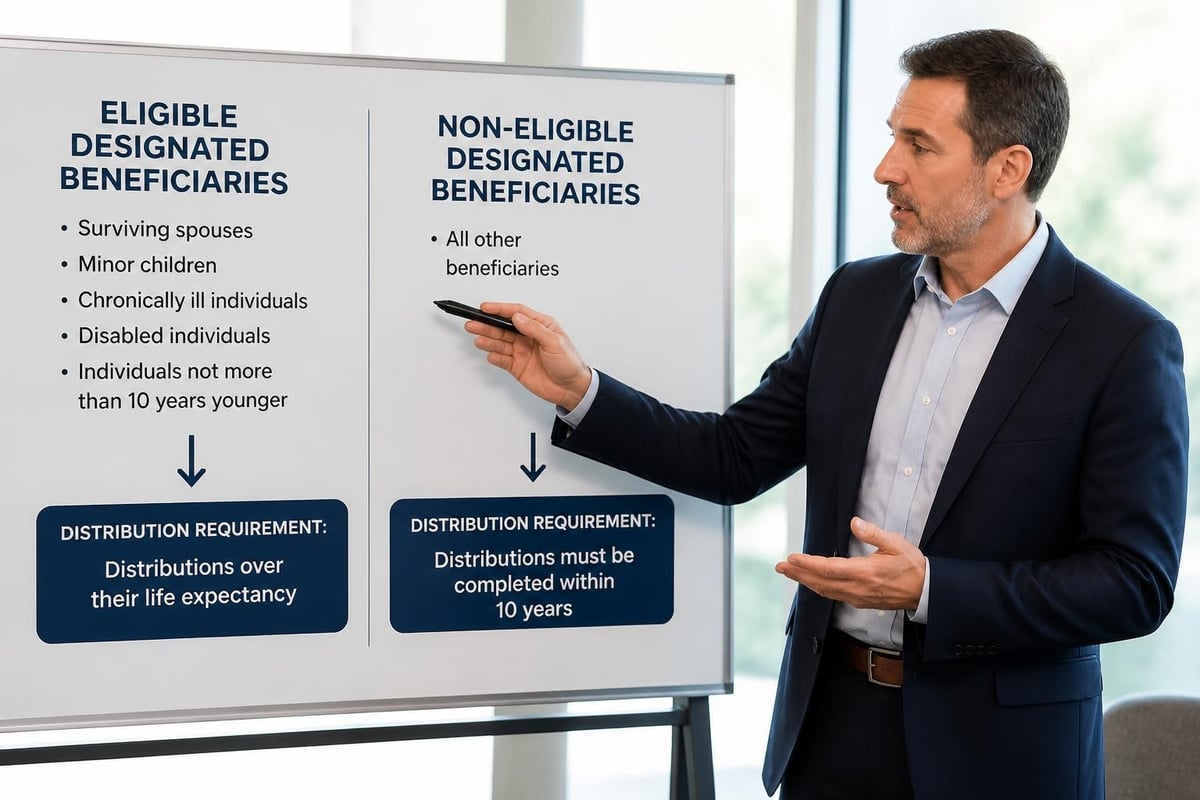
The SECURE Act established distinct beneficiary categories that determine your distribution options. Understanding which category applies to your situation is critical for compliance and strategic planning.
Eligible Designated Beneficiaries
This classification includes specific individuals who receive more flexible distribution options:
- Surviving spouses who inherit Roth IRAs
- Minor children of the deceased account owner (until reaching majority)
- Disabled individuals as defined by IRS regulations
- Chronically ill individuals meeting specific criteria
- Individuals not more than 10 years younger than the deceased owner
Eligible designated beneficiaries generally have access to the "stretch" provision, allowing distributions over their life expectancy. This extended timeframe maximizes the potential for tax-free growth within the inherited account.
Non-Eligible Designated Beneficiaries
Most adult children, grandchildren, siblings, and other beneficiaries fall into this category. These individuals must follow the 10-year rule, requiring complete distribution of the inherited Roth IRA by December 31 of the tenth year following the owner's death.
The 10-year rule provides flexibility within the decade-long window. Non-eligible designated beneficiaries can take distributions in any amount or pattern during those ten years, or wait until the final year, as long as the account is fully distributed by the deadline. This flexibility enables strategic tax planning, though it's shortened considerably from the previous stretch IRA rules.
Spousal Inheritance Options
Surviving spouses enjoy the most flexibility when inheriting a Roth IRA, with several distinct options unavailable to other beneficiaries. Fidelity outlines these spousal options in detail, highlighting the strategic considerations for each approach.
Treat the Account as Your Own
Spouses can elect to treat an inherited Roth IRA as their own account. This option allows you to:
- Name your own beneficiaries
- Make additional contributions if you have earned income and meet eligibility requirements
- Avoid required minimum distributions during your lifetime
- Maintain maximum flexibility for future planning
This approach works particularly well for younger spouses who want to continue building retirement assets and may benefit from additional contribution opportunities.
Open an Inherited Roth IRA
Alternatively, spouses can maintain the account as an inherited Roth IRA. This option might appeal to spouses who:
- Need access to funds before age 59½ without early withdrawal penalties
- Want to preserve the five-year clock from the original account
- Prefer to delay the decision about treating it as their own
Roll Over to Your Existing Roth IRA
Spouses can consolidate an inherited Roth IRA with their existing Roth IRA, simplifying account management and maintaining all funds under their own name. This streamlined approach reduces administrative complexity while preserving the tax-free growth potential.
| Spousal Option | Primary Advantage | Best For |
|---|---|---|
| Treat as Own | Maximum flexibility, contribution eligibility | Younger spouses building wealth |
| Inherited IRA | Penalty-free early access | Spouses under 59½ needing funds |
| Rollover | Account consolidation | Simplifying estate management |
Distribution Rules for Non-Spouse Beneficiaries
For non-spouse beneficiaries, withdrawal rules have become significantly more restrictive since the SECURE Act's implementation. Understanding these requirements prevents costly mistakes and potential penalties.
The 10-Year Distribution Requirement
Non-eligible designated beneficiaries must empty the inherited Roth IRA within ten years of the original owner's death. Unlike traditional IRAs, there are no annual required minimum distributions during this period for Roth accounts, offering strategic flexibility.
You can structure withdrawals to align with your financial needs and tax situation. Common strategies include:
- Taking equal annual distributions to create predictable cash flow
- Delaying all distributions until year ten to maximize tax-free growth
- Taking larger distributions in lower-income years to manage overall tax liability
- Coordinating withdrawals with major expenses like education costs or home purchases
Exceptions for Minor Children
Minor children of the deceased owner can stretch distributions over their life expectancy, but this benefit terminates when they reach the age of majority. At that point, the 10-year rule begins, requiring full distribution within ten years of reaching adulthood.

Tax Implications and Strategic Considerations
The tax advantages of inherited Roth IRAs make them valuable assets, but avoiding tax traps requires careful planning and understanding the nuances of current regulations.
The Five-Year Rule
For distributions to be completely tax-free, the original Roth IRA must have been established for at least five years before the owner's death. If this requirement isn't met, earnings (but not contributions) may be subject to income tax upon distribution.
The five-year clock starts on January 1 of the year the original owner made their first Roth IRA contribution. This timing consideration affects beneficiaries of newer Roth accounts and those converted from traditional IRAs shortly before death.
State Tax Considerations
While Roth IRA distributions are federally tax-free, state tax treatment varies. Some states may impose inheritance or estate taxes depending on the account value and your relationship to the deceased. Consulting with a tax professional familiar with your state's regulations is advisable.
Coordination with Estate Planning
Proper beneficiary designation is critical for efficient wealth transfer. The Motley Fool provides comprehensive guidance on what beneficiaries should do after inheriting a Roth IRA, emphasizing the importance of updating your own beneficiary designations after receiving an inherited account.
When you inherit a Roth IRA, you should:
- Verify beneficiary status with the custodian immediately
- Understand your distribution timeline based on your beneficiary classification
- Retitle the account properly to maintain its inherited status
- Name your own beneficiaries for any remaining balance
- Document your distribution strategy to ensure compliance
Special Situations and Considerations
Certain inheritance scenarios require additional attention and specialized knowledge to navigate effectively.
Trust Beneficiaries
When a trust is named as the beneficiary of a Roth IRA, distribution rules become considerably more complex. Fidelity explains the intricacies of inherited IRA rules for trusts, noting that the trust structure affects distribution timelines and tax treatment.
Trusts may be classified as either see-through or non-qualifying, which determines whether individual beneficiaries' life expectancies can be used for distribution calculations. The SECURE Act limited the benefits of trust beneficiaries in many cases, making pre-death planning even more critical.
Multiple Beneficiaries
When multiple beneficiaries share an inherited Roth IRA, each person's beneficiary classification affects the entire account unless it's split into separate inherited IRAs by December 31 of the year following the owner's death. This separation allows each beneficiary to apply their own distribution rules.
Estate as Beneficiary
If no beneficiary is designated or the estate is named, the inherited Roth IRA must typically be distributed within five years of death. This accelerated timeline reduces the potential for tax-free growth and eliminates flexibility available to designated beneficiaries.
Maximizing the Value of Your Inherited Roth IRA
Strategic management of an inherited Roth IRA can significantly impact your long-term financial outcomes. NerdWallet provides an overview of inherited IRA options that beneficiaries should evaluate based on their individual circumstances.
Investment Management Strategies
- Maintain tax-free growth potential by investing appropriately for your time horizon
- Consider risk tolerance changes as you approach the distribution deadline
- Rebalance periodically to maintain alignment with your overall financial plan
- Coordinate with other assets to optimize your complete investment portfolio
Distribution Timing Considerations
For non-spouse beneficiaries subject to the 10-year rule, distribution timing can be optimized by:
- Analyzing current and projected future income levels to minimize overall tax impact on other income sources
- Coordinating with major life events such as retirement, education expenses, or business ventures
- Preserving tax-free growth by delaying distributions when possible
- Planning for the distribution deadline to avoid forced large withdrawals in year ten
Working with professionals who specialize in retirement planning and estate planning can help you develop a comprehensive strategy that integrates your inherited Roth IRA with your broader financial goals.

Why Original Owners Choose Roth IRAs for Legacy Planning
Understanding why Roth IRAs make excellent legacy assets helps beneficiaries appreciate the gift they've received and manage it appropriately. Kiplinger highlights compelling reasons to leave heirs a Roth IRA, emphasizing the unique advantages these accounts provide.
Tax-Free Inheritance Benefits
Unlike traditional IRAs that burden heirs with income tax liabilities, Roth IRAs pass tax-free to beneficiaries. This characteristic can be particularly valuable when:
- Beneficiaries are in high tax brackets
- The account has experienced substantial growth
- Heirs need immediate access to funds for specific purposes
No Lifetime RMDs for Original Owners
Original Roth IRA owners never face required minimum distributions during their lifetime, allowing maximum flexibility to preserve wealth for heirs. This advantage enables account values to grow substantially before inheritance occurs.
Estate Planning Advantages
Roth IRAs provide several estate planning benefits that make them strategic legacy tools:
- Reduced taxable estate value through Roth conversions completed during the owner's lifetime
- Predictable tax-free income stream for beneficiaries during the distribution period
- Flexibility in distribution timing for heirs to coordinate with their financial needs
- Simplified beneficiary planning compared to other assets subject to probate
Common Mistakes to Avoid
Beneficiaries often make errors that diminish the value of inherited Roth IRAs or create compliance problems. Awareness of these pitfalls helps you preserve the account's benefits.
Failing to Take Timely Distributions
Missing the 10-year deadline results in severe penalties, potentially 50% of the amount that should have been distributed. Setting up automatic distributions or working with financial professionals ensures compliance with timing requirements.
Improper Account Titling
The inherited Roth IRA must be titled correctly to maintain its tax-advantaged status. The account should indicate it's inherited and identify both the deceased owner and beneficiary. Errors in titling can trigger immediate taxation of the entire account.
Neglecting Beneficiary Designations
After inheriting a Roth IRA, naming your own beneficiaries is essential. Without proper designations, remaining assets may pass through probate rather than directly to your intended heirs.
Missing the Spousal Treatment Deadline
Spouses who want to treat an inherited Roth IRA as their own should make this election thoughtfully and understand any related deadlines. Different custodians have varying procedures for this election.
Integration with Comprehensive Financial Planning
An inherited Roth IRA should be viewed as one component of your complete financial picture rather than an isolated asset. Professional guidance can help you optimize how this account fits within your broader wealth management strategy.
Consider how the inherited account affects:
- Retirement income planning and your projected cash flow needs
- Tax planning strategies across all income sources
- Investment allocation across your entire portfolio
- Estate planning for your own heirs
- Charitable giving goals if philanthropy is important to you
Those seeking personalized financial guidance benefit from coordinating inherited Roth IRA management with other financial planning elements to create a cohesive strategy aligned with their unique circumstances and objectives.
Regulatory Updates and Future Considerations
The regulatory environment surrounding inherited retirement accounts continues to evolve. The SECURE Act 2.0, passed in late 2022, made additional changes to retirement account rules, though the core inherited Roth IRA provisions remained largely unchanged.
Staying informed about regulatory developments is essential for long-term planning. Future legislation may modify distribution requirements, beneficiary classifications, or tax treatment. Working with financial professionals who monitor these changes helps ensure your strategy remains compliant and optimized.
| Aspect | Pre-SECURE Act | Current Rules (2026) |
|---|---|---|
| Non-spouse beneficiaries | Life expectancy distributions | 10-year rule for most |
| Eligible designated beneficiaries | Same as non-spouse | Life expectancy option retained |
| Spousal options | Multiple choices | Same flexibility maintained |
| RMDs during distribution period | Yes, for traditional IRAs | No annual RMDs for Roth IRAs |
Managing an inherited Roth IRA requires careful attention to distribution rules, tax implications, and strategic opportunities that align with your specific financial situation. The decisions you make regarding distribution timing, investment management, and integration with your overall financial plan can significantly impact the long-term value you receive from this inheritance. At Brookwood Investment Group, our fiduciary advisors provide personalized guidance on retirement planning, investment management, and estate planning strategies tailored to your unique goals and circumstances. Whether you've recently inherited a Roth IRA or want to optimize your legacy planning, Brookwood Investment Group offers the expertise and virtual-first accessibility to help you make informed decisions that support your financial future.
