
A well-executed roth conversion strategy represents one of the most powerful tools available to individuals seeking greater control over their retirement tax liability. As we navigate through 2026, the interplay between current tax rates, future legislative uncertainty, and individual financial circumstances creates unique opportunities for strategic conversions. Converting traditional retirement accounts to Roth IRAs involves paying taxes today in exchange for tax-free growth and distributions tomorrow, but this decision requires careful analysis of multiple factors including current income, projected retirement expenses, and anticipated tax bracket changes.
Understanding the Fundamentals of Roth Conversions
The mechanics of a roth conversion strategy involve transferring assets from tax-deferred accounts such as traditional IRAs or 401(k)s into a Roth IRA. When you execute this conversion, the transferred amount becomes taxable income in the year of conversion. This additional income can push you into higher tax brackets, making the timing and amount of conversions critical to overall success.
Key Differences Between Traditional and Roth Accounts
Traditional retirement accounts offer an upfront tax deduction, allowing contributions to reduce your current taxable income. Investment growth occurs tax-deferred, but all distributions in retirement face ordinary income tax treatment. Additionally, these accounts require you to take required minimum distributions (RMDs) beginning at age 73, forcing taxable withdrawals whether you need the income or not.
Roth accounts operate under opposite rules. Contributions come from after-tax dollars with no immediate deduction, but qualified distributions emerge completely tax-free. Perhaps more importantly, Roth IRAs impose no RMDs during the account owner's lifetime, providing flexibility for estate planning and allowing assets to continue growing tax-free indefinitely.

Strategic Timing Considerations for 2026
The timing of conversions can dramatically impact their effectiveness. Several factors converge in 2026 that make strategic planning particularly important for those considering a roth conversion strategy.
Identifying Low-Income Years
Converting during years when your income temporarily drops creates opportunities to fill lower tax brackets at reduced rates. Common scenarios include:
- Early retirement years before pension or Social Security benefits begin
- Business owners experiencing cyclical revenue fluctuations
- Professionals taking sabbaticals or career transitions
- Years with significant business losses or deductions
- Gaps between employment and required minimum distributions
The goal involves converting enough to maximize your current tax bracket without spilling into the next higher rate. For 2026, understanding the specific bracket thresholds for your filing status allows precise calculation of optimal conversion amounts.
Market Volatility Windows
Market downturns present unique conversion opportunities. When your traditional IRA balance declines due to market conditions, converting the same number of shares results in lower taxable income. If the market subsequently recovers, that appreciation occurs in your Roth account where it grows tax-free.
This strategy requires careful consideration of your risk tolerance and time horizon. As noted by experts discussing common mistakes to avoid during Roth conversions, timing the market should never be the primary driver of conversion decisions.
Tax Bracket Management Techniques
A sophisticated roth conversion strategy involves precise tax bracket management to minimize the total tax burden over your lifetime. This approach requires multi-year planning and regular adjustments based on changing circumstances.
Bracket-Filling Strategy
The bracket-filling approach involves converting just enough each year to reach the top of your current tax bracket without exceeding it. This methodology spreads conversions across multiple years, potentially keeping you in lower brackets than a single large conversion would trigger.
| Tax Strategy | 2026 Single Filer Bracket | Conversion Amount | Effective Rate |
|---|---|---|---|
| Conservative | Up to 12% bracket | $47,150 | 10-12% |
| Moderate | Up to 22% bracket | $100,525 | 15-18% |
| Aggressive | Up to 24% bracket | $191,950 | 18-21% |
These thresholds change annually with inflation adjustments, making it essential to review your strategy each year. Working with fiduciary financial advisors can help ensure you optimize these decisions within the broader context of your financial plan.
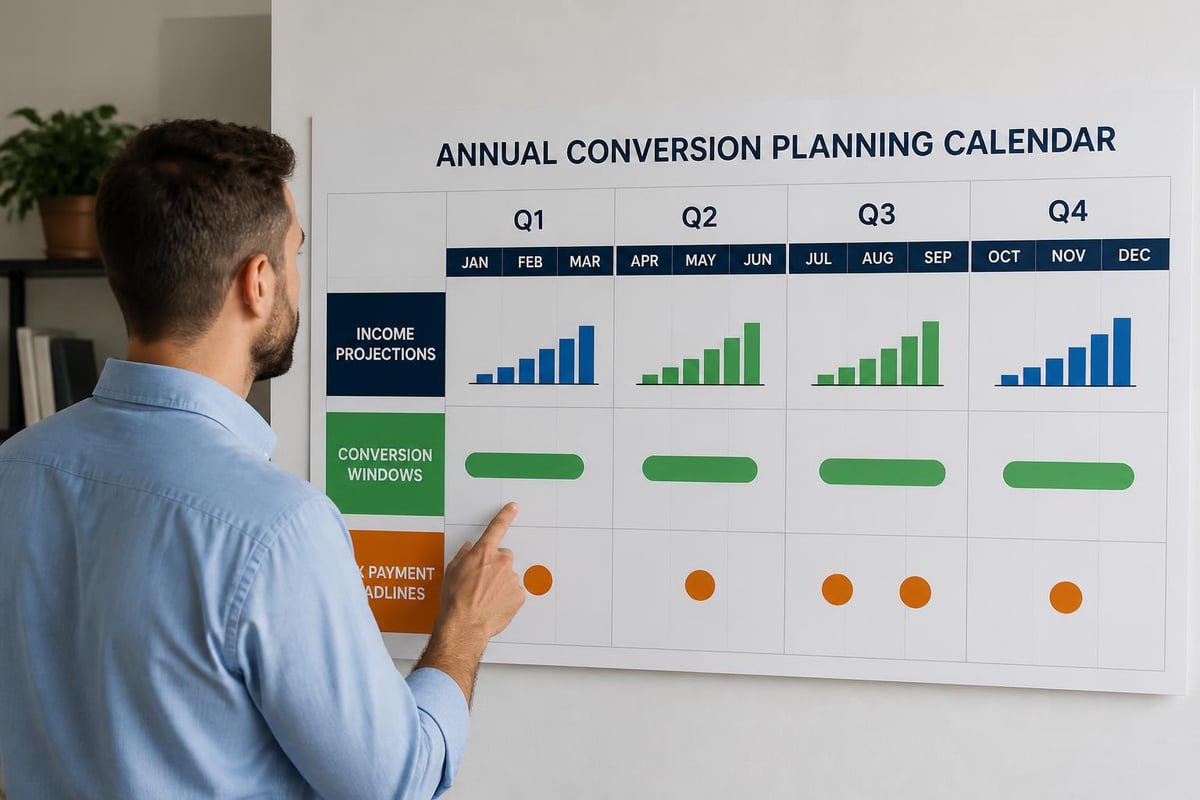
Multi-Year Conversion Planning
Rather than converting your entire traditional IRA balance at once, spreading conversions over five to ten years often produces superior tax outcomes. This approach provides several advantages:
- Bracket control: Staying within predetermined tax brackets each year
- Flexibility: Adjusting annual conversion amounts based on income fluctuations
- Tax law adaptation: Responding to legislative changes affecting rates or rules
- Income smoothing: Avoiding large spikes that trigger additional taxes or Medicare surcharges
The comprehensive 2026 guide to Roth conversion strategies emphasizes the importance of considering effective tax rates, which include not just marginal rates but also phaseouts of deductions and credits.
Advanced Strategies for High-Income Professionals
Business owners and high-income professionals face unique considerations when implementing a roth conversion strategy. Their variable income patterns and additional planning opportunities require specialized approaches.
Coordinating Conversions with Business Income
For business owners, synchronizing conversions with business cycles can produce significant tax savings. Converting during lower-revenue years or when making large equipment purchases that generate deductions allows you to offset conversion income more effectively.
Consider these coordination tactics:
- Schedule conversions in years with major capital expenditures
- Time conversions around business losses or restructuring
- Coordinate with qualified business income deductions
- Plan around retirement plan contribution timing
- Leverage charitable contributions to offset conversion income
Backdoor Roth Considerations
High earners who exceed Roth IRA contribution limits often use backdoor Roth strategies, making non-deductible traditional IRA contributions followed by immediate conversions. However, the pro-rata rule requires careful attention when substantial pre-tax IRA balances exist.
The pro-rata calculation considers all your traditional, SEP, and SIMPLE IRAs collectively. Converting only non-deductible contributions while maintaining large pre-tax balances results in partially taxable conversions. Solutions include rolling pre-tax IRA balances into employer 401(k) plans before executing backdoor conversions, though not all plans accept these rollovers.
Impact on Required Minimum Distributions
One of the most compelling aspects of a roth conversion strategy involves reducing or eliminating future required minimum distributions. RMDs force taxable withdrawals from traditional retirement accounts beginning at age 73, potentially pushing retirees into higher tax brackets than necessary.
RMD Compression Benefits
By converting traditional IRA balances to Roth accounts before RMDs begin, you reduce the future required distribution amounts. This creates several advantages:
Tax flexibility: Smaller RMDs mean greater control over annual taxable income
Social Security optimization: Lower RMDs reduce the likelihood of triggering higher taxation on Social Security benefits
Medicare premium avoidance: Keeping income below IRMAA thresholds prevents Medicare surcharges
Estate planning efficiency: Roth IRAs pass to heirs without RMD requirements during the original owner's lifetime
A 55-year-old with $500,000 in traditional IRAs who converts $50,000 annually for ten years will face dramatically smaller RMDs at age 73 compared to leaving those funds untouched. The reduction in forced withdrawals provides spending flexibility and potential tax savings throughout retirement.
Inherited IRA Considerations
The SECURE Act changed inherited IRA rules, generally requiring non-spouse beneficiaries to withdraw all funds within ten years. This compressed distribution period often forces beneficiaries into higher tax brackets as they empty inherited traditional IRAs.
Converting to Roth accounts before death eliminates this tax burden for heirs. They still face the ten-year withdrawal requirement for inherited Roth IRAs, but those distributions emerge tax-free. For individuals prioritizing wealth transfer to the next generation, this benefit often justifies paying conversion taxes during their lifetime.
Avoiding Common Conversion Pitfalls
Even well-intentioned conversion strategies can produce disappointing results when common mistakes occur. Understanding these pitfalls helps you develop a more robust roth conversion strategy.
The Recharacterization Limitation
Prior to 2018, taxpayers could reverse Roth conversions through recharacterization if they regretted the decision or if market declines reduced the converted account value. Current law eliminated this option for conversions completed after December 31, 2017. This permanence makes pre-conversion planning even more critical, as noted by experts discussing why Roth conversions aren’t suitable for everyone.
Failing to Plan for Tax Payments
Converting without adequate funds to pay the resulting taxes forces you to either withhold taxes from the conversion itself or scramble to find payment sources. Withholding taxes from the conversion reduces the amount landing in your Roth account and may trigger early withdrawal penalties if you're under age 59½.
The optimal approach involves paying conversion taxes from non-retirement account funds. This allows the full converted amount to grow tax-free in your Roth account. Planning ahead ensures you have sufficient cash reserves or can adjust conversion amounts to match available tax payment resources.
Ignoring the Five-Year Rule
Roth accounts impose a five-year waiting period before converted amounts can be withdrawn penalty-free, even if you're over age 59½. Each conversion starts its own five-year clock, creating multiple tracking requirements for those executing annual conversions.
Understanding this timing helps you avoid unexpected penalties. The Roth conversion ladder strategy deliberately uses these rules to create penalty-free income streams in early retirement, but requires careful planning and record-keeping.
Quantifying the Conversion Decision
Determining whether a roth conversion strategy makes sense for your specific situation requires detailed financial modeling. Several key variables influence the outcome of this analysis.
Break-Even Analysis Components
| Variable | Impact on Conversion Value | Planning Consideration |
|---|---|---|
| Current tax rate | Higher rates reduce conversion appeal | Time conversions when rates are low |
| Retirement tax rate | Higher future rates increase conversion value | Project income sources and brackets |
| Years until withdrawal | Longer periods favor conversions | Consider age and retirement timeline |
| Investment returns | Higher returns amplify conversion benefits | Use conservative assumptions |
| Estate planning goals | Legacy priorities may justify higher costs | Include heir tax situations |
Professional financial modeling incorporates these variables along with your specific circumstances to project outcomes across various scenarios. This analysis often reveals that partial conversions provide better results than all-or-nothing approaches.
State Tax Considerations
State income tax treatment adds another layer of complexity to conversion analysis. Some individuals retire to states with no income tax, making it advantageous to delay conversions until after relocating. Others face mandatory state tax withholding on distributions regardless of residence, affecting the relative value of conversions.

Working with Professional Advisors
The complexity of Roth conversion decisions often warrants professional guidance. Coordinating conversions with your overall retirement planning and estate planning strategies ensures all elements work together effectively.
Integrated Tax Planning Approach
Effective conversion planning doesn't occur in isolation. It connects with multiple aspects of your financial life:
- Investment strategy: Asset location decisions affect conversion timing and amounts
- Income planning: Coordinating wages, business income, and other sources
- Social Security timing: Delayed claiming strategies interact with conversion windows
- Charitable giving: Qualified charitable distributions and donor-advised funds offset conversion income
- Healthcare planning: ACA subsidies and Medicare premiums respond to income changes
This integrated approach, often provided through comprehensive financial strategy planning, considers how each decision affects the others to optimize your overall outcome.
Ongoing Strategy Adjustment
A roth conversion strategy requires regular review and adjustment. Tax laws change, your financial situation evolves, and market conditions fluctuate. Annual reviews allow you to:
- Recalculate optimal conversion amounts based on current income
- Adjust for tax law changes affecting rates or rules
- Respond to market movements affecting account balances
- Incorporate major life changes such as job transitions or inheritances
- Refine projections as you approach retirement
The three key tactics recommended by Schwab emphasize maximizing current brackets, spreading conversions across years, and planning early for tax changes, all of which benefit from ongoing professional oversight.
Special Situations and Considerations
Certain circumstances create unique conversion opportunities or challenges that require specialized planning approaches.
Early Retirement Scenarios
Individuals retiring before age 59½ often find themselves in ideal conversion situations. They typically face several years of lower income before pension or Social Security benefits begin, creating windows to convert at reduced tax rates. However, accessing funds to pay conversion taxes requires careful planning to avoid early withdrawal penalties.
Strategies for early retirees include:
- Using taxable account funds to cover living expenses and taxes
- Implementing Roth conversion ladders for penalty-free access
- Coordinating substantially equal periodic payments (72(t)) if needed
- Planning conversion sequences to fund the conversion ladder
- Balancing conversion opportunities against cash flow needs
Employer Plan Conversions
Some 401(k) plans now offer in-plan Roth conversion options, allowing you to convert employer plan balances without rolling to an IRA first. This can provide advantages for high earners seeking to maintain access to plan features while executing conversions.
However, as discussed in guidance about converting traditional 401(k)s to Roth 401(k)s, these conversions carry specific considerations including company matching coordination and withdrawal rules that differ from Roth IRAs.
Qualified Charitable Distributions
For those over age 70½, qualified charitable distributions (QCDs) from IRAs provide a tax-efficient alternative or complement to conversions. QCDs allow up to $105,000 annually (2026 limit) to be transferred directly from IRAs to charities, satisfying RMD requirements without increasing taxable income.
Combining QCDs with conversions creates a balanced approach: use QCDs to satisfy RMDs tax-efficiently while converting additional amounts in lower-income years to reduce future RMD burdens.
Year-End Planning Opportunities
December 31 represents a critical deadline for Roth conversions, as they must be completed by year-end to count for that tax year. This timing creates specific planning opportunities and challenges.
Fourth-quarter income certainty: By late year, you have greater visibility into annual income, allowing more precise conversion calculations to fill tax brackets exactly.
Market timing flexibility: You can assess year-to-date market performance to determine if conditions favor conversion from a valuation perspective.
Tax law visibility: Upcoming tax law changes often become clearer late in the year, informing whether to accelerate or delay conversions.
Estimated tax adjustment: Final conversions allow you to adjust estimated tax payments or increase withholding to cover the additional liability.
The trade-off involves reduced time for converted assets to grow tax-free during the year compared to conversions executed in January. For most situations, the improved accuracy of year-end conversions outweighs this minor disadvantage.
Documentation and Compliance Requirements
Proper record-keeping ensures you can substantiate conversions and track the various timing rules affecting Roth accounts.
Essential Records to Maintain
- Form 1099-R: Documents the conversion amount from the distributing institution
- Form 5498: Shows the Roth IRA contribution (conversion) amount received
- Form 8606: Reports non-deductible IRA contributions affecting pro-rata calculations
- Conversion tracking: Spreadsheet or system noting each conversion date and amount for five-year rule monitoring
- Tax return copies: Historical returns showing conversion reporting and tax payments
These records become particularly important if you execute multiple conversions over several years or if you need to demonstrate compliance with withdrawal rules when taking distributions.
Reporting Requirements
Conversions must be reported on your tax return in the year they occur. The conversion amount appears as income on Form 1040, with Form 8606 providing detailed calculations when non-deductible contributions exist in traditional IRAs.
Failing to properly report conversions can trigger IRS notices or incorrect tax assessments. Professional tax preparation becomes increasingly valuable as your roth conversion strategy grows more complex.
Implementing a successful roth conversion strategy requires balancing current tax costs against future benefits while considering your unique financial circumstances, goals, and risk tolerance. The decision involves complex trade-offs between known taxes today and uncertain taxes tomorrow, influenced by factors ranging from income projections to estate planning priorities. Brookwood Investment Group provides personalized guidance on conversion strategies as part of comprehensive financial planning, helping clients navigate these complex decisions within their broader retirement and tax planning objectives.
