
Transforming decades of savings into a reliable retirement income stream requires careful planning and strategic execution. As you approach or enter retirement, understanding how to systematically withdraw from your portfolio becomes just as important as the accumulation phase that preceded it. Retirement drawdown strategies encompass the methods, timing, and sequencing decisions that determine how you'll convert your nest egg into sustainable cash flow while managing taxes, market volatility, and longevity risk. With proper planning, you can help ensure your assets support your lifestyle throughout retirement while potentially leaving a legacy for your heirs.
Understanding the Foundation of Withdrawal Planning
Retirement drawdown strategies begin with establishing a sustainable baseline withdrawal rate. The traditional 4% rule has long served as a starting point, suggesting retirees could withdraw 4% of their portfolio in year one and adjust that dollar amount for inflation annually. However, market conditions, portfolio composition, and retirement length all influence what might be appropriate for your specific situation.
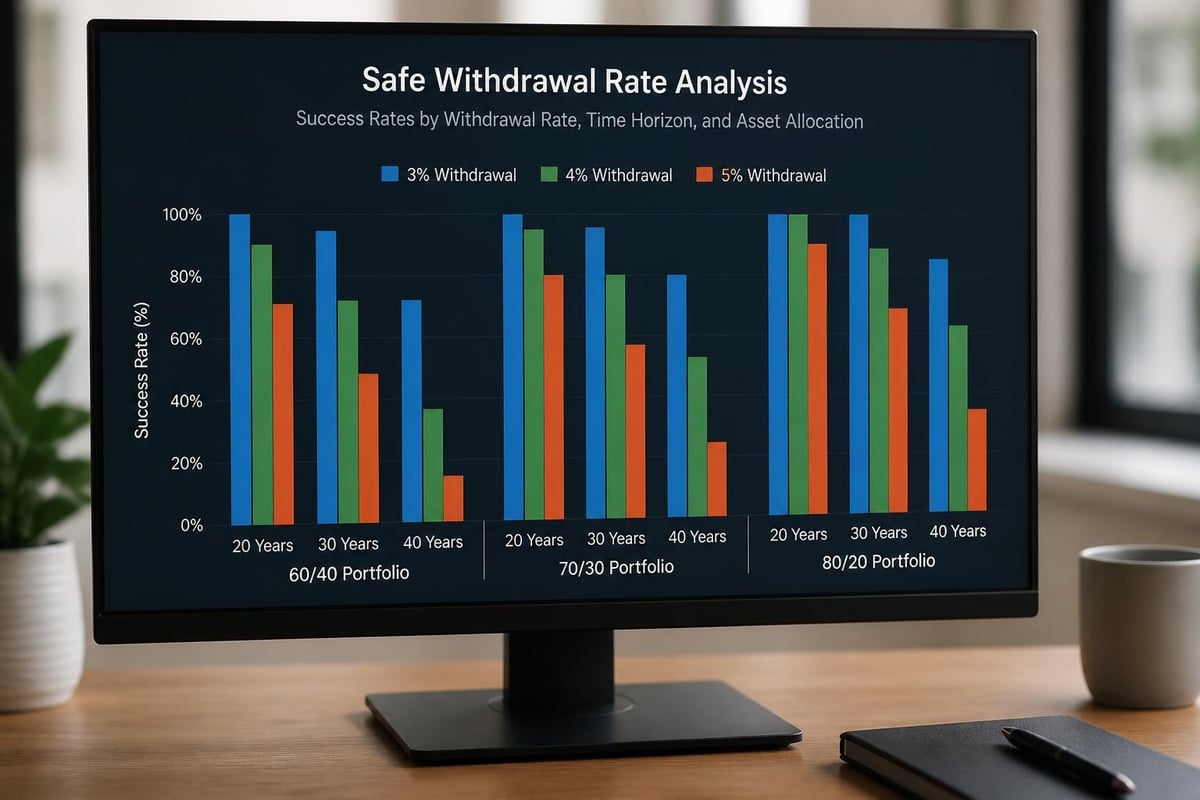
Research from Morningstar’s analysis for 2026 estimates a “safe” starting withdrawal rate around 3.9% based on a 30-year retirement horizon, reflecting current market valuations and bond yields. This updated guidance recognizes that static rules require periodic reassessment based on economic conditions. Your personal withdrawal rate should account for several factors:
- Current portfolio balance and asset allocation
- Expected retirement duration and health status
- Additional income sources like Social Security or pensions
- Legacy goals and estate planning objectives
- Flexibility to adjust spending during market downturns
Dynamic Versus Static Approaches
Not all retirement drawdown strategies treat withdrawals as fixed amounts. Dynamic strategies adjust distributions based on portfolio performance, market conditions, or predetermined rules. The guardrails approach, for example, establishes upper and lower portfolio value thresholds that trigger spending adjustments. If your portfolio grows beyond the upper threshold, you can increase spending. Conversely, if it falls below the lower threshold, you reduce distributions temporarily.
Another dynamic method involves taking a fixed percentage of your current portfolio value each year rather than a dollar amount adjusted for inflation. This approach automatically reduces distributions when markets decline and increases them during strong performance periods, though it introduces spending volatility that some retirees may find challenging.
Tax-Efficient Withdrawal Sequencing
The order in which you tap different account types significantly impacts your after-tax income and portfolio longevity. Traditional retirement drawdown strategies often follow a sequence designed to minimize lifetime tax liability while providing flexibility for future planning needs.
| Account Type | Tax Treatment | Typical Withdrawal Priority | Strategic Considerations |
|---|---|---|---|
| Taxable brokerage | Capital gains rates | First | Allows tax-loss harvesting; step-up basis at death |
| Tax-deferred (Traditional IRA/401k) | Ordinary income | Second | Required minimum distributions eventually apply |
| Tax-free (Roth IRA) | No tax on qualified distributions | Last | Maximum growth potential; no RMDs; estate benefits |
This conventional wisdom assumes you'll benefit from lower capital gains rates on taxable accounts first, preserve tax-deferred growth as long as possible, and save Roth accounts for last to maximize tax-free compounding. However, your optimal sequence may differ based on current tax bracket, expected future tax rates, and estate planning goals.
Working with financial advisors who understand tax strategies can help you model different withdrawal sequences to determine which approach best serves your specific circumstances. Some retirees benefit from strategic Roth conversions during early retirement years when income drops but before Required Minimum Distributions begin at age 73, effectively filling up lower tax brackets with conversions.
Coordinating Multiple Income Sources
Effective retirement drawdown strategies coordinate portfolio withdrawals with other income sources to optimize tax efficiency. Delaying Social Security benefits while drawing from retirement accounts can make sense if you're in relatively good health and want to maximize your guaranteed lifetime income. This approach allows your Social Security benefit to grow by approximately 8% annually between your full retirement age and age 70.
Conversely, if you have substantial tax-deferred assets, taking portfolio withdrawals before age 73 can help reduce future RMD amounts, potentially keeping you in a lower tax bracket throughout retirement. The interplay between these decisions creates numerous permutations that benefit from professional analysis and projection modeling.
Managing Required Minimum Distributions
Beginning at age 73, most tax-deferred retirement accounts mandate annual withdrawals based on IRS life expectancy tables. These Required Minimum Distributions become a critical component of retirement drawdown strategies, as failing to withdraw the correct amount triggers a significant penalty-25% of the amount you should have withdrawn (reduced to 10% if corrected promptly).
Your RMD calculation divides your prior year-end account balance by a life expectancy factor from IRS tables. As you age, this divisor decreases, forcing you to withdraw an increasing percentage of your remaining balance each year. For many retirees, RMDs eventually exceed their spending needs, creating tax consequences and potentially affecting Medicare premiums or Social Security taxation.

Strategic approaches to RMD management include:
- Pre-RMD Roth conversions to reduce future tax-deferred balances
- Qualified charitable distributions that satisfy RMDs while supporting philanthropy (up to $105,000 annually in 2026)
- Portfolio positioning with high-growth assets in Roth accounts and income-producing assets in taxable accounts
- Strategic spending from tax-deferred accounts before age 73 to smooth lifetime tax liability
Qualified Charitable Distributions as a Strategy
For charitably inclined retirees aged 70½ or older, Qualified Charitable Distributions (QCDs) offer a powerful tool within retirement drawdown strategies. These direct transfers from your IRA to qualified charities count toward your RMD but don't increase your adjusted gross income. This exclusion provides several benefits beyond simple tax deduction, including avoiding Medicare premium surcharges and Social Security taxation thresholds that trigger at certain income levels.
Behavioral Factors in Drawdown Decisions
Financial calculations represent only part of effective retirement drawdown strategies. Research on how people make decumulation decisions reveals that psychological factors significantly influence withdrawal behaviors, often causing retirees to spend less than sustainable levels or make emotionally driven decisions during market volatility.
Many retirees experience difficulty transitioning from accumulation to distribution mindsets. After decades of saving and avoiding portfolio withdrawals, beginning to systematically draw down assets feels counterintuitive and uncomfortable. This psychological barrier often results in unnecessarily frugal spending during early retirement years when health and mobility would most benefit from adequate resources.
Studies examining asset decumulation patterns and the role of financial literacy demonstrate that actual retiree behaviors frequently diverge from optimal mathematical models. Understanding these behavioral tendencies helps in designing retirement drawdown strategies that you can actually implement and maintain through various market environments.
Creating Spending Flexibility
Building flexibility into your withdrawal approach provides both financial and psychological benefits. Consider segmenting your retirement spending into essential expenses, discretionary spending, and aspirational goals. Your retirement drawdown strategies can then align different income sources with these categories:
- Essential expenses: Covered by guaranteed sources like Social Security, pensions, and annuities
- Discretionary spending: Funded by portfolio withdrawals that can adjust with market performance
- Aspirational goals: Supported by portfolio growth exceeding baseline withdrawal needs
This bucketing approach creates mental accounting structures that make withdrawal decisions more comfortable while maintaining mathematical soundness. You preserve purchasing power for necessities while allowing flexibility in areas where temporary reductions won't significantly impact quality of life.
Asset Location and Withdrawal Efficiency
The placement of specific investments across different account types affects withdrawal efficiency. Tax-efficient retirement drawdown strategies consider not just which accounts to draw from, but how to position assets within those accounts to minimize tax drag and maximize after-tax returns.
Generally, tax-efficient placement follows these principles:
- Tax-inefficient assets (REITs, bonds, actively managed funds) belong in tax-deferred accounts
- Tax-efficient assets (index funds, municipal bonds, growth stocks) work well in taxable accounts
- Highest-growth potential assets maximize value in Roth accounts where earnings escape taxation entirely
As you implement retirement drawdown strategies, rebalancing becomes a tax management opportunity rather than just a risk control measure. Selling appreciated assets in taxable accounts to fund withdrawals while simultaneously purchasing those same assets in tax-deferred accounts maintains your target allocation while harvesting tax-advantaged gains.
Portfolio Positioning for Distribution Phase
The transition from accumulation to distribution often warrants portfolio adjustments beyond simple risk reduction. Research analyzing long-term equity investing and withdrawal rules across different market environments shows that asset allocation interacts significantly with withdrawal policy success rates.
While conventional wisdom suggests increasing bond allocations as you age, appropriate equity exposure remains important for portfolio longevity, particularly with longer retirement horizons. A completely conservative portfolio may struggle to generate sufficient returns to sustain withdrawals plus inflation over 30-plus years. Many successful retirement drawdown strategies maintain meaningful equity exposure (50-70%) well into retirement, adjusting gradually rather than making dramatic shifts at arbitrary ages.
Sequence of Returns Risk
One of the most significant threats to retirement drawdown strategies involves sequence of returns risk-the danger that poor market performance early in retirement permanently impairs your portfolio's ability to sustain distributions. Unlike the accumulation phase where timing matters less over long periods, retirees withdrawing funds during market downturns sell more shares to generate the same dollar amount, reducing the base available for future recovery.
Consider two retirees with identical portfolios, withdrawal rates, and average returns over 30 years. If one experiences strong returns early and poor returns late, while the other faces the reverse sequence, their outcomes differ dramatically despite identical average returns. The retiree suffering early losses may deplete their portfolio while the other maintains substantial wealth.
Several approaches help manage sequence risk:
- Maintain adequate cash reserves (1-2 years of expenses) to avoid selling during downturns
- Implement dynamic withdrawal adjustments that reduce spending temporarily after significant market declines
- Use rising equity glide paths that gradually increase stock exposure through retirement
- Consider partial annuitization to cover essential expenses with guaranteed income
The Bucket Strategy Approach
The bucket strategy segments your portfolio into time-based buckets, each designed to fund specific retirement periods. A typical implementation might include:
| Bucket | Time Horizon | Asset Allocation | Purpose |
|---|---|---|---|
| Immediate | 0-2 years | Cash, money market | Current spending; volatility buffer |
| Short-term | 3-7 years | Bonds, stable value | Near-term needs; reduced volatility |
| Long-term | 8+ years | Stocks, growth assets | Inflation protection; portfolio growth |
This approach creates psychological comfort by ensuring near-term needs are insulated from market volatility while maintaining growth potential for later years. You systematically refill the immediate bucket from longer-term buckets during favorable market conditions, effectively implementing a dynamic rebalancing and withdrawal strategy.

Healthcare Costs and Medicare Considerations
Healthcare expenses represent one of the most variable and potentially significant components affecting retirement drawdown strategies. Medicare premiums, supplemental insurance, prescription costs, and potential long-term care needs all factor into sustainable withdrawal planning.
Medicare Part B and Part D premiums incorporate Income-Related Monthly Adjustment Amounts (IRMAA) that increase costs for higher-income beneficiaries. These surcharges apply based on modified adjusted gross income from two years prior, creating planning opportunities within your withdrawal strategy. By managing which accounts you draw from and the timing of those withdrawals, you may avoid or minimize IRMAA surcharges.
Strategic considerations include:
- Avoiding large IRA distributions that spike income in a single year
- Spacing Roth conversions to prevent crossing IRMAA thresholds
- Using qualified charitable distributions to satisfy RMDs without increasing MAGI
- Harvesting capital losses to offset required gains
- Timing discretionary income events like business sales or real estate transactions
Working with advisors who specialize in retirement planning helps coordinate these moving parts into a cohesive strategy that minimizes healthcare costs while maintaining adequate income for other needs.
Estate Planning Integration
Your retirement drawdown strategies should align with estate planning objectives, as withdrawal decisions directly impact what you'll leave to heirs or charitable causes. Different account types receive vastly different tax treatment upon death, affecting optimal withdrawal sequencing for those with legacy goals.
Roth IRAs pass to beneficiaries tax-free and historically faced no required distributions during the owner's lifetime, making them powerful estate planning vehicles. Under current law, most non-spouse beneficiaries must empty inherited retirement accounts within 10 years, though the specifics continue evolving. This reality makes Roth conversions during your lifetime potentially valuable for heirs who will inherit assets in higher tax brackets than you currently face.
Conversely, taxable accounts receive a step-up in basis at death, eliminating built-in capital gains. If you hold significantly appreciated assets in taxable accounts and intend to leave them to heirs, spending down other accounts first may make sense despite the seemingly counterintuitive tax sequencing.
Balancing Present Needs with Legacy Goals
Many retirees struggle to balance enjoying their retirement with preserving assets for the next generation. Your retirement drawdown strategies should reflect your authentic priorities rather than defaulting to maximum preservation at the expense of current quality of life.
Consider establishing a floor level for estate purposes-an amount you're committed to preserving-and treating growth beyond that threshold as available for enhanced current spending or gifting during your lifetime. This approach provides clarity about priorities and prevents the common pattern of excessive frugality followed by large, unintended bequests.
Professional Guidance and Ongoing Adjustments
Retirement drawdown strategies require regular monitoring and adjustment as circumstances evolve. Tax laws change, portfolio values fluctuate, health situations develop, and personal priorities shift. What worked optimally at retirement's outset may need modification five or ten years later.
Annual reviews should assess:
- Whether your withdrawal rate remains sustainable given current portfolio values
- If tax bracket changes suggest different withdrawal sequencing
- How healthcare costs are tracking against projections
- Whether spending patterns align with original assumptions
- If estate planning objectives have changed
Collaborating with fiduciary advisors committed to your best interests ensures your strategy remains aligned with current conditions rather than becoming outdated. The virtual-first advisory model allows for regular check-ins and plan adjustments without the constraints of geographic limitations or office scheduling.
Effective retirement drawdown strategies don't follow rigid formulas but instead adapt to your unique circumstances, risk tolerance, and goals. The intersection of tax planning, investment management, and behavioral factors creates complexity that benefits from expert guidance, particularly as regulatory environments and market conditions continue evolving throughout your retirement years.
Successfully navigating retirement requires more than just accumulating assets-it demands thoughtful strategies for converting those savings into sustainable income while managing taxes, preserving capital, and maintaining flexibility. At Brookwood Investment Group, we specialize in creating personalized retirement drawdown strategies tailored to your specific situation, helping you confidently transition from saving to spending while pursuing your retirement goals. Our fiduciary commitment means we work exclusively in your best interest, providing the guidance you need to make informed decisions throughout your retirement journey.
