
When you leave an employer or retire, you face important decisions about what to do with your pension benefits. A pension rollover represents one of the most significant financial choices you'll make during your career transition, affecting your retirement income, tax situation, and long-term financial security. Understanding your options and the implications of each choice can help you make an informed decision that aligns with your retirement goals.
Understanding Pension Rollover Fundamentals
A pension rollover occurs when you transfer funds from an employer-sponsored pension plan into another qualified retirement account. This financial maneuver allows you to maintain the tax-deferred status of your retirement savings while gaining greater control over your investment choices and distribution options.
Types of Pension Plans and Rollover Eligibility
Defined benefit plans promise a specific monthly payment during retirement based on salary history and years of service. Defined contribution plans like 401(k) accounts accumulate based on employee and employer contributions plus investment returns.
Not all pension plans offer rollover options. Traditional defined benefit pensions typically provide limited choices:
- Monthly annuity payments for life
- Lump sum distributions (when available)
- Joint and survivor benefits for married participants
- Period-certain payment options
When employers offer a lump sum option, you can execute a pension rollover to an Individual Retirement Account (IRA) or another qualified plan. This decision requires careful analysis of your financial situation, life expectancy, and income needs.

Key Considerations Before Rolling Over
Working with a fiduciary financial advisor can help you evaluate whether a pension rollover makes sense for your circumstances. Several factors deserve examination:
| Factor | Keep Pension | Rollover to IRA |
|---|---|---|
| Investment Control | Limited to none | Full discretion |
| Fees | Often minimal | Varies by provider |
| Creditor Protection | Strong federal protection | State-dependent |
| Required Distributions | Plan rules apply | RMDs at age 73 |
| Beneficiary Options | Limited flexibility | Multiple options |
Your age, health status, and family situation significantly influence this decision. Individuals with shorter life expectancies might benefit from lump sum rollovers, while those expecting longevity may prefer guaranteed monthly income.
Tax Implications of Pension Rollovers
Understanding the tax consequences of your pension rollover strategy prevents costly mistakes and preserves your retirement savings. The IRS provides specific guidelines for tax-free transfers when executed properly.
Direct vs. Indirect Rollovers
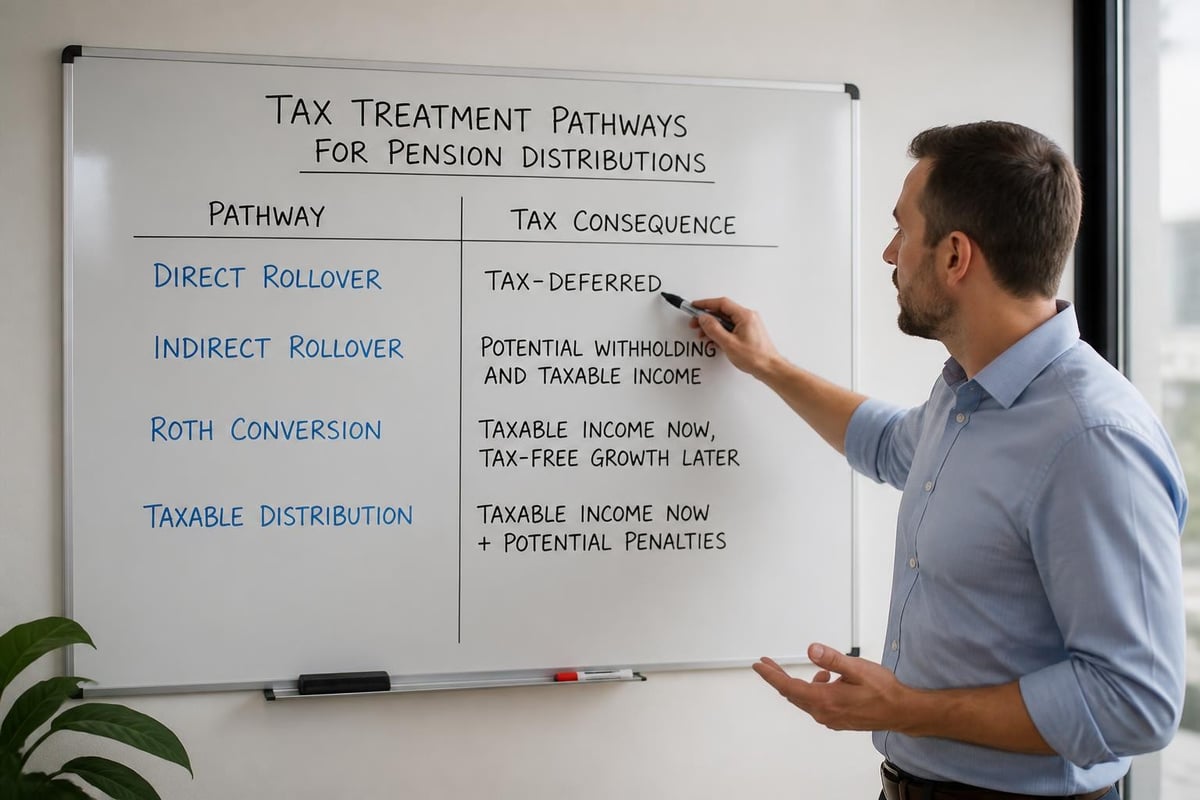
A direct rollover transfers funds from your pension plan directly to your IRA or new employer's plan. This method avoids mandatory tax withholding and eliminates the risk of creating a taxable event.
An indirect rollover involves receiving a distribution check, which triggers automatic 20% federal tax withholding. You must deposit the full distribution amount (including the withheld taxes from other sources) into a qualified account within 60 days to avoid taxation and potential penalties.
Direct rollovers offer several advantages:
- No mandatory withholding requirements
- Simplified transaction process
- Reduced error potential
- Immediate reinvestment of full balance
The 60-day rule for indirect rollovers contains no exceptions for hardships or misunderstandings. Missing this deadline converts your distribution into taxable income, with an additional 10% early withdrawal penalty if you're under age 59½.
Roth Conversion Considerations
Converting your pension rollover to a Roth IRA creates an immediate tax liability but offers long-term benefits. You'll pay ordinary income tax on the converted amount in the year of conversion.
Roth conversion advantages include:
- Tax-free qualified withdrawals in retirement
- No required minimum distributions during your lifetime
- Tax-free inheritance for beneficiaries
- Potential tax bracket arbitrage opportunities
Strategic timing matters when considering Roth conversions. Years with lower income, market downturns, or early retirement before claiming Social Security may present optimal conversion windows. Consulting with a CPA and financial advisor ensures you understand the tax impact across multiple years.
Evaluating Your Distribution Options
Your pension plan may offer various distribution methods beyond simple rollovers. Each option carries distinct advantages and limitations based on your personal circumstances.
Lump Sum Distribution Analysis
Taking a lump sum distribution and executing a pension rollover provides maximum flexibility but transfers investment risk and longevity risk to you. This approach works well for individuals who:
- Possess investment knowledge and discipline
- Have other guaranteed income sources
- Prefer leaving assets to heirs
- Face health conditions affecting life expectancy
- Need flexibility for major expenses
Calculating lump sum value requires understanding:
- Present value of future pension payments
- Discount rate assumptions used by the plan
- Current interest rate environment
- Your expected longevity versus plan assumptions
Interest rates significantly affect lump sum values. Rising rates decrease lump sum offers, while falling rates increase them. This relationship creates timing considerations when deciding whether to accept a lump sum offer.
Annuity Payment Options
Keeping your pension as monthly payments provides guaranteed income for life, eliminating investment decisions and longevity risk. The pension plan manages investments and bears the responsibility for funding your benefits.
| Payment Option | Description | Best For |
|---|---|---|
| Single Life | Highest monthly payment, stops at death | Single individuals, significant other assets |
| Joint & Survivor | Reduced payment, continues to spouse | Married couples, dependent spouse |
| Period Certain | Guaranteed minimum payment period | Those wanting beneficiary protection |
| Cost of Living Adjustment | Payments increase with inflation | Long retirement horizon |
Some employers offer partial lump sums combined with reduced monthly payments, creating a hybrid approach. This strategy provides both immediate capital and guaranteed lifetime income.
Investment Management After Your Rollover
Successfully completing a pension rollover represents just the first step. Managing your rolled-over assets requires strategic planning and ongoing attention to achieve your retirement objectives.
Asset Allocation Strategies
Your investment approach should reflect your age, risk tolerance, time horizon, and other income sources. Retirement planning and estate planning considerations influence how you structure your portfolio.
Conservative allocation (ages 65+):
- 30-40% stocks
- 50-60% bonds
- 10-20% cash and alternatives
Moderate allocation (ages 55-65):
- 50-60% stocks
- 35-40% bonds
- 5-10% cash and alternatives
Growth allocation (ages 45-55):
- 70-80% stocks
- 15-25% bonds
- 5-10% cash and alternatives
These allocations serve as starting points only. Your specific situation may warrant different approaches based on pension income, Social Security benefits, and other guaranteed income sources.
Required Minimum Distributions
Once you execute a pension rollover to an IRA, you become subject to required minimum distribution (RMD) rules. Beginning at age 73 (for those reaching this age in 2026), you must withdraw a minimum amount annually based on IRS life expectancy tables.
RMD calculation factors include:
- Prior year-end account balance
- IRS life expectancy divisor
- Beneficiary age (for inherited IRAs)
- Account type and ownership structure
Failing to take your full RMD results in a 25% excise tax on the amount not withdrawn (reduced to 10% if corrected within two years). Planning your RMD strategy helps minimize taxes and preserves wealth for your goals.
Common Pension Rollover Mistakes to Avoid
Even well-intentioned individuals make errors during the pension rollover process that create unnecessary tax burdens or reduce retirement security. Awareness of common pitfalls helps you navigate this complex decision successfully.
Timing and Documentation Errors
Missing deadlines represents one of the most costly mistakes in pension rollovers. The 60-day indirect rollover window allows no extensions, and tax consequences can devastate your retirement plans.
Critical deadlines to track:
- 60-day indirect rollover completion
- Direct rollover form submission deadlines
- Beneficiary designation updates
- RMD deadlines (by December 31 annually)
- First RMD special rule (April 1 following year you turn 73)
Documentation requirements demand attention to detail. Incomplete forms, missing signatures, or incorrect account numbers can delay transfers and potentially trigger taxable events. Maintaining copies of all rollover paperwork provides protection if questions arise later.
Overlooking Fee Structures
Pension plans typically charge minimal fees, while IRA providers vary significantly in their cost structures. High fees erode investment returns over time, potentially offsetting the benefits of increased investment control.

Compare these fee components when selecting a rollover destination:
- Annual account maintenance fees
- Investment management fees (expense ratios)
- Trading commissions and transaction costs
- Advisory fees for managed accounts
- Transfer or termination fees
A difference of just 1% in annual fees can reduce your retirement wealth by over 20% across a 25-year retirement. Understanding total costs helps you make informed decisions about where to direct your pension rollover.
Failing to Consider Creditor Protection
ERISA-qualified pension plans enjoy strong federal creditor protection. Once you complete a pension rollover to an IRA, you receive only state-level protection that varies significantly by jurisdiction.
If you face potential creditor issues, legal judgments, or professional liability concerns, maintaining funds in an employer plan might provide superior asset protection. Bankruptcy law provides some federal protection for IRAs, but it's generally weaker than ERISA plan protection.
Consult with legal and financial planning professionals to understand how your state's laws protect retirement accounts and whether a pension rollover could expose assets to claims.
Planning Your Retirement Income Strategy
Your pension rollover decision fits within your broader retirement income plan. Integrating multiple income sources creates financial security and tax efficiency throughout retirement.
Coordinating Income Sources
Most retirees rely on several income streams working together. Strategic coordination maximizes after-tax income while managing risk.
Common retirement income sources include:
- Social Security benefits
- Pension income (if not rolled over)
- IRA distributions
- Taxable investment account withdrawals
- Part-time work or business income
- Rental property income
- Annuity payments
The timing and sequence of tapping these sources significantly affects your tax situation and wealth preservation. Generally, you should withdraw from taxable accounts first, then tax-deferred accounts, and finally Roth accounts to maximize tax efficiency.
Withdrawal Sequencing Strategies
Your pension rollover assets represent tax-deferred funds that will eventually face taxation. Strategic withdrawal sequencing minimizes lifetime tax burden and maximizes spending power.
| Age Range | Primary Withdrawal Source | Secondary Source | Tax Consideration |
|---|---|---|---|
| 59½-62 | Taxable accounts | IRA (if needed) | Capital gains rates |
| 62-70 | Taxable accounts | Bridge with IRA | Delay Social Security |
| 70-73 | Combination approach | All sources | Social Security optimization |
| 73+ | RMD compliance | Supplement as needed | Required distributions |
Health insurance costs before Medicare eligibility may influence your strategy. Managing income below certain thresholds can qualify you for Affordable Care Act subsidies, potentially saving thousands annually.
Estate Planning Integration
Your pension rollover decision affects your estate plan and the legacy you leave to beneficiaries. IRAs offer more flexible beneficiary options than most pension plans, allowing you to designate multiple beneficiaries with different distribution options.
The SECURE Act changed inherited IRA rules significantly. Most non-spouse beneficiaries must now deplete inherited IRAs within ten years, eliminating the "stretch IRA" strategy for most heirs.
Key beneficiary considerations include:
- Spousal rollover privileges
- Required minimum distribution rules for beneficiaries
- Trust beneficiary designations for control
- Tax consequences for different beneficiary types
- Charitable beneficiary strategies
Naming beneficiaries properly ensures your pension rollover assets transfer according to your wishes without probate delays. Review and update beneficiary designations regularly, especially after major life events like marriage, divorce, or the birth of children.
Working with Financial Professionals
The complexity of pension rollover decisions often warrants professional guidance. The right advisor helps you analyze options, understand tax implications, and implement strategies aligned with your goals.
Fiduciary Standard of Care
When seeking help with pension rollovers and retirement planning, work with professionals who adhere to a fiduciary standard. Fiduciaries must act in your best interest, disclosing conflicts of interest and recommending suitable strategies for your situation.
Financial consulting companies that operate as fiduciaries provide objective advice without sales pressure or hidden compensation arrangements. This alignment of interests creates better outcomes for your financial future.
Questions to ask potential advisors include:
- Do you serve as a fiduciary 100% of the time?
- How are you compensated for your services?
- What experience do you have with pension rollovers?
- Can you provide references from similar clients?
- How do you coordinate with tax professionals?
Comprehensive Planning Approach
Your pension rollover affects multiple aspects of your financial life. Comprehensive planning integrates investment management, tax strategy, estate planning, and risk management into a cohesive approach.
Virtual advisory firms now provide sophisticated planning tools and personalized guidance without geographic limitations. Technology enables regular communication, portfolio monitoring, and plan adjustments as your circumstances change.
A holistic planning relationship addresses:
- Investment selection and asset allocation
- Tax-efficient distribution strategies
- Social Security claiming optimization
- Healthcare and long-term care planning
- Estate and legacy planning
- Risk management and insurance needs
This integrated approach ensures your pension rollover decision supports your overall financial objectives rather than existing in isolation.
Navigating a pension rollover requires careful consideration of your unique circumstances, tax situation, and retirement goals. Understanding your options empowers you to make decisions that preserve your wealth and provide financial security throughout retirement. At Brookwood Investment Group LLC, our fiduciary advisors provide personalized guidance on pension rollovers, retirement planning, and comprehensive wealth management strategies designed around your individual needs. Whether you're approaching retirement or already enjoying it, our virtual-first approach delivers professional financial advice tailored to your lifestyle and objectives.
