
Purchasing your first home represents a significant financial milestone, and many prospective buyers find themselves exploring every available funding source to make their dream a reality. Among the options frequently considered is tapping into retirement savings through a first time home buyer 401k withdrawal. While this approach may provide immediate access to funds, understanding the rules, tax consequences, and long-term implications is essential before making this decision. The intersection of retirement planning and homeownership requires careful analysis to determine whether accessing your 401(k) serves your overall financial interests.
Understanding First Time Home Buyer 401k Withdrawal Rules
The IRS does not offer a specific exception for a first time home buyer 401k withdrawal in the same way it does for Individual Retirement Accounts (IRAs). This critical distinction catches many prospective homeowners by surprise, as 401(k) withdrawal rules differ significantly from IRA regulations. While IRA account holders can withdraw up to $10,000 penalty-free for a first home purchase, 401(k) participants generally face a 10% early withdrawal penalty if they are under age 59½.
However, several pathways exist for accessing 401(k) funds for home purchases:
- 401(k) loans: Borrow against your account balance without triggering taxes or penalties
- Hardship withdrawals: Access funds for immediate financial needs, subject to plan rules
- Direct withdrawals: Take distributions that incur taxes and potential penalties
- In-service distributions: Available only if your plan permits and specific criteria are met
The 401(k) Loan Option
Taking a loan from your 401(k) represents the most common method for accessing retirement funds for a home purchase. Most plans allow you to borrow up to 50% of your vested balance or $50,000, whichever is less. This approach offers several advantages over direct withdrawals.
The loan must be repaid with interest, typically within five years, though some plans extend this period to 15 years for home purchases. Repayments flow back into your account, allowing you to rebuild your retirement savings. The interest rate usually aligns with the prime rate plus one or two percentage points.
| Feature | 401(k) Loan | Direct Withdrawal |
|---|---|---|
| Tax implications | None if repaid | Ordinary income tax applies |
| Early withdrawal penalty | None | 10% if under age 59½ |
| Impact on account | Temporarily reduced | Permanently reduced |
| Repayment required | Yes, typically 5 years | No |
| Future contribution limits | Unchanged | Unchanged |
One critical consideration involves employment changes. If you leave your employer, most plans require full loan repayment within 60 to 90 days. Failure to repay converts the loan into a taxable distribution, triggering both income taxes and the 10% early withdrawal penalty.

Tax Implications of First Time Home Buyer 401k Withdrawal
Understanding the tax burden associated with a first time home buyer 401k withdrawal is fundamental to making an informed decision. When you take a direct withdrawal from your 401(k), the IRS treats this money as ordinary income. This means the withdrawn amount gets added to your gross income for the year, potentially pushing you into a higher tax bracket.
For example, if you earn $75,000 annually and withdraw $30,000 from your 401(k), your taxable income increases to $105,000. This could move you from the 22% federal tax bracket to the 24% bracket, affecting not just the withdrawal but your entire income tax calculation. State income taxes may also apply, depending on where you live.
Calculating the True Cost
The financial impact extends beyond just income taxes. If you are under age 59½, the IRS imposes an additional 10% early withdrawal penalty on the distribution amount. This combination of ordinary income tax and penalties can significantly reduce the funds available for your home purchase.
Consider this breakdown for a $30,000 withdrawal:
- Withdrawal amount: $30,000
- Federal income tax (24% bracket): $7,200
- Early withdrawal penalty (10%): $3,000
- State income tax (varies by state): $1,500 to $3,000
- Net proceeds: Approximately $19,800 to $21,300
Working with fiduciary planning professionals can help you model these scenarios accurately based on your specific tax situation.
Impact on Long-Term Retirement Savings
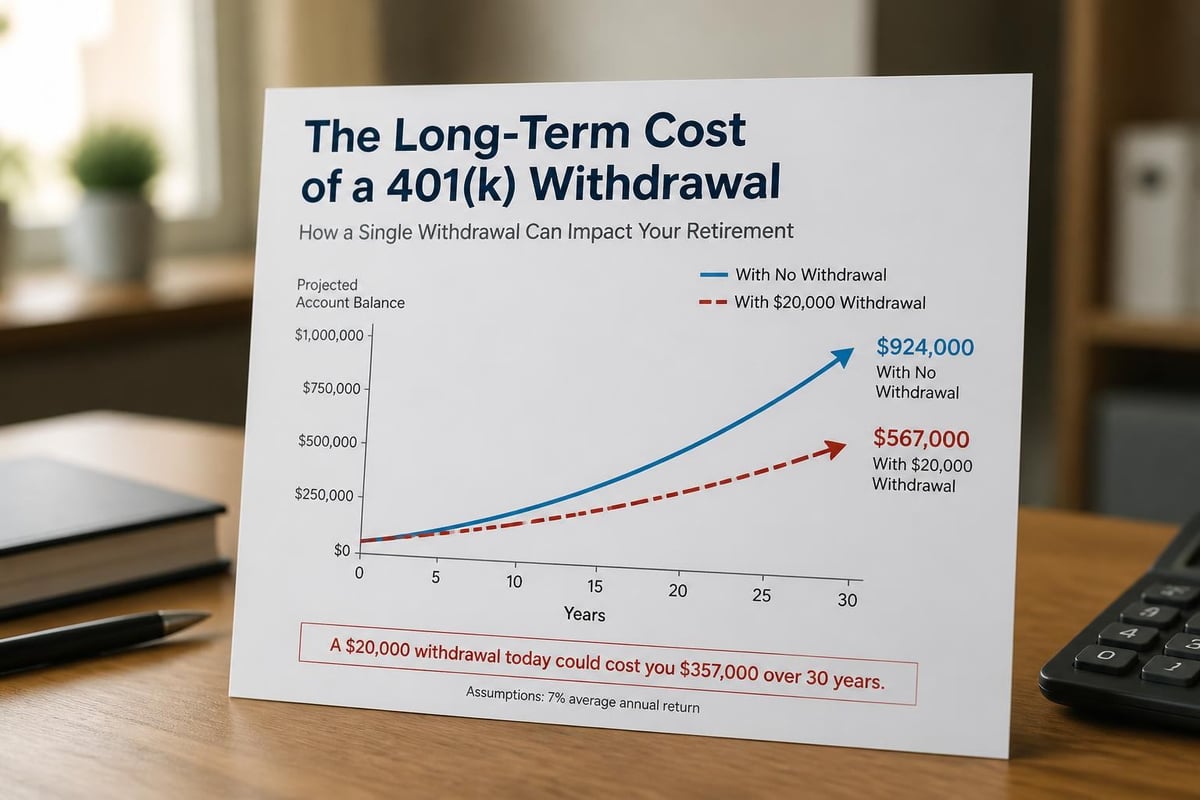
Perhaps the most significant consequence of a first time home buyer 401k withdrawal relates to the impact on your retirement readiness. When you remove funds from your 401(k), you lose not only the principal but also decades of potential compound growth. This opportunity cost often exceeds the immediate tax burden.
The Compound Growth Factor
Money withdrawn from your retirement account cannot benefit from market returns over the remaining years until retirement. For a 30-year-old withdrawing $30,000, that money could potentially grow to over $200,000 by age 65, assuming a 7% average annual return. This represents wealth that simply disappears when you tap into retirement savings prematurely.
The math becomes even more compelling when you factor in employer matching contributions. Many companies match employee 401(k) contributions up to a certain percentage. During loan repayment periods, some individuals reduce or stop their regular contributions, thereby forfeiting valuable matching dollars.
Alternatives to First Time Home Buyer 401k Withdrawal
Before proceeding with a first time home buyer 401k withdrawal, exploring alternative funding strategies may better serve your financial interests. Several options can help you achieve homeownership while preserving retirement savings.
Down Payment Assistance Programs
Numerous federal, state, and local programs offer grants or low-interest loans to first-time homebuyers. These programs often target specific income levels, professions, or geographic areas. Many homebuyers overlook these resources, missing opportunities for substantial financial assistance that requires no repayment.
FHA loans require as little as 3.5% down, while some conventional loan programs accept down payments as low as 3%. VA loans and USDA loans offer zero-down-payment options for qualified buyers. These programs reduce the immediate cash needed for a home purchase.
Building a Dedicated Savings Plan
Delaying your home purchase by 12 to 24 months while aggressively saving can provide the necessary down payment without compromising retirement security. Consider these strategies:
- Automate transfers from checking to a dedicated home savings account
- Reduce discretionary spending temporarily to accelerate savings
- Direct windfalls such as bonuses or tax refunds to your home fund
- Generate additional income through side projects or selling unused items
- Review and optimize your monthly budget to identify savings opportunities
Many financial institutions offer high-yield savings accounts that can help your down payment fund grow while maintaining liquidity and safety.
When First Time Home Buyer 401k Withdrawal Makes Sense
Despite the drawbacks, certain circumstances may justify considering a first time home buyer 401k withdrawal. The decision requires careful evaluation of your complete financial picture and long-term goals.
Evaluating Your Unique Situation
If you have multiple retirement accounts with substantial balances, withdrawing from one account may have minimal impact on your overall retirement readiness. Similarly, individuals closer to retirement age who plan to downsize in the future might reasonably access 401(k) funds for a home purchase.
Consider these factors when evaluating whether to proceed:
- Total retirement savings across all accounts
- Years remaining until retirement
- Current savings rate and employer match
- Expected Social Security benefits
- Other income sources in retirement
- Current debt obligations
- Housing market conditions in your area
- Alternative funding options available
The importance of estate planning also factors into this decision, as your home becomes part of your overall estate and wealth transfer strategy.
Short-Term Housing Market Considerations
In rapidly appreciating housing markets, some buyers feel pressure to purchase quickly before prices rise further. While this urgency is understandable, careful financial strategy planning should drive the decision rather than fear of missing out.
Housing markets operate in cycles, and timing your purchase based on market conditions while maintaining financial stability often produces better long-term outcomes than rushing into homeownership by depleting retirement savings.
Working with Plan Administrators and Understanding Your Options
Each 401(k) plan operates under its own specific rules and regulations. Before making any decisions regarding a first time home buyer 401k withdrawal, thoroughly review your plan documents and consult with your plan administrator.
Key Questions to Ask Your Plan Administrator
Start by gathering information about your plan's specific provisions:
- Does the plan permit loans, and what are the terms?
- Are hardship withdrawals allowed for home purchases?
- What documentation is required to process a withdrawal or loan?
- What is the repayment schedule if you take a loan?
- What happens to an outstanding loan if you leave the company?
- Are there any waiting periods or restrictions on accessing funds?
Documentation requirements vary significantly between plans. Some require proof of home purchase, while others simply need your withdrawal request. Understanding these requirements early prevents delays when you are ready to close on a property.
| Plan Feature | Typical Parameters | Impact on Homebuyers |
|---|---|---|
| Maximum loan amount | Lesser of 50% of vested balance or $50,000 | Limits how much you can access |
| Loan repayment period | 5 years (up to 15 for home purchase) | Affects monthly payment amount |
| Interest rate | Prime rate plus 1-2% | Determines total repayment cost |
| Hardship withdrawal criteria | Plan-specific | May or may not include home purchase |
| In-service distribution rules | Age and service requirements | Limited availability for younger workers |
Strategies for Minimizing Financial Impact
If you determine that a first time home buyer 401k withdrawal represents your best option, several strategies can help minimize the long-term financial impact on your retirement security.
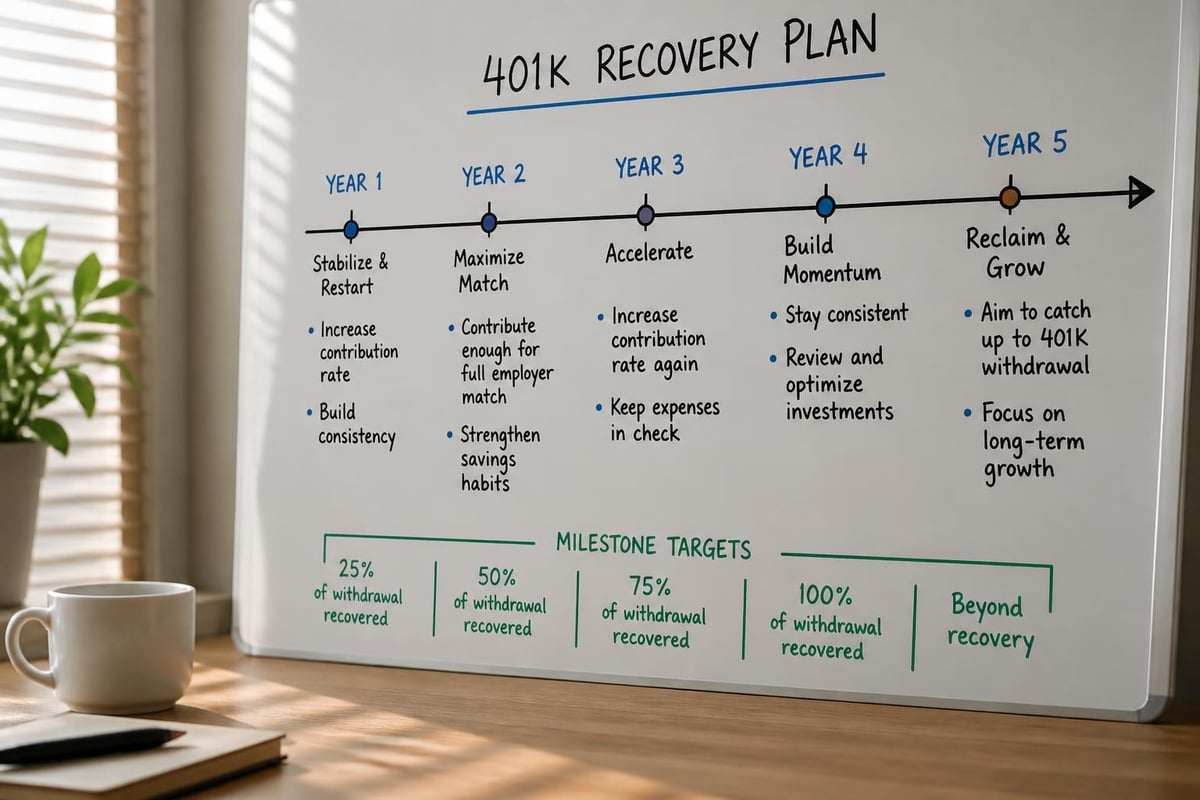
Accelerating Recovery After Withdrawal
Once you complete your home purchase, prioritize rebuilding your retirement savings. Consider these approaches:
- Maximize future contributions to catch up on lost savings
- Capture all employer matching funds by contributing at least to the match threshold
- Increase contribution rates with each raise or bonus
- Utilize catch-up contributions if you are age 50 or older
- Diversify retirement savings across multiple account types
The key involves treating retirement savings as a non-negotiable expense, similar to your mortgage payment. Retirement planning strategies should adapt to accommodate both your home ownership goals and long-term financial security.
Tax Planning Considerations
Strategic timing of a first time home buyer 401k withdrawal can reduce the tax burden. If you anticipate a year with lower income due to a career transition, sabbatical, or other circumstances, scheduling your withdrawal during that year may result in lower taxes.
Additionally, understanding tax strategy implications helps you prepare for the tax bill. Setting aside funds to cover the tax liability prevents surprises at filing time. Some individuals even increase their withholding from other income sources to offset the taxes due on the withdrawal.
Comparing 401k Access to IRA First-Time Homebuyer Exception
Understanding the difference between 401(k) and IRA rules for home purchases helps clarify why accessing 401(k) funds creates more challenges. The IRS provides a specific exception for first-time homebuyers using IRA funds, allowing up to $10,000 in penalty-free withdrawals (though ordinary income taxes still apply).
This exception applies to traditional IRAs, Roth IRAs, SEP IRAs, and SIMPLE IRAs. The $10,000 lifetime limit applies per person, meaning married couples can each withdraw $10,000 from their respective IRAs for a combined $20,000. The IRS defines "first-time homebuyer" broadly as someone who has not owned a home in the past two years.
Strategic Account Selection
If you have both 401(k) and IRA accounts, accessing IRA funds first may reduce the financial impact. The penalty-free IRA withdrawal preserves more of your funds compared to a 401(k) withdrawal subject to the 10% early withdrawal penalty.
However, this approach still triggers ordinary income taxes and permanently removes funds from tax-advantaged accounts. The decision requires balancing immediate needs against long-term retirement security, which is where investment management guidance proves valuable.
Making the Final Decision
The choice to proceed with a first time home buyer 401k withdrawal represents a significant financial decision with lasting implications. This decision should not be made in isolation but rather as part of a comprehensive financial strategy that considers all aspects of your financial life.
Creating a Decision Framework
Develop a structured approach to evaluate this option:
Financial Analysis:
- Calculate exact tax liability based on your income
- Model retirement account growth with and without withdrawal
- Compare total costs of 401(k) access versus alternative funding
- Project your retirement readiness under different scenarios
Risk Assessment:
- Evaluate job security and likelihood of employment changes
- Consider housing market stability in your area
- Assess ability to rebuild retirement savings
- Identify backup plans if financial circumstances change
Alternative Exploration:
- Research all available first-time homebuyer programs
- Investigate family loan or gift possibilities
- Consider less expensive properties or different locations
- Evaluate whether delaying purchase makes sense
The financial risks associated with depleting retirement accounts warrant thorough analysis before proceeding. Professional guidance can illuminate factors you might not have considered and help you understand the true cost of various options.
Professional Guidance for Complex Decisions
Navigating the intersection of home buying and retirement planning requires expertise in both areas. A fiduciary financial advisor can provide objective guidance tailored to your specific circumstances, helping you understand how a first time home buyer 401k withdrawal fits into your broader financial picture.
Professional advisors can model different scenarios, showing you the long-term impact of various choices on your retirement readiness. They can also help identify alternatives you might not have considered and ensure your decision aligns with your overall financial goals.
The complexity of these decisions increases when you factor in tax implications, investment strategy, estate planning considerations, and other financial priorities competing for your resources. Comprehensive planning addresses all these elements simultaneously rather than optimizing for a single goal in isolation.
Accessing your 401(k) for a home purchase involves significant tradeoffs between current homeownership goals and future retirement security. Understanding the rules, tax consequences, and long-term implications helps you make an informed decision aligned with your complete financial picture. Whether you are exploring a first time home buyer 401k withdrawal or seeking alternative funding strategies, Brookwood Investment Group LLC offers personalized guidance to help you navigate these complex decisions. Our fiduciary advisors can analyze your unique situation, model various scenarios, and develop a comprehensive strategy that balances your homeownership dreams with long-term financial security.
