
Financial emergencies can strike when you least expect them, forcing difficult decisions about accessing retirement savings. A fidelity 401k hardship withdrawal represents one option for individuals facing immediate and substantial financial need, though it comes with specific requirements and potential long-term consequences. Understanding the eligibility criteria, tax implications, and alternatives before tapping into your retirement account can help you make informed decisions aligned with your overall financial strategy.
Understanding Fidelity 401k Hardship Withdrawal Eligibility
The Internal Revenue Service establishes strict criteria for what constitutes a qualifying hardship event. Not every financial setback qualifies, and plan participants must demonstrate an immediate and heavy financial need that cannot be met through other reasonably available resources.
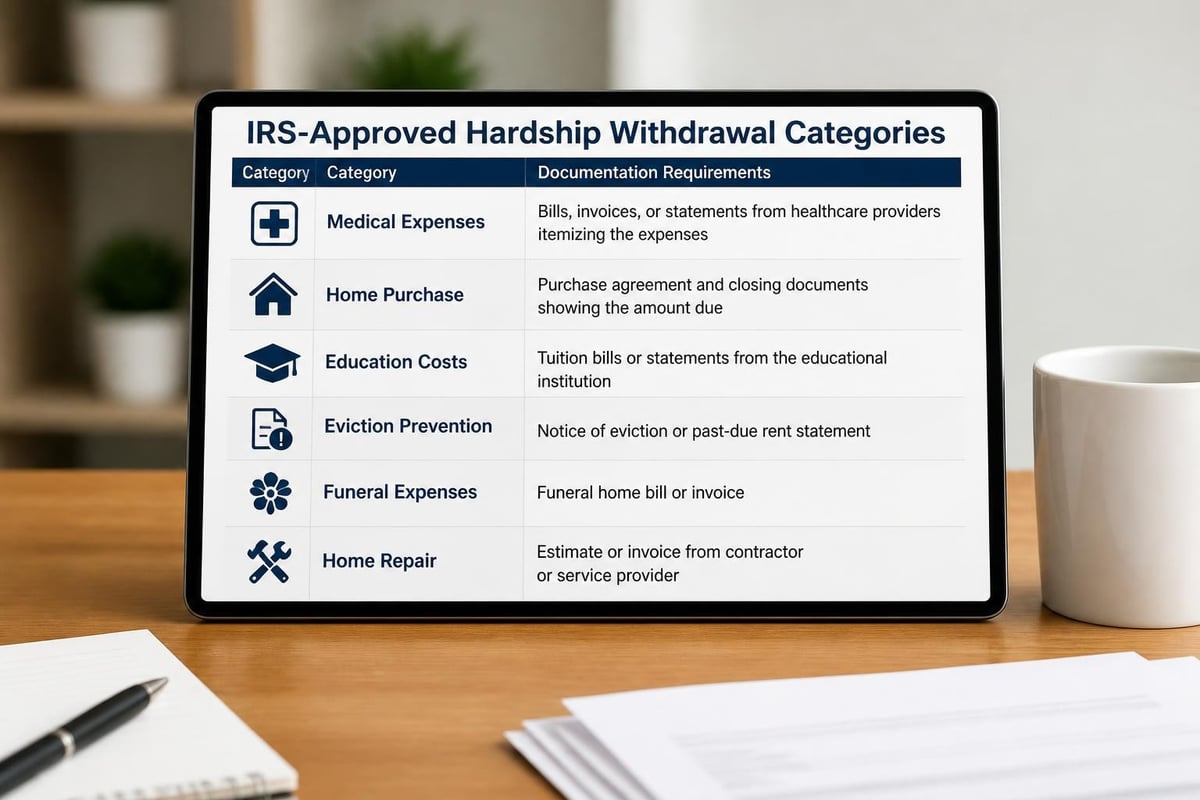
According to IRS regulations governing 401k hardship withdrawals, qualifying events typically include:
- Medical expenses for you, your spouse, dependents, or primary beneficiary
- Costs directly related to purchasing a principal residence (excluding mortgage payments)
- Tuition and related educational fees for the next 12 months of post-secondary education
- Payments necessary to prevent eviction or foreclosure on your primary residence
- Funeral and burial expenses for immediate family members
- Certain expenses for repair of damage to your principal residence
Documentation Requirements
Fidelity requires comprehensive documentation to verify your hardship claim. The burden of proof falls on the plan participant to demonstrate both the qualifying event and the inability to meet the expense through other means.
You must typically provide invoices, bills, contracts, or other official documents showing the expense amount and nature. Additionally, Fidelity may require evidence that you have exhausted other available resources, including available plan loans, distributions from other retirement accounts, and personal savings.
Tax Implications and Penalties
A fidelity 401k hardship withdrawal triggers immediate tax consequences that can significantly reduce the amount you actually receive. Unlike loans from your 401k, hardship withdrawals cannot be repaid to the plan, making them a permanent reduction to your retirement savings.
The withdrawn amount counts as ordinary income for the tax year in which you receive it. This additional income may push you into a higher tax bracket, potentially creating an unexpected tax burden when you file your return.
| Tax Consequence | Impact | Typical Amount |
|---|---|---|
| Federal Income Tax | Immediate withholding | 10-37% depending on bracket |
| Early Withdrawal Penalty | If under age 59½ | 10% of distribution |
| State Income Tax | Varies by location | 0-13% depending on state |
| Net Received | After all taxes/penalties | 50-80% of withdrawal |
The Early Withdrawal Penalty
For participants under age 59½, the additional 10% early withdrawal penalty applies to most hardship distributions. The penalties associated with Fidelity 401k hardship withdrawals can substantially reduce the funds available to address your financial emergency.
Limited exceptions to the 10% penalty exist, including permanent disability, certain medical expenses exceeding 7.5% of adjusted gross income, or separation from service after age 55. However, these exceptions require specific documentation and do not eliminate regular income tax obligations.
The Application Process for Hardship Withdrawals
Initiating a fidelity 401k hardship withdrawal requires careful navigation through Fidelity's administrative procedures. The process typically takes several business days to complete, so planning ahead becomes essential when facing time-sensitive financial needs.
Step-by-Step Withdrawal Process
- Review your plan's summary plan description to confirm hardship withdrawal provisions and specific requirements
- Contact Fidelity directly through their dedicated retirement services line or online portal
- Complete the hardship withdrawal application with detailed information about your qualifying event
- Submit required documentation proving the expense and amount needed
- Await plan administrator review which may take 3-7 business days
- Receive approval or denial with detailed explanation of the decision
- Accept distribution terms including tax withholding elections
- Receive funds typically within 3-5 business days after approval
The Fidelity 401k hardship withdrawal overview provides additional guidance on navigating their specific procedures and requirements.
Alternatives to Consider Before Withdrawing
Before pursuing a fidelity 401k hardship withdrawal, exploring alternative options may provide more financially advantageous solutions. Working with fiduciary financial advisors can help you evaluate all available options within the context of your complete financial picture.
401k Loan Option
Many Fidelity 401k plans offer loan provisions that allow participants to borrow against their account balance. Unlike hardship withdrawals, loans must be repaid with interest, but they avoid immediate taxation and penalties.
Advantages of 401k loans include:
- No income tax on borrowed amounts
- No early withdrawal penalty regardless of age
- Interest payments return to your own account
- Typically lower interest rates than personal loans
- No credit check required
The differences between 401k loans and withdrawals reveal significant financial implications that deserve careful consideration. Loans typically allow borrowing up to 50% of your vested balance or $50,000, whichever is less.

Additional Funding Alternatives
| Alternative Source | Considerations | Potential Benefits |
|---|---|---|
| Emergency Savings | Preserves retirement funds | No tax consequences |
| Personal Loan | Fixed repayment terms | Maintains retirement growth |
| Home Equity Line | Lower interest rates | Tax-deductible interest in some cases |
| Family Assistance | Interest-free options | Preserves long-term savings |
| Payment Plans | Spreads cost over time | Avoids immediate large withdrawal |
Working with professionals who specialize in retirement planning and estate planning can provide valuable perspective on balancing immediate needs with long-term financial security.
Impact on Retirement Savings Growth
The true cost of a fidelity 401k hardship withdrawal extends far beyond immediate taxes and penalties. Removing funds from your retirement account eliminates their growth potential, creating a compounding effect that can significantly reduce your retirement nest egg.
Consider a 40-year-old withdrawing $20,000 for a qualifying hardship. Assuming a 7% average annual return, that $20,000 would grow to approximately $118,000 by age 67. When you factor in the immediate 30-40% reduction from taxes and penalties, the actual cost of accessing that $20,000 could exceed $130,000 in future retirement resources.
Contribution Suspension Requirements
Under IRS regulations, participants who take hardship withdrawals may face a mandatory suspension period during which they cannot contribute to their 401k plan. While recent tax law changes reduced this suspension from six months to potentially zero for some plans, Fidelity plan administrators maintain discretion over suspension policies.
This contribution suspension creates additional retirement savings loss, particularly if you cannot receive employer matching contributions during the suspension period. The financial strategy planning required to recover from a hardship withdrawal can take years of increased future contributions.
Recent Regulatory Changes Affecting Withdrawals
The Setting Every Community Up for Retirement Enhancement (SECURE) Act and subsequent legislation modified several aspects of retirement plan withdrawals. These changes expanded qualifying reasons for hardship distributions and modified procedural requirements.
Key regulatory updates include:
- Elimination of the requirement to take available plan loans before hardship withdrawals
- Expansion of qualifying expenses to include primary beneficiaries
- Potential elimination of the six-month contribution suspension (plan-dependent)
- Updated safe harbor provisions for plan administrators
Understanding IRS regulations for Fidelity 401k hardship withdrawals requires staying current with evolving tax law, making professional guidance particularly valuable for complex situations.

When Hardship Withdrawals Make Sense
Despite their costs, certain situations may justify a fidelity 401k hardship withdrawal when no reasonable alternatives exist. The key lies in thoroughly evaluating whether the immediate need outweighs the long-term consequences.
Scenarios where hardship withdrawals might represent the best available option include preventing foreclosure on your primary residence when all other funding sources are exhausted, covering emergency medical procedures not covered by insurance that cannot wait, or addressing immediate safety concerns requiring urgent home repairs.
Creating a Recovery Plan
If you determine that a hardship withdrawal represents your best option, developing a comprehensive recovery strategy becomes essential. This plan should address rebuilding your retirement savings, adjusting your retirement timeline if necessary, and preventing future emergency fund depletion.
Consider increasing your contribution rate once eligible to contribute again, evaluating your emergency fund adequacy to prevent future retirement account access, reviewing your overall financial plan with professionals offering personalized financial guidance, and exploring catch-up contribution strategies if you are age 50 or older.
Special Considerations for Different Life Stages
The implications of a fidelity 401k hardship withdrawal vary significantly based on your current age and retirement timeline. Younger workers have more time to recover from the setback, while those closer to retirement may face more severe consequences.
Early Career Considerations
Workers in their 20s and 30s benefit from decades of potential recovery time, yet they also sacrifice the most significant compounding growth. The long-term cost of early withdrawals can be staggering when measured across 30-40 years of lost growth potential.
Mid-Career Strategy
Those in their 40s and early 50s face a critical balancing point. While recovery time remains available, the window narrows considerably. Every dollar withdrawn represents lost growth during peak earning years when contribution capacity typically reaches its highest levels.
Pre-Retirement Challenges
For individuals within 10-15 years of retirement, hardship withdrawals can derail carefully constructed retirement plans. The reduced time horizon for recovery may necessitate delayed retirement, reduced retirement lifestyle expectations, or increased savings rates that strain current budgets.
Professional guidance from advisors specializing in fiduciary planning becomes particularly valuable when evaluating these age-specific considerations and developing appropriate recovery strategies.
Plan-Specific Variations and Employer Policies
While IRS regulations establish the framework for hardship withdrawals, individual Fidelity 401k plans may implement more restrictive provisions. Your employer's plan document governs specific eligibility criteria, documentation requirements, and administrative procedures.
Some plans limit hardship withdrawals to employee contributions only, excluding employer matching contributions and earnings. Others may permit access to all vested balances. The variation in plan provisions makes reviewing your specific plan's summary plan description essential before assuming withdrawal availability.
Vesting Schedules and Withdrawal Limits
Employer matching contributions typically follow vesting schedules ranging from immediate to six years. Only vested portions of employer contributions may be available for hardship withdrawals, potentially limiting the accessible amount when you need it most.
Understanding how retirement planning strategies intersect with your specific plan provisions helps set realistic expectations about available resources and potential alternatives.
The Role of Professional Financial Guidance
Navigating the complexities of a fidelity 401k hardship withdrawal benefits significantly from professional advice tailored to your unique circumstances. Financial advisors can help evaluate whether a hardship withdrawal represents the best solution among available alternatives, model the long-term impact on your retirement trajectory, and develop recovery strategies that minimize lasting damage to your financial security.
Understanding potential drawbacks and considerations before proceeding with a withdrawal can prevent decisions made in crisis moments from creating long-term financial challenges. Professional advisors bring objective perspective during emotionally charged financial emergencies, helping you see beyond immediate pressures to consider broader implications.
Working with professionals who provide comprehensive investment management and financial planning ensures that hardship withdrawal decisions integrate with your complete financial picture, including tax planning, estate considerations, and overall wealth management strategy.
Accessing retirement funds through a fidelity 401k hardship withdrawal requires careful consideration of immediate needs balanced against long-term retirement security. The decision carries significant tax implications, potential penalties, and lasting impact on your financial future that extend far beyond the immediate relief provided. Brookwood Investment Group LLC offers personalized financial guidance to help you evaluate all available options, understand the true cost of retirement account withdrawals, and develop comprehensive strategies that address immediate challenges while protecting your long-term financial goals. Schedule a consultation to discuss your specific situation and explore alternatives that align with your unique financial circumstances.
