
Federal employees and military members face unique financial emergencies that sometimes require accessing retirement savings before leaving service. The Thrift Savings Plan allows participants to request a hardship withdrawal under specific circumstances, but this decision carries significant long-term consequences that demand careful consideration. Understanding the rules, tax implications, and alternatives helps ensure you make informed choices that align with your broader financial goals while addressing immediate needs.
What Qualifies as a TSP Hardship Withdrawal
A tsp hardship withdrawal allows participants to access their retirement savings while still employed, but only for specific qualifying events that demonstrate genuine financial need. The Federal Retirement Thrift Investment Board regulates these withdrawals through strict eligibility criteria designed to protect retirement security.
Qualifying Financial Hardships
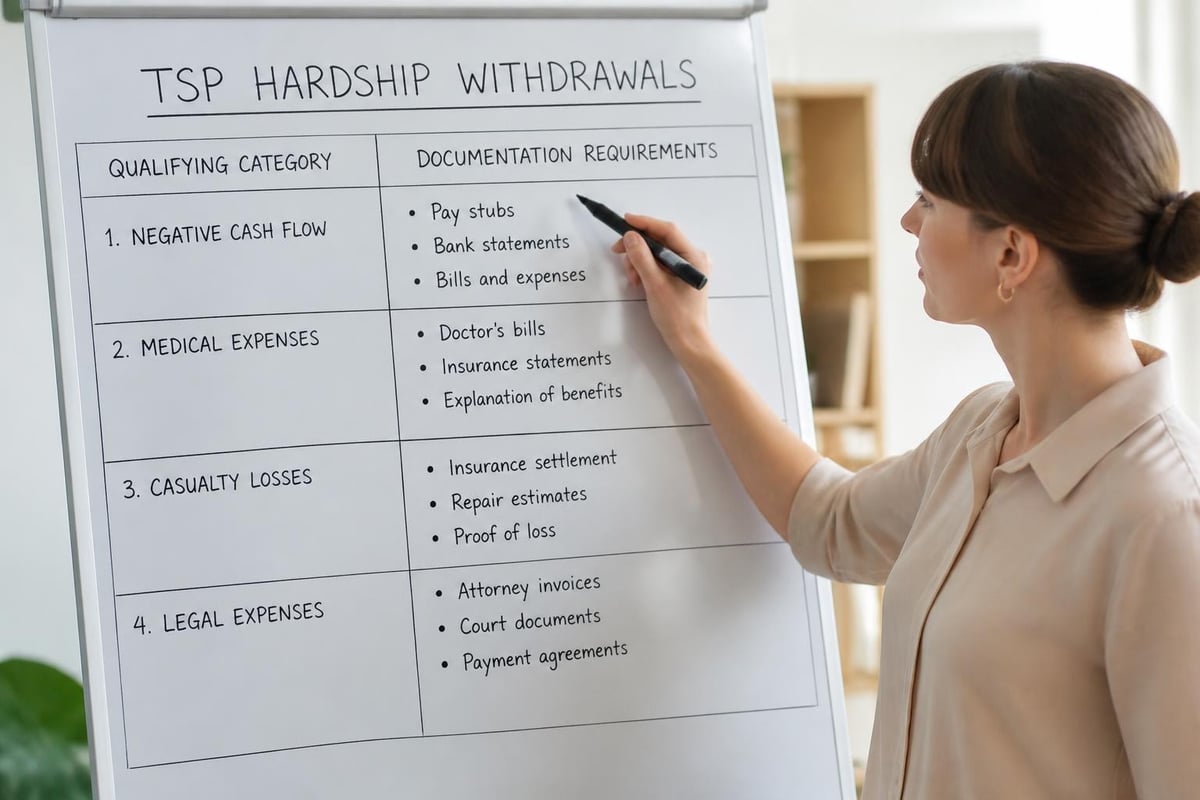
The TSP recognizes four categories of financial hardship that permit early withdrawals:
- Negative monthly cash flow that creates an immediate financial need
- Medical expenses for you, your spouse, or dependents
- Personal casualty losses such as fire, flood, or natural disaster damage
- Legal expenses related to separation or divorce, including court costs and attorney fees
Each category requires documentation proving both the hardship and the amount needed. The TSP does not accept general financial difficulty or debt consolidation as qualifying reasons.
Amount Restrictions and Limitations
You can only withdraw the minimum amount necessary to meet your financial need, including any taxes owed on the distribution. The TSP calculates this by requiring you to specify your hardship amount and then adding estimated federal and state tax withholding.
Important constraints include:
- You must have at least $1,000 in your account
- Only your own contributions and earnings are available (not employer matching)
- You cannot request more than your demonstrated need
- The six-month suspension rule no longer applies as of 2026
The Application Process and Documentation Requirements
Requesting a tsp hardship withdrawal requires careful preparation and thorough documentation. The process has become more streamlined in recent years, but rigorous proof requirements remain to prevent abuse of hardship provisions.
Step-by-Step Application Procedure
- Log into your TSP account at tsp.gov using your credentials
- Navigate to the withdrawals section and select "Financial Hardship"
- Complete the online form specifying your hardship type and amount needed
- Upload required documentation proving your hardship and financial need
- Review and submit your request electronically
- Await TSP review which typically takes 7-10 business days
- Receive funds via direct deposit or check once approved
The TSP requires you to certify under penalty of perjury that you have insufficient cash or other liquid assets to meet the need. This certification carries legal weight and should not be taken lightly.
Documentation Standards by Hardship Type
Different hardship categories require specific supporting documents to prove eligibility:
| Hardship Type | Required Documentation | Additional Notes |
|---|---|---|
| Negative Cash Flow | Three months of paystubs and bills | Must show expenses exceed income |
| Medical Expenses | Itemized bills and insurance statements | Must exceed 7.5% of adjusted gross income |
| Casualty Loss | Insurance claim, damage estimates, photos | Must not be fully covered by insurance |
| Legal Expenses | Court orders, attorney invoices, settlement | Must relate to separation or divorce |
According to recent FRTIB participant activity reports, incomplete documentation accounts for the majority of delayed or denied hardship requests. Gathering comprehensive proof before starting your application accelerates the process significantly.
Tax Consequences and Financial Impact
The tax implications of a tsp hardship withdrawal often surprise participants who focus solely on accessing funds without considering the total cost. Understanding these consequences helps you evaluate whether the immediate benefit justifies the long-term impact on your retirement security.
Immediate Tax Obligations
Hardship withdrawals are taxed as ordinary income in the year you receive them. The TSP automatically withholds 20% for federal income taxes, but this may not cover your full tax liability depending on your bracket.
Key tax considerations:
- Federal withholding is mandatory at 20%
- State income tax withholding varies by jurisdiction
- The 10% early withdrawal penalty applies if you're under age 59½
- You cannot roll the funds into another retirement account
- The withdrawal increases your taxable income for the year
The IRS provides specific guidance on hardship distribution tax treatment that affects how you report these withdrawals on your annual return. Many participants underestimate their total tax bill and face unexpected liabilities the following April.
Long-Term Retirement Impact
Beyond immediate taxes, removing funds from your TSP permanently reduces your retirement accumulation potential. This opportunity cost compounds over decades.
Consider a 35-year-old federal employee who withdraws $15,000 for a financial hardship. Assuming a 7% annual return over 30 years, that withdrawal costs approximately $114,000 in lost retirement savings. This calculation doesn't account for lost employer matching during any contribution suspension period.
Working with professionals who specialize in retirement planning strategies can help you model these long-term effects and explore alternatives that preserve your retirement security.

Alternatives to Consider Before Withdrawing
A tsp hardship withdrawal should be your last resort after exhausting other options. Several alternatives provide access to funds with less severe consequences for your retirement future.
TSP Loan Programs
TSP loans allow you to borrow from your account and repay yourself with interest, avoiding taxes and penalties. The program offers two loan types:
- General purpose loans up to $50,000 for any reason (1-5 year term)
- Primary residence loans for purchasing or building your main home (1-15 year term)
You pay yourself back through payroll deductions at a competitive interest rate based on the G Fund rate plus 1%. The loan does not appear on your credit report and approval is virtually automatic if you meet basic eligibility requirements.
However, loans come with their own risks. If you separate from federal service before repaying, the outstanding balance becomes a taxable distribution subject to income tax and potential penalties. Understanding your complete financial situation helps determine whether a loan makes more sense than a withdrawal.
Emergency Savings and Cash Reserves
Building adequate emergency savings prevents most situations that trigger hardship withdrawals. Financial professionals typically recommend maintaining 3-6 months of expenses in liquid accounts separate from retirement savings.
Strategies to build emergency reserves:
- Automate savings transfers each payday
- Direct a portion of pay raises to savings accounts
- Use high-yield savings accounts to maximize growth
- Keep funds accessible but separate from checking accounts
Many federal employees find that redirecting just 5-10% of their TSP contributions to emergency savings creates a buffer that eliminates hardship withdrawal needs without significantly impacting retirement readiness.
Additional Financial Resources
Before requesting a tsp hardship withdrawal, explore these options:
- Payment plans directly with creditors or medical providers
- 0% balance transfer credit cards for temporary cash flow needs
- Home equity lines of credit if you own property
- Personal loans from credit unions or online lenders
- Family assistance as short-term bridge financing
- Government assistance programs for qualified individuals
- Employer-based emergency assistance available to some federal workers
Each alternative carries different costs, qualification requirements, and implications for your overall financial health. Comparing multiple options helps identify the least costly solution for your specific situation.
Recent Changes and Current Statistics
The TSP has evolved significantly in recent years, with regulatory changes and operational improvements affecting hardship withdrawals. Staying current on these developments ensures you understand your options under the latest rules.
2026 Regulatory Updates
The TSP modernized its withdrawal rules effective in recent years, removing several restrictions that previously complicated hardship access. The most significant change eliminated the six-month contribution suspension that formerly applied after hardship withdrawals.
This means participants who take a tsp hardship withdrawal in 2026 can continue making TSP contributions immediately afterward, preserving their retirement savings momentum and employer matching. This regulatory framework change aligns TSP rules more closely with private sector 401(k) plans.
Current Usage Patterns
According to the TSP Annual Report for 2024, hardship withdrawals represent a small but significant portion of plan activity. The data reveals important trends:
- Approximately 2.3% of active participants request hardship withdrawals annually
- Medical expenses and negative cash flow account for nearly 70% of requests
- Average withdrawal amounts have remained stable around $8,500-$10,000
- Approval rates exceed 85% when documentation is complete
These statistics suggest that while most participants preserve their TSP savings, a meaningful minority face genuine hardships requiring early access. Recent GAO analysis of withdrawal practices highlights the importance of participant education and alternative options.
Working with Financial Professionals
Navigating the complexities of a tsp hardship withdrawal benefits from professional guidance. The decision involves multiple financial dimensions that extend beyond immediate need.
When to Seek Professional Advice
Consider consulting with a financial professional when:
- You're uncertain whether your situation qualifies as a genuine hardship
- The withdrawal amount approaches $20,000 or more
- You have multiple financial challenges requiring comprehensive planning
- You're within 10 years of retirement
- You need help evaluating alternatives objectively
- Your spouse disagrees about withdrawing retirement funds
A fiduciary financial advisor can model the long-term impact of different scenarios and help you understand trade-offs. Fee-only advisors who work with federal employees bring specialized knowledge of TSP rules and federal benefit integration.
Comprehensive Financial Planning Considerations
Your TSP is one component of your broader financial picture. A tsp hardship withdrawal affects multiple planning areas:
Retirement income projections: Reduced TSP balance lowers future retirement income streams
Tax planning: Current-year withdrawal increases adjusted gross income, potentially affecting credits and deductions
Estate planning: Diminished retirement assets change legacy planning and beneficiary distributions
Risk management: Emergency that triggered withdrawal may indicate need for better insurance coverage
Addressing these interconnected issues requires holistic financial planning that coordinates retirement, tax, and estate strategies. Professional guidance helps ensure your short-term decision supports rather than undermines your long-term objectives.

Rebuilding Your Retirement After a Hardship Withdrawal
If you proceed with a tsp hardship withdrawal, developing a recovery plan helps minimize the long-term impact on your retirement security. Strategic actions can rebuild your TSP balance and restore your retirement trajectory.
Contribution Recovery Strategies
Once your immediate financial crisis resolves, prioritize returning to maximum TSP contributions. The power of compound growth means earlier contributions have disproportionate impact.
Practical recovery steps:
- Resume contributions immediately at your previous percentage or higher
- Increase contributions annually as you receive pay raises
- Maximize catch-up contributions if you're age 50 or older
- Redirect found money such as tax refunds or bonuses to TSP
- Review your allocation to ensure appropriate risk level for your timeline
Federal employees age 50+ can contribute an additional $7,500 in catch-up contributions for 2026, on top of the standard $23,000 limit. These higher limits create opportunities to accelerate recovery.
Preventing Future Hardship Withdrawals
Learning from the experience that necessitated your tsp hardship withdrawal helps prevent recurrence. Most financial emergencies stem from predictable risk categories.
Strengthen your financial foundation by:
- Building a robust emergency fund equal to 6-12 months of expenses
- Reviewing insurance coverage for health, disability, property, and liability
- Creating a realistic budget that accounts for irregular expenses
- Establishing automatic savings for known future costs
- Developing additional income streams when possible
The Office of Personnel Management provides TSP resources and connections to financial education programs specifically designed for federal employees. Taking advantage of these tools supports better financial decision-making.
Investment Strategy Adjustments
After taking a hardship withdrawal, review your TSP investment strategy to ensure it remains appropriate. Your reduced balance and timeline to retirement may warrant allocation changes.
| Time to Retirement | Suggested Allocation Focus | TSP Funds to Consider |
|---|---|---|
| 20+ years | Aggressive growth | C Fund, S Fund, I Fund |
| 10-20 years | Balanced growth | Mix of stock and G/F Funds |
| 5-10 years | Moderate, diversifying | L Funds, balanced mix |
| Under 5 years | Capital preservation | G Fund, F Fund, conservative L Fund |
These suggestions represent general guidelines, not personalized advice. Your optimal allocation depends on your complete financial picture, risk tolerance, and retirement income goals.
Special Considerations for Military Members
Uniformed service members face unique circumstances that affect tsp hardship withdrawal decisions differently than civilian federal employees.
Deployment and Combat Zone Impacts
Military members serving in combat zones receive special tax benefits that complicate hardship withdrawal calculations. Combat zone pay is generally tax-free, which affects both your current tax situation and the impact of a taxable withdrawal.
Additionally, deployment often creates financial pressures from:
- Maintaining two households during family separations
- Unexpected emergency travel needs
- Family members managing finances independently
- Reduced access to financial counseling resources
Service members should connect with military financial counselors before requesting a tsp hardship withdrawal to ensure they've explored all military-specific assistance programs.
Transition Planning Considerations
Members approaching separation or retirement face additional complexity. A tsp hardship withdrawal during your final year of service may affect:
- Your disability retirement calculations if applicable
- Coordination with Veterans Affairs benefits
- Transition to civilian employment and benefits
- Rollover opportunities to other retirement accounts
Many transitioning service members benefit from comprehensive financial planning that addresses the unique challenges of moving from military to civilian financial life.
Spousal Rights and Protections
Federal employees who are married must consider spousal rights before requesting a tsp hardship withdrawal. These protections exist to prevent one spouse from unilaterally depleting retirement assets.
Notification Requirements
If you're married and request a tsp hardship withdrawal exceeding certain thresholds, your spouse must receive notification. While spousal consent is not required for hardship withdrawals (unlike some other distribution types), this notification protects both spouses' interests.
The notification requirement ensures both partners understand the financial decision and its retirement implications. Many financial professionals recommend treating TSP decisions as joint choices regardless of legal requirements.
Community Property Considerations
For federal employees living in community property states, TSP assets may be considered jointly owned regardless of whose name appears on the account. This legal framework affects:
- Division of assets during divorce proceedings
- Estate planning and beneficiary designations
- Creditor claims against marital assets
- Gift tax implications of withdrawals
Understanding how state law intersects with federal TSP rules requires specialized knowledge. Consulting with professionals familiar with both retirement planning and state-specific regulations helps avoid costly mistakes.
A tsp hardship withdrawal provides crucial access to retirement funds during genuine financial emergencies, but the decision carries lasting consequences that extend far beyond immediate relief. Careful evaluation of alternatives, thorough understanding of tax implications, and strategic recovery planning help minimize the long-term impact on your retirement security. Whether you're navigating an urgent financial need or planning to rebuild after a hardship withdrawal, Brookwood Investment Group offers personalized, fiduciary guidance to help federal employees make informed decisions that align with their complete financial picture and long-term retirement goals.
