
Navigating retirement account transitions requires careful consideration of tax implications, timing, and procedural requirements. When changing jobs or retiring, understanding your options for moving accumulated retirement funds becomes crucial to preserving your financial future. A direct rollover 401k represents one of the most efficient methods for transferring retirement assets from an employer-sponsored plan to an Individual Retirement Account (IRA) or another qualified retirement plan without incurring immediate tax consequences or penalties.
Understanding the Direct Rollover Mechanism
A direct rollover 401k involves the transfer of retirement funds directly from your current 401(k) plan administrator to another qualified retirement account. This method differs significantly from indirect rollovers, where you receive a check made payable to you personally. The direct transfer method eliminates the requirement for mandatory withholding and reduces the risk of unintended tax consequences.
The mechanics work as follows: Your current plan administrator sends the funds directly to the receiving financial institution. You never take personal possession of the money, which means the IRS does not treat this transaction as a distribution. This distinction matters significantly because it avoids the automatic 20% withholding that occurs with indirect rollovers.
Key Advantages of Direct Transfer Methods
The direct rollover process offers several compelling benefits that make it the preferred choice for most individuals managing retirement transitions:
- No mandatory tax withholding on the transferred amount
- Elimination of the 60-day deadline associated with indirect rollovers
- Reduced administrative complexity and paperwork requirements
- Lower risk of missing critical deadlines that could trigger taxable events
- Immediate reinvestment of the full account balance
- Simplified record-keeping for tax purposes
The absence of withholding represents a substantial advantage. When executing an indirect rollover, the plan administrator must withhold 20% for federal taxes, requiring you to replace that amount from personal funds within 60 days to avoid taxes and penalties on the withheld portion.

Eligibility and Timing Considerations
Not all situations permit immediate access to your 401(k) funds for rollover purposes. Understanding when you can initiate a direct rollover 401k helps you plan transitions more effectively.
Qualifying Events for Rollovers
Most employer-sponsored retirement plans permit rollovers only after specific triggering events:
- Separation from employment through resignation, termination, or retirement
- Reaching age 59½ while still employed (if plan allows)
- Plan termination by the employer
- Qualifying hardship distributions (limited circumstances)
- Specific in-service distribution provisions outlined in plan documents
Many employees assume they can roll over their 401(k) at any time, but this misconception can lead to planning challenges. Most plans restrict rollovers to separation from service or other qualifying events. Consulting with experienced financial advisors who specialize in retirement planning can help you understand your specific plan's provisions.
Strategic Timing for Maximum Benefit
The timing of your direct rollover 401k can influence your overall financial strategy in several ways. Market conditions, tax planning objectives, and personal financial needs all factor into optimal timing decisions.
| Timing Factor | Consideration | Potential Impact |
|---|---|---|
| Market volatility | High volatility periods | May want to wait for stability before moving |
| Tax year planning | Year-end considerations | Aligns with broader tax strategy |
| New employment | Starting new job | Coordination with new employer plan |
| Retirement timing | Approaching retirement | Integration with income planning |
The Step-by-Step Direct Rollover Process
Executing a direct rollover 401k requires methodical attention to detail and coordination between financial institutions. The process typically involves several distinct phases, each with specific requirements and timeframes.
Initial Planning and Account Selection
Before initiating the rollover, determine where you want your retirement funds to reside. Your primary options include an IRA at a brokerage firm, a self-directed IRA, or a new employer's 401(k) plan if available and accepting rollovers.
Each destination offers different advantages. IRAs generally provide broader investment options and greater flexibility, while new employer plans may offer institutional pricing on investments and creditor protections that vary by state. Understanding the differences between wealth management approaches can inform this critical decision.
Executing the Transfer
The actual transfer process involves specific steps that must be completed accurately:
- Contact your current plan administrator to request direct rollover paperwork
- Open the receiving account at your chosen financial institution if not already established
- Complete rollover distribution forms specifying direct transfer to the new custodian
- Verify receiving account information including account numbers and institution details
- Submit documentation to your current plan administrator
- Confirm receipt with the receiving institution once transfer completes
According to typical rollover timelines, direct transfers usually complete within two to four weeks, though some complex situations may require longer. The receiving institution processes the incoming funds and invests them according to your instructions.

Documentation and Record Keeping
Maintaining thorough documentation throughout the rollover process protects you from potential complications. Keep copies of all forms submitted, correspondence with plan administrators, and confirmation statements showing completed transfers.
Your plan administrator will issue a Form 1099-R in the tax year following your rollover. This form reports the distribution to the IRS, but when properly coded for a direct rollover, it shows the transaction as non-taxable. Verify the distribution code is correct to avoid unnecessary questions from the IRS.
Tax Implications and Regulatory Compliance
Understanding the tax treatment of your direct rollover 401k ensures you avoid unexpected liabilities and make informed decisions about your retirement assets. While direct rollovers generally avoid immediate taxation, specific situations require careful consideration.
Traditional vs. Roth Account Considerations
The type of 401(k) account you're rolling over influences tax treatment and available options:
Traditional 401(k) Direct Rollovers:
- Transfer to Traditional IRA maintains tax-deferred status
- No immediate tax consequences when executed properly
- Future distributions taxed as ordinary income
- Required Minimum Distributions (RMDs) apply starting at age 73
Roth 401(k) Direct Rollovers:
- Should transfer to Roth IRA to maintain tax-free status
- No tax consequences on properly executed rollovers
- Qualified distributions remain tax-free in retirement
- No RMDs during account owner's lifetime for Roth IRAs
Some individuals consider converting traditional 401(k) funds to Roth accounts during rollover. This strategy triggers immediate taxation on the converted amount but can provide long-term tax benefits. The Motley Fool’s comprehensive guide on 401(k) rollovers explores various conversion strategies and their implications.
Avoiding Common Tax Pitfalls
Several scenarios can inadvertently trigger tax consequences even when attempting a direct rollover:
- Receiving a check payable to you personally instead of to the new custodian
- Rolling over after-tax contributions without proper allocation tracking
- Missing deadlines for indirect rollovers mistakenly initiated
- Commingling Roth and traditional funds in a single account
- Failing to roll over company stock properly when held in the plan
Comparing Rollover Alternatives
While direct rollover 401k transactions offer significant advantages, understanding alternative approaches helps you make informed decisions based on your specific circumstances.
Direct vs. Indirect Rollovers
The fundamental difference between these methods centers on who handles the funds during transfer:
| Feature | Direct Rollover | Indirect Rollover |
|---|---|---|
| Withholding | 0% | 20% mandatory |
| Timeline | No deadline | 60-day requirement |
| Risk level | Very low | Moderate to high |
| Complexity | Simple | More complex |
| IRS reporting | Straightforward | Requires careful documentation |
Indirect rollovers serve limited practical purposes in most situations. The 60-day deadline creates unnecessary risk, and the mandatory withholding requires replacing those funds from personal resources to avoid taxes on the withheld amount.
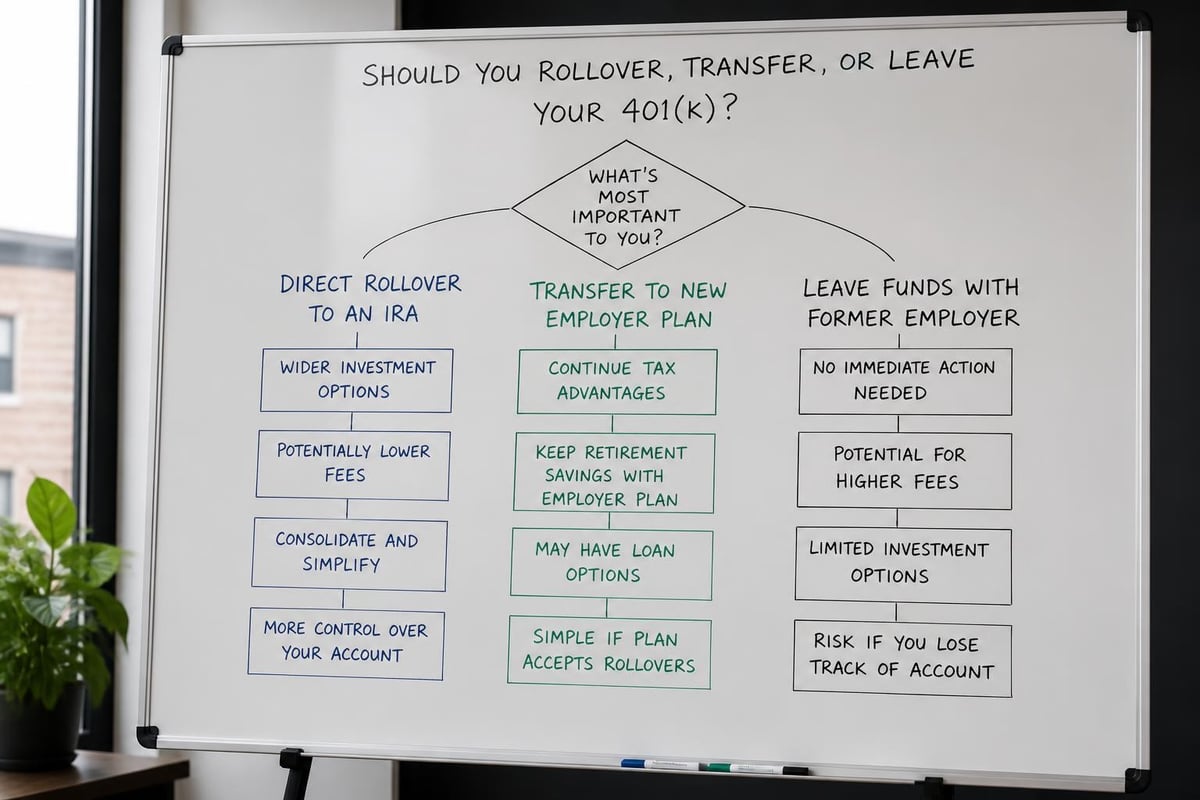
Leaving Funds in Former Employer Plans
Some individuals choose to maintain their 401(k) with a former employer rather than executing a rollover. This option makes sense in specific circumstances:
- Exceptional investment options with low institutional fees
- Strong creditor protections in your state
- Loans outstanding against the account (though most become due upon separation)
- Age 55 or older separation allowing penalty-free early withdrawals
However, maintaining multiple retirement accounts across former employers complicates financial planning and may result in orphaned accounts that become difficult to track over time.
Special Situations and Advanced Considerations
Certain circumstances require additional analysis when planning your direct rollover 401k strategy. These situations often benefit from professional guidance to navigate complex regulations and optimize outcomes.
Net Unrealized Appreciation for Company Stock
If your 401(k) holds significant employer stock with substantial appreciation, special tax rules may apply. Net Unrealized Appreciation (NUA) treatment allows you to pay capital gains rates on the appreciation rather than ordinary income tax rates.
Executing this strategy requires distributing the stock directly (not rolling it over) and meeting specific requirements. While this doesn't involve a direct rollover 401k for the stock portion, you can still roll over other plan assets directly while taking advantage of NUA treatment for company stock.
Multiple Account Consolidation
Managing several retirement accounts from different employers creates tracking challenges and may result in suboptimal asset allocation. Consolidating multiple 401(k) accounts through direct rollovers into a single IRA simplifies management and provides comprehensive portfolio visibility.
Consolidation benefits include:
- Unified investment strategy across all retirement assets
- Simplified required minimum distribution calculations
- Reduced administrative fees and account maintenance costs
- Easier beneficiary designation management
- Clearer picture of overall retirement readiness
Required Minimum Distributions During Rollovers
Individuals over age 73 must satisfy Required Minimum Distribution (RMD) obligations before executing a direct rollover 401k. You cannot roll over the RMD amount itself, as it must be distributed to you personally and reported as taxable income.
The sequence matters: take your RMD first, then initiate the direct rollover for remaining funds. Failing to complete your RMD before rolling over can result in excess contribution issues and potential penalties.
Working with Financial Professionals
The complexity of retirement account transitions often warrants professional guidance. Fiduciary advisors who prioritize your interests can help navigate the technical requirements while aligning rollover decisions with your broader financial objectives.
Questions to Address with an Advisor
A comprehensive rollover consultation should cover several critical areas:
- Investment options comparison between current and potential new accounts
- Fee structure analysis across different account types
- Tax planning implications for current and future years
- Estate planning considerations and beneficiary designations
- Integration with overall retirement income strategy
- Asset allocation recommendations for transferred funds
Professional advisors can also identify opportunities you might otherwise miss, such as optimal timing for Roth conversions or strategies to minimize tax drag in retirement.
Selecting the Right Receiving Institution
Where you direct your rollover funds influences your investment options, costs, and ongoing service quality. Consider these factors when selecting a receiving institution:
- Investment selection breadth including mutual funds, ETFs, individual securities, and alternative investments
- Fee structures for account maintenance, trading, and advisory services
- Research and planning tools available to account holders
- Customer service quality and accessibility
- Platform technology for account management and monitoring
- Advisory services if you want ongoing professional guidance
Understanding how different wealth management firms structure their services helps you identify the best fit for your needs and preferences.
Implementation Best Practices
Following established best practices when executing your direct rollover 401k minimizes complications and ensures smooth completion of the transfer process.
Pre-Rollover Checklist
Before initiating your rollover, verify these items are complete:
- Confirmed eligibility for rollover under current plan rules
- Opened receiving account with complete and accurate information
- Reviewed investment options at receiving institution
- Calculated and completed any required RMDs
- Determined treatment of any after-tax contributions
- Verified beneficiary designations on new account
- Obtained and reviewed rollover distribution forms
- Confirmed direct transfer instructions with both institutions
Post-Rollover Verification
Once your transfer completes, take these steps to ensure everything processed correctly:
- Verify the full amount transferred without unexpected deductions
- Confirm funds are invested according to your instructions
- Review tax reporting codes on Form 1099-R when received
- Update your financial planning documents with new account information
- Adjust automated contributions or distributions as needed
NerdWallet provides detailed guidance on evaluating whether a rollover aligns with your financial goals and circumstances.
Common Questions and Misconceptions
Many individuals harbor misconceptions about direct rollover 401k transactions that can lead to suboptimal decisions or unnecessary complications.
Rollover Frequency and Limitations
Unlike indirect rollovers, which are limited to one per 12-month period across all IRAs, direct rollovers from employer plans face no such frequency restrictions. You can execute multiple direct rollovers in a single year if changing jobs multiple times or consolidating several accounts.
This distinction matters significantly for individuals with complex employment histories or those systematically consolidating retirement assets.
Impact on Contribution Limits
Executing a direct rollover does not count against your annual contribution limits for IRAs or 401(k) plans. You can roll over $500,000 from a former employer's 401(k) and still make the maximum annual IRA contribution ($7,000 in 2026, or $8,000 if age 50 or older).
Creditor Protection Considerations
Federal law provides strong creditor protection for 401(k) plans under ERISA. IRA creditor protection varies by state law, though federally protected up to certain limits in bankruptcy. If creditor protection is a primary concern, evaluate whether maintaining funds in an employer plan or rolling to a new employer's 401(k) might be preferable to an IRA rollover.
Kiplinger’s rollover guide outlines five essential steps while emphasizing important financial and tax implications to consider throughout the process.
Integration with Comprehensive Financial Planning
Your direct rollover 401k decision should not occur in isolation. It represents one component of a comprehensive financial strategy that addresses retirement income needs, tax optimization, estate planning, and investment management.
Retirement Income Planning
Consider how rolled-over funds will generate income in retirement. This influences whether you consolidate accounts, which investments you select, and how you structure withdrawals. Creating a customized retirement income plan helps ensure your rollover decision supports your long-term objectives.
Tax Strategy Coordination
Rollover timing can be coordinated with other tax planning moves to optimize your overall tax situation. This might include:
- Roth conversion strategies in low-income years
- Harvesting tax losses to offset conversion income
- Timing large distributions to minimize Medicare premium surcharges
- Coordinating with charitable giving strategies like Qualified Charitable Distributions
Estate Planning Alignment
Beneficiary designations on retirement accounts supersede instructions in wills, making proper designation critical. When rolling over to an IRA, you have the opportunity to review and update beneficiaries, consider trust structures for complex situations, and align retirement assets with overall estate planning objectives. Understanding estate planning advantages helps you make informed beneficiary decisions.
A direct rollover 401k offers a tax-efficient, straightforward method for transitioning retirement assets between accounts while avoiding withholding and strict deadlines. Understanding the process, requirements, and strategic considerations enables you to make informed decisions that preserve and potentially enhance your retirement security. If you're navigating a job transition or consolidating retirement accounts, Brookwood Investment Group LLC provides personalized guidance on rollover strategies, investment management, and comprehensive retirement planning tailored to your unique financial situation and long-term goals.
