
Building financial security requires more than simply setting money aside each month. Effective savings planning involves a strategic approach to accumulating wealth, protecting against unforeseen circumstances, and working toward specific financial objectives. Whether you're preparing for retirement, building an emergency fund, or saving for a major purchase, a well-structured plan can help you navigate the complexities of personal finance while adapting to changing life circumstances and economic conditions.
Understanding the Foundation of Savings Planning
Savings planning represents a comprehensive approach to managing your financial resources with intentionality and purpose. This process involves assessing your current financial situation, identifying short-term and long-term objectives, and developing a systematic method for allocating funds toward those goals.
The core principle underlying successful savings planning centers on consistency rather than perfection. Many individuals delay starting their savings journey because they believe they need substantial amounts to make a meaningful difference. However, regular contributions, regardless of size, can compound over time to create significant wealth accumulation.
Evaluating Your Current Financial Position
Before developing a savings strategy, you need a clear picture of your financial landscape. This assessment includes:
- Income sources: Regular salary, bonuses, side income, investment returns
- Fixed expenses: Housing, insurance, loan payments, utilities
- Variable expenses: Groceries, entertainment, discretionary spending
- Existing savings: Emergency funds, retirement accounts, investment portfolios
- Debt obligations: Credit cards, student loans, mortgages
Creating a detailed inventory of these elements allows you to identify how much you can realistically allocate toward savings each month. This baseline understanding forms the foundation for setting achievable targets that align with your income and spending patterns.

Establishing Clear Savings Objectives
Effective savings planning requires specific, measurable goals rather than vague intentions. The objectives you set will determine your savings rate, investment approach, and timeline for achieving desired outcomes.
Short-Term Savings Goals
Short-term objectives typically span one to three years and might include:
- Building an emergency fund covering three to six months of living expenses
- Saving for a down payment on a vehicle
- Funding a vacation or significant event
- Creating a buffer for irregular expenses like insurance premiums or property taxes
These goals generally benefit from liquid, low-risk savings vehicles that prioritize capital preservation and accessibility over growth potential.
Medium-Term Financial Targets
Medium-term goals extend from three to ten years and often involve:
- Accumulating a home down payment
- Funding educational expenses
- Starting a business venture
- Making significant home improvements
For these timeframes, you might consider a balanced approach that combines safety with moderate growth potential, allowing your savings to potentially outpace inflation while remaining relatively accessible.
Long-Term Wealth Building
Long-term savings planning typically focuses on objectives beyond ten years, with retirement planning representing the most common priority. These extended timeframes may allow for investment strategies that seek higher growth potential, as there's typically more time to navigate market fluctuations.
Working with fiduciary planning professionals can help ensure your long-term strategy aligns with your risk tolerance and retirement timeline.
Selecting Appropriate Savings Vehicles
Different savings goals require different financial instruments. Understanding the characteristics of various account types helps you match your objectives with suitable options.
| Account Type | Best For | Key Features | Considerations |
|---|---|---|---|
| High-Yield Savings Account | Emergency funds, short-term goals | FDIC insured, liquid, competitive interest | Interest rates vary with market conditions |
| Money Market Account | Short to medium-term savings | Higher yields than standard savings, check-writing ability | May require higher minimum balances |
| Certificates of Deposit | Known future expenses | Fixed rates, FDIC insured | Early withdrawal penalties apply |
| 401(k)/403(b) | Retirement savings | Tax advantages, potential employer match | Access restrictions before age 59½ |
| Traditional IRA | Retirement with current tax deduction | Tax-deferred growth | Required minimum distributions at 73 |
| Roth IRA | Tax-free retirement income | Tax-free qualified withdrawals | Income limits for contributions |
Tax-Advantaged Retirement Accounts
Maximizing contributions to tax-advantaged retirement accounts represents a cornerstone of long-term savings planning. For 2026, individuals can contribute up to $23,500 to 401(k) plans, with an additional $7,500 catch-up contribution for those aged 50 and older. IRA contribution limits stand at $7,000, with a $1,000 catch-up provision.
These vehicles offer significant benefits, including immediate tax deductions for traditional accounts or tax-free growth for Roth accounts. If your employer offers matching contributions, prioritizing these accounts can effectively increase your savings rate through free money.
Developing a Systematic Savings Approach
Consistency matters more than contribution size when building wealth over time. Establishing automated systems removes decision fatigue and ensures regular progress toward your objectives.
The Pay-Yourself-First Method
This approach treats savings as a non-negotiable expense rather than an afterthought. By automatically transferring a predetermined amount to savings accounts immediately after receiving income, you prioritize wealth building before discretionary spending can deplete available resources.
Implementation steps:
- Calculate your target savings rate based on your goals and timeline
- Set up automatic transfers from checking to savings accounts
- Schedule transfers to coincide with paycheck deposits
- Adjust spending habits to accommodate the reduced available cash flow
- Review and increase transfer amounts periodically as income grows
The 50/30/20 Budgeting Framework
This popular budgeting method allocates income across three categories:
- 50% for needs: Essential expenses like housing, utilities, groceries, insurance
- 30% for wants: Discretionary spending including entertainment, dining, hobbies
- 20% for savings: Retirement contributions, emergency fund, debt repayment
While these percentages serve as general guidelines, your personal circumstances may require adjustments. High-cost-of-living areas might necessitate allocating more than 50% to needs, while aggressive savers might direct 30% or more toward wealth accumulation.

Managing Risk Through Diversification
Prudent savings planning extends beyond simply accumulating funds. Protecting your financial resources requires thoughtful consideration of risk management strategies.
Emergency Fund Essentials
An emergency fund serves as your financial shock absorber, protecting against unexpected expenses or income interruptions. Most financial professionals suggest maintaining three to six months of living expenses in readily accessible accounts.
Factors influencing your target emergency fund size include:
- Employment stability and income predictability
- Number of income earners in your household
- Health insurance coverage and potential medical expenses
- Home and vehicle age and condition
- Availability of family support systems
Insurance as a Savings Protection Tool
While insurance premiums represent an expense rather than savings, adequate coverage protects your accumulated wealth from catastrophic losses. Essential coverage types include health, disability, life, homeowners or renters, and auto insurance.
Disability insurance deserves particular attention, as your ability to earn income represents your most valuable asset. A disability could derail even the most carefully constructed savings plan if you lack adequate income replacement coverage.
Optimizing Your Savings Strategy Over Time
Savings planning is not a set-it-and-forget-it endeavor. Regular reviews and adjustments help ensure your approach remains aligned with evolving circumstances and objectives.
Annual Financial Check-Ups
Conducting comprehensive reviews at least annually allows you to:
- Assess progress toward established goals
- Adjust contribution amounts based on income changes
- Rebalance investment allocations as needed
- Update objectives to reflect life changes
- Evaluate new savings vehicles or strategies
Life events such as marriage, divorce, childbirth, career changes, or inheritance may necessitate more frequent adjustments to your financial strategy planning.
Increasing Savings Rates Progressively
As your income grows through raises, bonuses, or career advancement, consider increasing your savings rate proportionally. The concept of lifestyle inflation, where expenses rise to match income gains, can undermine long-term wealth building if left unchecked.
A practical approach involves directing at least 50% of any income increase toward savings and investment accounts. This strategy allows for some improvement in quality of life while accelerating progress toward financial objectives.
Coordinating Savings With Tax Efficiency
Understanding the tax implications of various savings strategies can significantly enhance your wealth accumulation over time. Different account types receive different tax treatment, creating opportunities for strategic planning.
Tax-Deferred Versus Tax-Free Growth
Traditional retirement accounts offer immediate tax deductions but require paying taxes on withdrawals in retirement. Roth accounts use after-tax dollars but provide tax-free qualified distributions. The optimal choice depends on your current versus expected future tax bracket.
Generally, if you anticipate being in a higher tax bracket during retirement, Roth accounts may offer advantages. Conversely, if you expect a lower retirement tax rate, traditional accounts might provide greater benefits. Many individuals benefit from maintaining both account types, creating tax diversification in retirement.
Health Savings Accounts
For those with high-deductible health plans, Health Savings Accounts (HSAs) offer unique triple-tax advantages. Contributions reduce current taxable income, growth occurs tax-free, and qualified medical expense withdrawals incur no taxes.
In 2026, individuals can contribute $4,300 to HSAs, while family coverage allows $8,550. Those aged 55 and older can add an additional $1,000. These accounts can serve dual purposes: covering current healthcare costs while building a medical expense reserve for retirement.
Balancing Debt Repayment and Savings
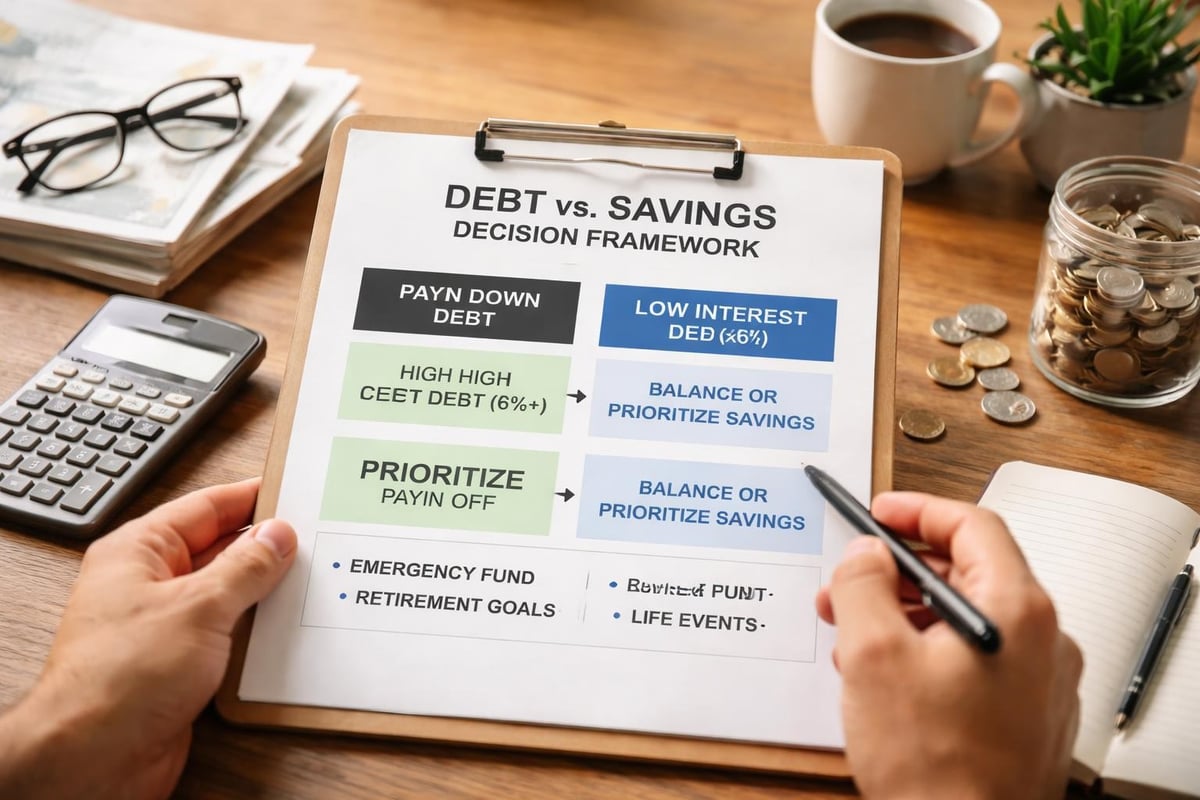
One common dilemma involves prioritizing debt elimination versus savings accumulation. The optimal approach depends on interest rates, debt types, and individual circumstances.
High-Interest Debt Priority
Credit card debt and other high-interest obligations (typically above 8-10% annually) generally warrant aggressive repayment before maximizing savings contributions. The guaranteed return from eliminating high-interest debt often exceeds potential investment returns on a risk-adjusted basis.
However, maintaining a small emergency fund even while addressing high-interest debt prevents having to rely on additional credit when unexpected expenses arise.
Strategic Simultaneous Approach
For moderate-interest debt like student loans or mortgages, a balanced approach often makes sense:
| Strategy Component | Action | Rationale |
|---|---|---|
| Minimum debt payments | Continue all required payments | Protect credit score, avoid penalties |
| Emergency fund | Build to $1,000-$2,000 initially | Cover small unexpected expenses |
| Employer match | Maximize retirement match contributions | Capture free money (typically 50-100% return) |
| Additional savings or debt | Evaluate interest rates versus potential returns | Allocate extra resources strategically |
This framework ensures you're making progress on multiple financial priorities simultaneously rather than focusing exclusively on one area.
Leveraging Professional Guidance
While self-directed savings planning works for some individuals, many benefit from professional expertise in developing and implementing comprehensive strategies. Financial advisors can provide objective analysis, identify blind spots, and help navigate complex decisions regarding account selection, investment allocation, and tax optimization.
Financial advisors independent of product sales commissions can offer guidance aligned with your interests rather than compensation incentives. Fiduciary advisors are legally obligated to prioritize client interests, providing an additional layer of confidence in the advice received.
Professional guidance becomes particularly valuable during major life transitions, complex financial situations involving multiple account types, or when approaching retirement. The cost of professional advice often pales in comparison to the potential value of optimized tax strategies, appropriate risk management, and coordinated planning across various financial domains.
Adapting to Economic Conditions
External economic factors influence savings planning strategies, though fundamental principles remain constant regardless of market conditions. Interest rate environments, inflation rates, and market volatility all impact the effectiveness of different savings approaches.
Inflation Considerations
Inflation erodes purchasing power over time, making it essential that your savings growth outpaces rising costs. In periods of elevated inflation, holding excessive amounts in low-yielding savings accounts can result in diminished real value despite nominal balance growth.
Diversifying your savings across different vehicles, including some with growth potential that may outpace inflation, helps protect long-term purchasing power. However, this must be balanced against liquidity needs and risk tolerance.
Interest Rate Impact
Rising interest rates typically benefit savers through higher yields on savings accounts, money market accounts, and certificates of deposit. Conversely, falling rates reduce these returns, potentially necessitating adjustment to savings rates or investment strategies to maintain progress toward goals.
Fixed-income investments also respond to interest rate changes, with bond values typically declining when rates rise. Understanding these dynamics helps inform decisions about appropriate savings vehicles for different time horizons.
Creating Accountability and Tracking Progress
Regular monitoring of your savings progress provides motivation and enables timely course corrections when needed. Establishing systems for tracking and accountability increases the likelihood of achieving your objectives.
Quantifiable Milestones
Breaking large goals into smaller milestones creates opportunities for celebrating progress and maintaining motivation. Rather than focusing solely on a distant retirement number, establish interim targets such as:
- Reaching your first $10,000 in retirement savings
- Completing a fully-funded emergency fund
- Achieving a specific net worth milestone
- Increasing your savings rate by a certain percentage
These checkpoints provide regular feedback on your progress and help maintain momentum through the long journey of wealth accumulation.
Technology and Tracking Tools
Numerous applications and platforms facilitate savings tracking, budget management, and progress visualization. These tools can aggregate accounts, categorize spending, and project future balances based on current contribution rates.
While technology streamlines monitoring, the key lies in regularly reviewing the information and taking action when adjustments are warranted. Monthly reviews of spending patterns, savings contributions, and account balances help ensure you remain on track toward your objectives.
Building Savings Discipline and Consistency
Behavioral factors often determine success or failure in savings planning more than technical knowledge or income level. Developing strong financial habits creates the foundation for long-term wealth accumulation.
Strategies for maintaining discipline:
- Automate contributions to remove temptation
- Separate savings into different accounts for specific goals
- Limit exposure to spending triggers and temptations
- Find low-cost alternatives for common discretionary expenses
- Focus on value rather than price in purchasing decisions
- Regularly remind yourself of your long-term objectives
Understanding that savings planning represents a marathon rather than a sprint helps maintain perspective during challenging periods. Temporary setbacks or reduced contribution periods don't derail long-term success if you maintain consistency over extended timeframes.
Working with professionals who understand your unique situation can help you develop customized plan approaches that acknowledge both your financial realities and behavioral tendencies. This personalized guidance often proves more valuable than generic advice that fails to account for individual circumstances.
Effective savings planning requires combining technical knowledge with disciplined execution, adapting strategies to changing circumstances while maintaining focus on long-term objectives. The journey toward financial security involves numerous decisions about account selection, contribution rates, and resource allocation across competing priorities. Brookwood Investment Group LLC provides personalized, fiduciary guidance to help you navigate these complexities and develop savings strategies aligned with your unique goals and life circumstances. Schedule a consultation to explore how professional advice might enhance your financial planning efforts.
