
Understanding the minimum withdrawal from IRA requirements represents a critical component of retirement planning. The IRS mandates that traditional IRA account holders begin taking distributions at a specified age, ensuring that tax-deferred funds eventually generate taxable income. These withdrawals, known as Required Minimum Distributions (RMDs), carry significant tax implications and potential penalties for non-compliance. Whether you're approaching retirement or already managing distributions, knowing how these rules apply to your specific situation can help optimize your retirement income strategy while avoiding costly mistakes.
Understanding Required Minimum Distributions
Required Minimum Distributions represent the minimum amount you must withdraw from traditional IRAs and employer-sponsored retirement plans annually once you reach a certain age. The IRS retirement plans guidance establishes these rules to ensure that retirement funds, which have grown tax-deferred for decades, eventually generate taxable income for the government.
The SECURE 2.0 Act modified the age requirements for beginning RMDs. For individuals who reached age 72 after December 31, 2022, the required beginning date shifted to age 73. This legislation further increases the starting age to 75 for those reaching that milestone in 2033 or later. These changes provide additional years for tax-deferred growth before mandatory withdrawals begin.
Which Accounts Require Minimum Withdrawals
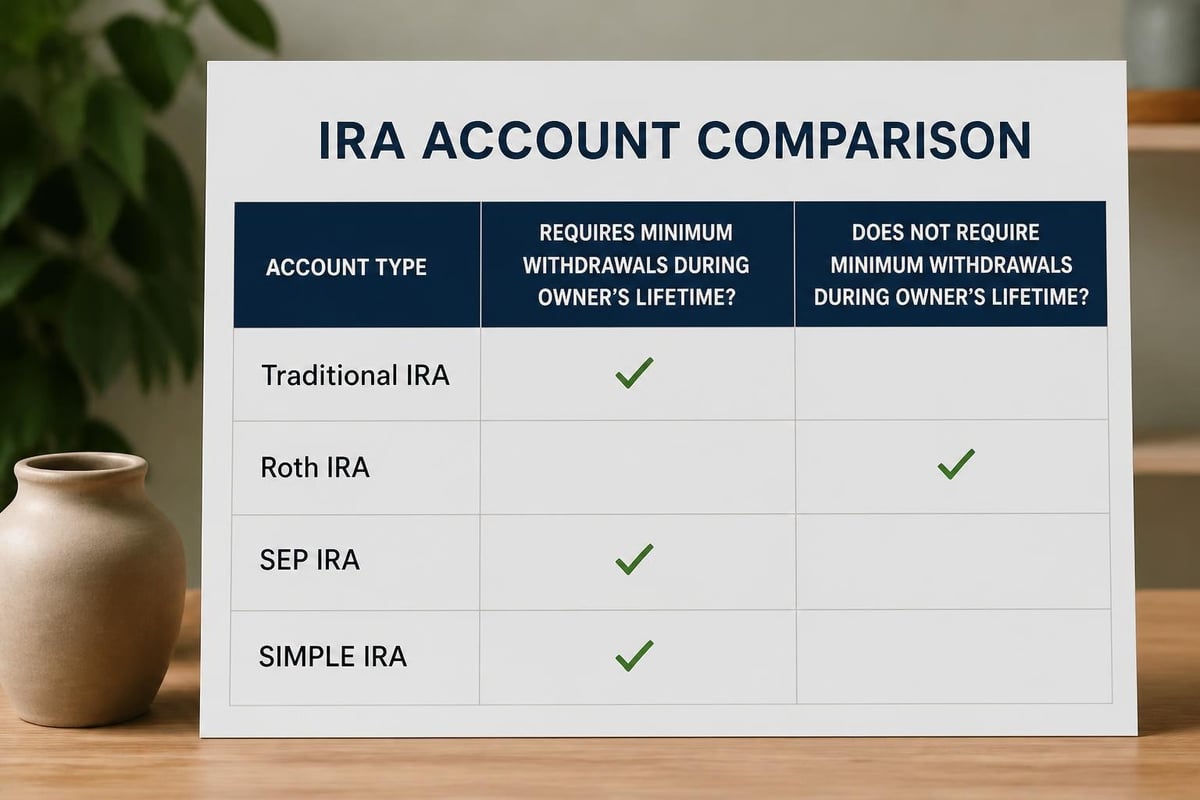
The minimum withdrawal from IRA rules apply to several retirement account types:
- Traditional IRAs
- SEP IRAs
- SIMPLE IRAs
- 401(k) plans
- 403(b) plans
- 457(b) plans
- Profit-sharing plans
- Other defined contribution plans
Roth IRAs stand as the notable exception. Original Roth IRA owners face no RMD requirements during their lifetime, making these accounts valuable estate planning tools. Beneficiaries who inherit Roth IRAs, however, may face distribution requirements depending on their relationship to the deceased and when the account was inherited.
Calculating Your Required Minimum Distribution
The calculation for your minimum withdrawal from IRA accounts involves two primary components: your account balance and the appropriate life expectancy factor. The IRS provides standardized tables that determine your distribution period based on your age.
The Calculation Process
To calculate your RMDs accurately, follow these steps:
- Determine your IRA balance as of December 31 of the previous year
- Identify your age as of your birthday in the current year
- Locate the corresponding distribution period from the appropriate IRS table
- Divide your account balance by the distribution period
For most IRA owners, the Uniform Lifetime Table applies. This table assumes a beneficiary exactly 10 years younger than you, regardless of who your actual beneficiary is. The distribution period decreases as you age, requiring progressively larger withdrawal percentages.
| Age | Distribution Period | Approximate Percentage |
|---|---|---|
| 73 | 26.5 | 3.77% |
| 75 | 24.6 | 4.07% |
| 80 | 20.2 | 4.95% |
| 85 | 16.0 | 6.25% |
| 90 | 12.2 | 8.20% |
Example calculation: If your traditional IRA held $500,000 on December 31, 2025, and you turn 75 in 2026, your minimum withdrawal from IRA would be $500,000 divided by 24.6, equaling approximately $20,325.
Timing and Deadlines for Withdrawals
Understanding when to take your minimum withdrawal from IRA accounts prevents unnecessary penalties and allows for strategic tax planning. The first RMD deadline follows different rules than subsequent years.
First-Year Exception
For your initial RMD year, you have until April 1 of the year following the year you turn 73. If you turn 73 in 2026, you could delay your first distribution until April 1, 2027. However, this creates a potential tax complication: you would need to take two distributions in 2027-the delayed 2026 RMD and your regular 2027 RMD. This doubling could push you into a higher tax bracket.
For all subsequent years, you must withdraw your RMD by December 31. Working with professionals who provide retirement planning services can help determine whether delaying your first distribution makes sense for your tax situation.
Penalties for Missing Distributions
Failing to take the full minimum withdrawal from IRA accounts triggers substantial penalties. The IRS assesses an excise tax of 25% on the amount you should have withdrawn but did not. If you correct the shortfall promptly, the penalty may reduce to 10%.
Consider this scenario: Your RMD is $20,000, but you only withdrew $12,000. The $8,000 shortfall would generate a $2,000 penalty (25% of $8,000). These penalties stack on top of the regular income taxes you owe on distributions.

Tax Implications of IRA Withdrawals
Every dollar withdrawn from a traditional IRA as part of your minimum withdrawal from IRA requirement counts as ordinary income. Unlike capital gains, which receive preferential tax treatment, RMDs face taxation at your marginal income tax rate.
Federal and State Tax Considerations
The tax impact varies significantly based on your total income. RMDs combine with Social Security benefits, pension income, investment income, and any wages to determine your adjusted gross income (AGI). Higher AGI levels can trigger several consequences:
- Increased Medicare Part B and Part D premiums (IRMAA surcharges)
- Taxation of Social Security benefits
- Phase-out of deductions and credits
- Higher capital gains tax rates
Understanding how IRAs impact Social Security helps you plan strategically for combined income sources. Some states exempt retirement income from taxation, while others tax it fully. Your state residency during retirement significantly affects your after-tax income.
Withholding and Estimated Taxes
Financial institutions do not automatically withhold taxes from your minimum withdrawal from IRA distributions unless you request it. You can specify a withholding percentage when taking distributions. Many retirees choose 10-20% federal withholding, adjusting based on their total tax liability.
If you don't withhold sufficient taxes from RMDs, you may need to make quarterly estimated tax payments. The IRS expects taxpayers to pay at least 90% of their current year tax liability or 100% of their prior year liability (110% for higher earners) to avoid underpayment penalties.
Strategies for Managing Required Distributions
Strategic planning around your minimum withdrawal from IRA obligations can minimize tax burdens and preserve wealth. Several approaches merit consideration based on your circumstances.
Qualified Charitable Distributions
Individuals age 70½ or older can make Qualified Charitable Distributions (QCDs) directly from their IRA to eligible charities. These transfers satisfy your RMD requirement while excluding the distribution from your taxable income. The annual limit is $105,000 per person for 2026.
Benefits of QCDs include:
- Satisfying RMD requirements without increasing taxable income
- Avoiding the AGI increase that could affect Medicare premiums
- Supporting charitable causes
- Providing tax benefits even if you claim the standard deduction
QCDs must go directly from your IRA custodian to the qualified charity. You cannot withdraw the funds yourself and then donate them to receive this treatment.
Roth Conversion Strategies
Before RMDs begin, converting traditional IRA assets to Roth IRAs can reduce future required distributions. While conversions trigger immediate tax liability, they eliminate that portion of your IRA from future RMD calculations. Roth IRAs offer tax-free growth and no lifetime RMDs, as detailed in discussions about leaving heirs a Roth IRA.
Strategic conversion planning might involve:
- Converting amounts that keep you within your current tax bracket
- Timing conversions during lower-income years
- Converting before Medicare enrollment to avoid IRMAA impacts
- Spreading conversions across multiple years
| Strategy | Tax Impact Now | Long-Term Benefit | Best For |
|---|---|---|---|
| QCD | None (excluded from income) | Reduced AGI | Charitably inclined |
| Roth Conversion | Immediate tax on conversion | Tax-free growth, no RMDs | Those with time before RMDs |
| December Withdrawal | Standard income tax | Better cash flow planning | Most retirees |
| Reinvestment | Standard income tax | Continued growth potential | Those who don't need income |
Special Situations and Exceptions
Several circumstances create exceptions or modifications to the standard minimum withdrawal from IRA rules. Understanding these situations ensures compliance while maximizing flexibility.
Still-Working Exception
If you participate in a 401(k) or similar employer plan and continue working past age 73, you may delay RMDs from that specific plan until you retire. This exception does not apply to IRAs or employer plans from previous employers. Additionally, if you own 5% or more of the company sponsoring the plan, this exception does not apply.
Inherited IRAs
Beneficiaries who inherit traditional IRAs face different distribution requirements than original owners. The SECURE Act substantially changed these rules for most non-spouse beneficiaries. Under current law, most beneficiaries must withdraw the entire inherited IRA balance within 10 years of the original owner's death.
Spousal beneficiaries retain more flexibility:
- Treating the IRA as their own
- Rolling it into their existing IRA
- Remaining as beneficiary and taking distributions based on their life expectancy
These choices carry significantly different tax implications. The rules for normal IRA withdrawals apply differently to inherited accounts than to original owner accounts.

Multiple IRA Accounts
If you own several traditional IRAs, you must calculate the RMD separately for each account. However, you can aggregate the total required amount and withdraw it from one IRA or any combination of your IRAs. This flexibility allows you to choose which accounts to draw from based on investment performance, fund availability, or rebalancing needs.
Employer plans follow different aggregation rules. While you can aggregate RMDs among 403(b) accounts, you must take separate distributions from each 401(k) plan you own.
Working with Financial Professionals
The complexity of minimum withdrawal from IRA regulations, combined with their interaction with broader retirement and tax planning, makes professional guidance valuable. Fiduciary advisors provide advice in your best interest, helping coordinate RMD strategies with overall financial objectives.
Comprehensive Planning Approach
Effective RMD planning integrates multiple financial planning dimensions:
- Tax optimization across federal and state jurisdictions
- Social Security claiming strategies
- Medicare premium management
- Estate planning objectives
- Investment allocation adjustments
- Cash flow planning
Virtual-first advisory firms can provide personalized guidance regardless of your location, offering flexibility that matches modern lifestyles. The detailed FAQs on RMDs from the IRS answer many technical questions, but applying these rules to your unique situation benefits from professional expertise.
Annual Review and Adjustments
Your minimum withdrawal from IRA requirements change annually as your age increases and account balances fluctuate. Establishing a systematic review process ensures accurate calculations and timely distributions. Many retirees coordinate their RMD planning with annual tax planning meetings, reviewing the prior year's results and projecting the coming year's obligations.
Managing Large IRA Balances
Retirees with substantial IRA balances face unique challenges. As account values grow, the impact of RMDs increases substantially, potentially pushing retirees into higher tax brackets even when they don't need the income for living expenses.
For accounts exceeding $1 million, even the initial RMD at age 73 approaches $40,000. This amount grows as distribution periods shorten with age. Strategies to manage large RMD obligations include:
- Beginning systematic Roth conversions well before RMDs start
- Maximizing QCDs to eligible charities
- Coordinating distributions with other income sources to smooth tax brackets
- Using distributions to fund life insurance for estate planning
- Implementing tax-loss harvesting in taxable accounts to offset RMD income
The various types of required IRA withdrawals serve different purposes throughout retirement. Understanding how each type works and when it applies helps create comprehensive withdrawal strategies.
Documentation and Record-Keeping
Maintaining thorough records of your minimum withdrawal from IRA transactions protects you if questions arise. Your IRA custodian typically sends Form 1099-R documenting distributions, but you should retain supporting documentation showing your RMD calculations.
Essential Records to Keep
- Year-end IRA account statements
- Distribution confirmations
- RMD calculation worksheets
- Tax returns showing reported distributions
- QCD acknowledgment letters from charities
- Correspondence with IRA custodians
These records become particularly important if you have multiple IRAs, inherited accounts, or complex distribution strategies. They provide audit protection and help ensure accurate tax reporting.
Custodians often calculate and report your RMD amount, but ultimate responsibility for taking correct distributions rests with you. Reviewing custodian calculations against your own records or those of your financial advisor prevents errors.
Looking Ahead: Planning Beyond RMDs
While satisfying the minimum withdrawal from IRA requirements remains essential, comprehensive retirement planning extends beyond compliance. RMDs represent one component of broader income and legacy planning strategies.
Consider how your IRA distributions interact with long-term objectives. Are you preserving wealth for heirs? Funding specific retirement lifestyle goals? Supporting charitable causes? Your answers shape optimal distribution strategies that may exceed minimum requirements.
Strategic estate planning considerations influence whether minimizing RMDs or accelerating distributions better serves your goals. Some retirees benefit from taking more than the minimum to reduce future tax burdens or reposition assets for estate planning purposes.
Managing the minimum withdrawal from IRA requirements demands attention to detailed rules, strategic tax planning, and coordination with your broader financial objectives. Understanding how these mandatory distributions affect your retirement income, tax liability, and long-term wealth preservation positions you to make informed decisions that align with your unique circumstances. Whether you're approaching your first RMD or managing ongoing distributions, Brookwood Investment Group offers personalized, fiduciary guidance to help navigate these complex regulations while pursuing your retirement goals through virtual-first advisory services tailored to your specific needs.
