
Navigating financial emergencies often forces individuals to consider options they would prefer to avoid, including accessing retirement savings before reaching retirement age. A fidelity investments hardship withdrawal represents one such option available to participants in employer-sponsored 401(k) plans administered through Fidelity. Understanding the specific requirements, tax consequences, and long-term impact of these withdrawals can help you make informed decisions during challenging financial circumstances. This comprehensive guide explores the mechanics of hardship withdrawals, eligibility criteria, documentation requirements, and alternatives worth considering before reducing your retirement nest egg.
Understanding Hardship Withdrawal Basics
A fidelity investments hardship withdrawal allows participants to access funds from their employer-sponsored retirement plan when facing an immediate and heavy financial need. The IRS establishes strict criteria that define what qualifies as a legitimate hardship, and Fidelity administers these withdrawals according to both federal regulations and the specific provisions outlined in each employer's plan document.
Unlike standard distributions taken after age 59½, hardship withdrawals carry significant restrictions and consequences. The withdrawn amount becomes subject to ordinary income tax, and participants under age 59½ typically face an additional 10% early withdrawal penalty. These costs can substantially reduce the actual funds available to address the underlying financial emergency.
What Qualifies as an Immediate and Heavy Financial Need
The IRS recognizes specific categories of expenses that may justify a hardship withdrawal. These safe harbor provisions include:
- Medical expenses for the participant, spouse, dependents, or primary beneficiary
- Costs directly related to the purchase of a principal residence (excluding mortgage payments)
- Tuition and related educational fees for the next 12 months of post-secondary education
- Payments necessary to prevent eviction or foreclosure on a principal residence
- Funeral and burial expenses for deceased parents, spouse, children, dependents, or primary beneficiary
- Expenses for repair of damage to the participant's principal residence that would qualify for casualty deduction
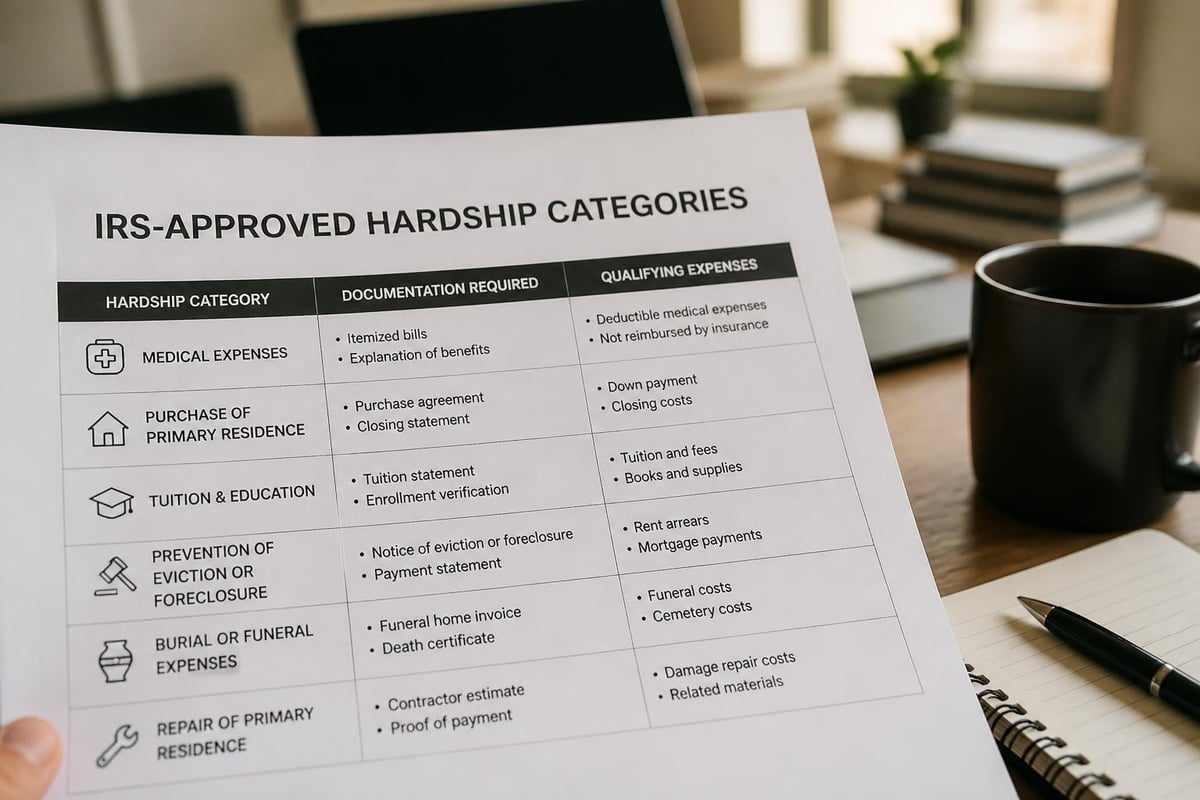
Plan sponsors may include additional hardship categories beyond these safe harbor provisions, though Fidelity requires documentation proving both the immediate nature and amount of the financial need. The Urban Institute's research on household financial resilience highlights how retirement account access relates to broader emergency savings challenges facing American families.
Documentation and Application Process
Initiating a fidelity investments hardship withdrawal requires careful preparation and submission of specific documentation. The Fidelity NetBenefits forms hub provides access to the required paperwork, though the exact forms vary based on employer plan provisions and the hardship category claimed.
Required Documentation by Category
| Hardship Category | Typical Documentation Required |
|---|---|
| Medical Expenses | Bills, explanation of benefits, insurance statements showing unpaid amounts |
| Home Purchase | Purchase agreement, closing statement, or contract with dates and amounts |
| Tuition Payments | Enrollment verification, tuition bill from educational institution |
| Eviction/Foreclosure Prevention | Notice from landlord or lender, payment demand letter, court documents |
| Funeral Expenses | Death certificate, funeral home invoice or contract |
| Home Repairs | Contractor estimates, insurance adjuster reports, damage documentation |
Participants must demonstrate that the withdrawal amount does not exceed the immediate financial need, including amounts necessary to pay taxes and penalties on the distribution itself. Many individuals underestimate this requirement when calculating how much to request.
Completing the Withdrawal Request
The official withdrawal form requires detailed information about the financial hardship, supporting documentation, and acknowledgment of tax consequences. Processing typically takes 3-7 business days after Fidelity receives complete documentation, though complex situations may require additional review time.
Working with financial advisors who understand retirement planning can help you navigate this process and evaluate whether a hardship withdrawal represents the most appropriate solution for your situation.
Tax Implications and Penalties
The tax burden associated with a fidelity investments hardship withdrawal often surprises participants who focus solely on accessing funds during an emergency. Understanding these costs upfront allows for more accurate planning and may influence the decision to pursue alternative funding sources.
Federal Income Tax Treatment
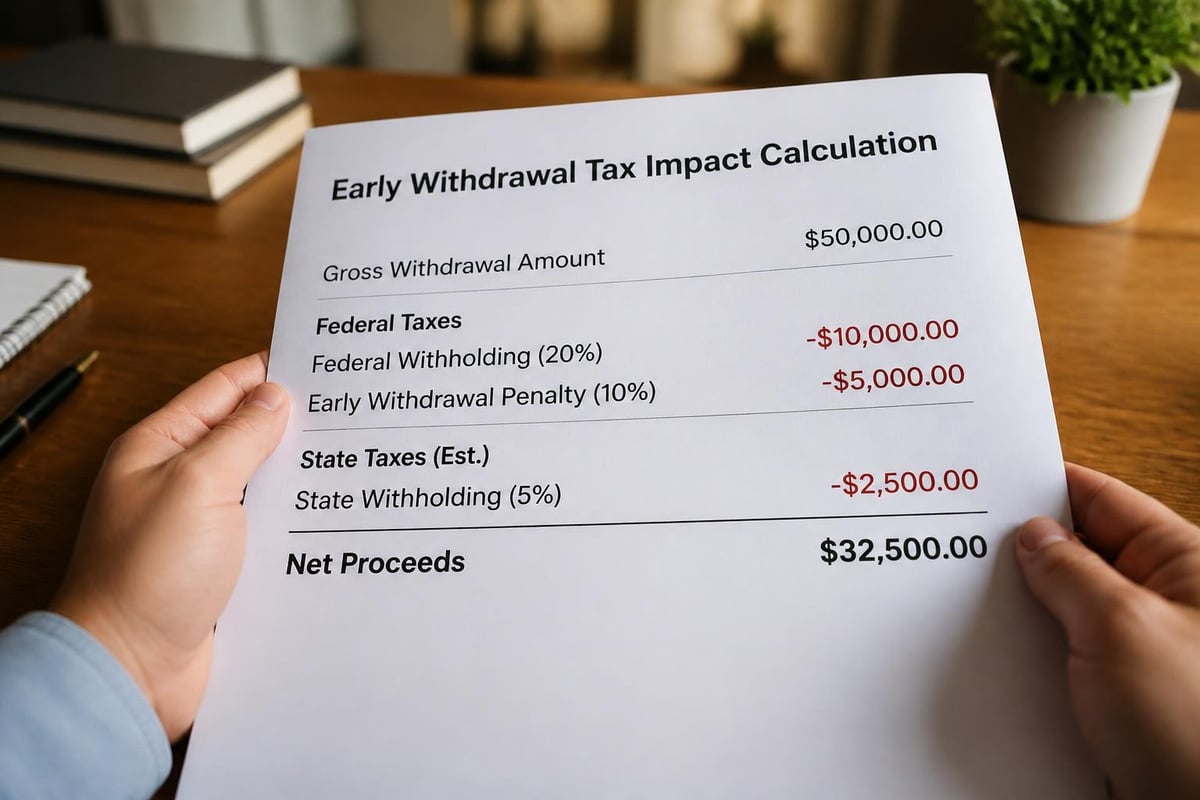
Hardship withdrawals constitute taxable income in the year you receive the distribution. Fidelity typically withholds 20% for federal income taxes, though your actual tax liability depends on your marginal tax bracket. If your total income for the year places you in a 24% bracket, the actual tax owed exceeds the withheld amount, creating a potential surprise when filing your return.
Key tax considerations include:
- Mandatory 20% federal withholding at distribution
- Additional tax liability if your marginal rate exceeds 20%
- State income tax in most jurisdictions
- Potential to push you into a higher tax bracket for the year
- No option to roll the funds to another retirement account
The IRS guidance on hardship distribution consequences provides detailed information about tax treatment and reporting requirements that participants should review before proceeding.
Early Withdrawal Penalty
Participants under age 59½ generally face a 10% additional tax penalty on hardship withdrawals. Limited exceptions exist, including total and permanent disability or qualified medical expenses exceeding 7.5% of adjusted gross income. The penalty applies to the gross distribution amount, not just the amount received after withholding.
Long-Term Impact on Retirement Security
Beyond immediate tax consequences, a fidelity investments hardship withdrawal creates lasting effects on retirement readiness that merit careful consideration. Vanguard's research on how Americans use hardship withdrawals reveals important patterns about participant behavior and long-term outcomes.
Lost Growth Potential
Every dollar withdrawn from a retirement account eliminates not only the principal but also decades of potential compound growth. A $20,000 hardship withdrawal taken at age 35 removes approximately $160,000 from retirement savings by age 65, assuming a 7% average annual return. This opportunity cost often exceeds the immediate financial benefit, particularly when alternative funding sources exist.
Contribution Restrictions
Prior to 2019, participants taking hardship withdrawals faced a six-month suspension from making new contributions to their retirement plan. While the Bipartisan Budget Act eliminated this requirement, some older plan documents may still impose contribution restrictions. Additionally, reduced account balances mean you miss out on ongoing employer matching contributions during any period of suspended participation.
Psychological and Behavioral Effects
Research indicates that individuals who tap retirement savings for non-retirement purposes often struggle to rebuild their accounts. The psychological barrier of having accessed these funds once lowers resistance to doing so again, potentially establishing a pattern that undermines long-term financial security.
Alternatives to Consider Before Withdrawing
Before initiating a fidelity investments hardship withdrawal, exploring alternative funding sources can help preserve retirement savings while addressing immediate financial needs. Financial planning strategies should prioritize options with fewer long-term consequences.
401(k) Loans
Many Fidelity-administered plans offer loan provisions allowing participants to borrow from their account balance without triggering taxes or penalties. Loans typically permit borrowing up to 50% of the vested balance (maximum $50,000) with repayment through payroll deductions over five years.
| Feature | Hardship Withdrawal | 401(k) Loan |
|---|---|---|
| Tax Treatment | Taxable income | Not taxable if repaid |
| 10% Penalty | Yes (if under 59½) | No |
| Repayment Required | No | Yes, via payroll |
| Account Balance Impact | Permanent reduction | Temporary reduction |
| Contribution Eligibility | Generally unaffected | Can continue contributing |
The Kiplinger guide on avoiding 401(k) hardship withdrawals provides additional context on loan provisions and other alternatives worth considering.
Emergency Savings and Other Resources
Building an emergency fund separate from retirement accounts represents the ideal first line of defense against financial hardships. Three to six months of essential expenses in a readily accessible savings account can address most common financial emergencies without compromising retirement security.
Additional alternatives include:
- Health Savings Account (HSA) withdrawals for qualified medical expenses (tax and penalty-free)
- Home equity lines of credit for homeowners with sufficient equity
- Personal loans from banks or credit unions at competitive rates
- Payment plans negotiated directly with service providers or creditors
- Community assistance programs for specific needs like medical bills or utilities
Working with a fiduciary financial advisor helps you evaluate these options in the context of your complete financial picture and long-term goals.
Special Circumstances and Recent Changes
The regulatory environment surrounding hardship withdrawals continues evolving, with recent changes affecting both eligibility and procedures for fidelity investments hardship withdrawal requests.
Disaster-Related Provisions
FEMA-declared disasters may qualify participants for special withdrawal provisions with modified documentation requirements and potential penalty relief. These disaster hardship withdrawals often permit higher distribution amounts and extended repayment options when available. Fidelity maintains specific forms and processes for disaster-related requests accessible through their plan administrator portal.
Roth 401(k) Considerations
For participants with Roth 401(k) balances, hardship withdrawals follow a specific ordering rule. Contributions (which were already taxed) come out first, followed by earnings. Only the earnings portion of a Roth hardship withdrawal triggers additional taxes and penalties, potentially reducing the overall tax burden compared to traditional pre-tax account withdrawals.
Spousal Consent Requirements
Married participants in certain types of plans may require spousal consent before receiving a hardship distribution. This protection ensures both spouses understand the impact on retirement security before reducing account balances. The specific consent requirements depend on the plan type and the participant's vested account balance.
Making an Informed Decision
Evaluating whether to proceed with a fidelity investments hardship withdrawal requires balancing immediate financial pressures against long-term retirement security. This decision merits careful analysis rather than reactive choices made during stressful circumstances.

Questions to Ask Before Proceeding
Financial assessment questions:
- Does the expense truly constitute an immediate and heavy financial need?
- Have I exhausted all alternative funding sources?
- Can I negotiate a payment plan for the underlying expense?
- What is the total cost including taxes, penalties, and lost growth?
- How will this withdrawal affect my retirement timeline?
Documentation and process questions:
- Do I have all required documentation to support my hardship claim?
- Does my employer's plan permit hardship withdrawals for this expense category?
- What is the realistic timeline for receiving funds?
- Are there contribution restrictions following the withdrawal?
NerdWallet's comprehensive guide on early 401(k) withdrawals offers additional perspective on weighing these considerations in plain language.
Professional Guidance Value
Complex financial decisions benefit from objective professional advice. A fiduciary advisor can help you model different scenarios, understand the true cost of various options, and develop strategies to rebuild retirement savings if a withdrawal becomes necessary. This personalized financial guidance takes into account your complete financial situation, including other assets, income sources, and long-term goals.
Plan-Specific Variations and Employer Policies
While IRS regulations establish the baseline framework for hardship withdrawals, individual plan documents may impose additional restrictions or offer expanded categories. Understanding your specific plan's provisions is essential before assuming you qualify for a fidelity investments hardship withdrawal.
Employer Plan Document Authority
Your employer's retirement plan document serves as the governing authority for hardship withdrawal provisions. Some plans limit hardship withdrawals to specific contribution types (excluding employer match, for example), while others may restrict the frequency of withdrawal requests or impose waiting periods between distributions.
Verification Standards
Plans may adopt either self-certification or documentation-required approaches for verifying hardship claims. Self-certification allows participants to attest that they meet the requirements without submitting detailed documentation, though Fidelity or the plan sponsor may still conduct spot audits. Documentation-required approaches demand upfront proof of the financial hardship before processing any withdrawal request.
Source of Funds Restrictions
Not all money in your Fidelity 401(k) account may be available for hardship withdrawal. Common restrictions include:
- Safe harbor employer contributions may be completely restricted
- Traditional employer matching contributions often unavailable
- Earnings on certain contribution types may be excluded
- Rollover contributions from previous employers might be restricted
Understanding which account sources are available for hardship purposes helps you accurately calculate the maximum amount you can access if needed.
Rebuilding After a Hardship Withdrawal
If circumstances require you to proceed with a fidelity investments hardship withdrawal, developing a recovery plan helps minimize long-term damage to your retirement security. Proactive steps can accelerate account balance restoration and keep your retirement timeline on track.
Immediate Actions Post-Withdrawal
Once you receive hardship withdrawal funds, several immediate steps can limit ongoing damage:
- Resume contributions as soon as financially feasible to restart the compounding process
- Increase contribution rates if possible to help recoup lost growth
- Ensure you capture full employer match by contributing at least to the match threshold
- Set aside funds for tax filing if the 20% withholding proves insufficient
- Document the withdrawal for accurate tax reporting and personal financial records
Long-Term Recovery Strategies
Comprehensive retirement planning following a hardship withdrawal should include strategies such as working an extra year or two before retirement, reducing planned retirement expenses, maximizing catch-up contributions after age 50, or pursuing additional income sources to boost savings rates. Each situation requires customized planning that reflects your unique circumstances and goals.
Tracking your progress toward rebuilding retirement savings provides motivation and allows for course corrections if results fall short of targets. Annual reviews with a financial advisor help ensure you remain on track despite the temporary setback.
Understanding the full implications of a fidelity investments hardship withdrawal empowers you to make informed decisions during financial emergencies while preserving as much retirement security as possible. If you're facing a financial hardship and weighing your options, Brookwood Investment Group offers personalized, fiduciary guidance to help you evaluate alternatives, understand consequences, and develop strategies aligned with your long-term financial goals. Our virtual-first approach makes it easy to get professional advice when you need it most, ensuring you can navigate difficult financial decisions with confidence and clarity.
