
Facing a financial emergency can feel overwhelming, especially when your retirement savings represent the only accessible source of funds. If you participate in a Voya-administered 401(k) plan, you may have heard about hardship withdrawals as a potential option during times of severe financial distress. Understanding how a voya hardship withdrawal works, the strict qualifying criteria, and the long-term implications for your retirement security is essential before making this consequential decision. This guide examines the regulations, process, and alternatives that may better protect your financial future.
What Qualifies as a Voya Hardship Withdrawal
The Internal Revenue Service establishes strict criteria for what constitutes an immediate and heavy financial need that may justify a hardship distribution from your retirement account. IRS regulations on hardship distributions define specific circumstances under which plan participants may access their funds before retirement age.
Approved Hardship Reasons
A voya hardship withdrawal typically requires one of the following qualifying events:
- Medical expenses for you, your spouse, dependents, or primary beneficiary that exceed 7.5% of adjusted gross income
- Costs directly related to purchasing your principal residence (excluding mortgage payments)
- Tuition, educational fees, and room and board for the next 12 months of post-secondary education for you, your spouse, children, dependents, or primary beneficiary
- Payments to prevent eviction or foreclosure on your principal residence
- Funeral and burial expenses for your deceased parent, spouse, children, dependents, or primary beneficiary
- Certain expenses to repair damage to your principal residence that would qualify for a casualty loss deduction
- Emergency personal expenses under recent SECURE 2.0 provisions (up to $1,000 annually)
The specific documentation requirements that Voya requires may include bills, eviction notices, purchase contracts, or other third-party verification of the financial need. Your specific plan document determines which hardships your employer has chosen to permit.

Financial Need Requirements
Demonstrating immediate and heavy financial need requires more than simply wanting access to your money. The IRS mandates that you must have exhausted other available resources before taking a voya hardship withdrawal. This typically means:
Your plan administrator will likely require written attestation that you cannot reasonably obtain funds from other sources, including reimbursement or compensation by insurance, liquidation of assets without causing additional hardship, stopping elective deferrals under the plan, or other distributions or loans from your employer's plans.
The amount you withdraw cannot exceed the sum needed to satisfy the financial need plus any taxes and penalties you will owe on the distribution. This limitation ensures hardship withdrawals serve their intended purpose rather than providing general access to retirement funds.
The Voya Hardship Withdrawal Process
Navigating the administrative requirements for a hardship distribution requires careful attention to deadlines, documentation, and procedural steps. The process typically spans several weeks from initial request to receiving funds.
Step-by-Step Application Procedure
- Contact your plan administrator through Voya's participant website or customer service line to initiate a hardship withdrawal request
- Complete the required forms including attestations about your financial need and lack of other resources
- Gather supporting documentation such as medical bills, eviction notices, tuition statements, or funeral invoices
- Submit your complete application package through Voya's secure portal or by mail
- Await plan administrator review which typically takes 7-10 business days
- Receive approval or denial notification with specific reasons if your request is not approved
- Choose your distribution method such as direct deposit or check mailing once approved
When working with professional financial guidance, you can better understand whether a hardship withdrawal represents the most prudent option given your complete financial picture.
Required Documentation
| Hardship Reason | Typical Documentation Required |
|---|---|
| Medical Expenses | Itemized bills, explanation of benefits, proof of payment already made |
| Home Purchase | Purchase contract, closing statement, proof of down payment due date |
| Education Costs | Tuition bill, enrollment verification, payment deadline documentation |
| Eviction/Foreclosure | Eviction notice, foreclosure letter, proof of amounts owed |
| Funeral Expenses | Death certificate, funeral home invoice, proof of relationship |
| Casualty Loss | Insurance claim, repair estimates, photos of damage |
The documentation must clearly establish both the nature of the financial need and the specific amount required. Vague or incomplete submissions will delay processing or result in denial.
Tax Implications and Penalties
Understanding the tax consequences of a voya hardship withdrawal is critical before proceeding. Unlike loans from your 401(k), hardship withdrawals are permanent distributions that trigger immediate tax obligations.
Federal and State Tax Treatment
Hardship withdrawals are included in your taxable income for the year you receive them. If you withdraw $20,000 from your Voya 401(k) and you are in the 22% federal tax bracket, you will owe approximately $4,400 in federal income tax on that distribution. State income taxes will add to this burden in most states.
Voya will withhold 20% for federal taxes automatically, but this may not cover your full tax liability depending on your tax bracket. The comprehensive tax rules outlined in IRS Publication 575 provide detailed examples of how hardship distributions affect your tax return.
Early Withdrawal Penalties
If you are under age 59½ when you take a voya hardship withdrawal, you typically face an additional 10% early distribution penalty on top of ordinary income taxes. This penalty effectively increases the cost of accessing your retirement funds substantially.
Example calculation for a 35-year-old taking a $20,000 hardship withdrawal:
- Gross distribution: $20,000
- Federal income tax (22% bracket): $4,400
- Early withdrawal penalty (10%): $2,000
- State income tax (5% example): $1,000
- Total taxes and penalties: $7,400
- Net amount received: $12,600
Recent legislation has created limited exceptions. The SECURE 2.0 Act provisions detailed in IRS Notice 2024-55 allow penalty-free emergency distributions up to $1,000 and withdrawals for domestic abuse survivors under specific circumstances.

Long-Term Impact on Retirement Savings
The immediate financial relief a voya hardship withdrawal provides comes at a significant cost to your long-term retirement security. Understanding these consequences helps frame whether the short-term benefit justifies the long-term sacrifice.
Lost Growth Potential
When you withdraw funds from your retirement account, you lose not only the principal but also decades of potential compound growth. A $20,000 hardship withdrawal at age 35 eliminates approximately $147,000 in retirement savings by age 65, assuming a 7% average annual return.
| Age at Withdrawal | Amount Withdrawn | Lost Growth by Age 65 (7% return) | Total Opportunity Cost |
|---|---|---|---|
| 30 | $15,000 | $114,405 | $129,405 |
| 35 | $20,000 | $147,138 | $167,138 |
| 40 | $25,000 | $154,443 | $179,443 |
| 45 | $30,000 | $142,026 | $172,026 |
| 50 | $35,000 | $115,589 | $150,589 |
These projections assume you do not replace the withdrawn amount, which many people cannot afford to do after experiencing the financial hardship that necessitated the withdrawal in the first place.
Contribution Suspension Requirements
Many Voya-administered plans require participants who take hardship withdrawals to suspend their own contributions for six months following the distribution. This means you will miss out on:
- Employer matching contributions during the suspension period
- Additional tax-deferred savings opportunities
- Dollar-cost averaging benefits during the suspension timeframe
The inability to contribute can further compound the retirement savings setback, particularly if you miss significant market gains during your suspension period.
Reduced Account Balance
Your voya hardship withdrawal permanently reduces your account balance. Unlike a 401(k) loan that you repay over time, hardship withdrawals cannot be repaid. This reduction affects not only your retirement nest egg but also your future contribution limits if your plan uses account balance to determine certain features.
Furthermore, retirement planning strategies often depend on maintaining consistent account growth trajectories. Significant withdrawals may require substantial adjustments to your retirement age, expected lifestyle, or supplemental savings rates.
Alternatives to Consider Before Taking a Hardship Withdrawal
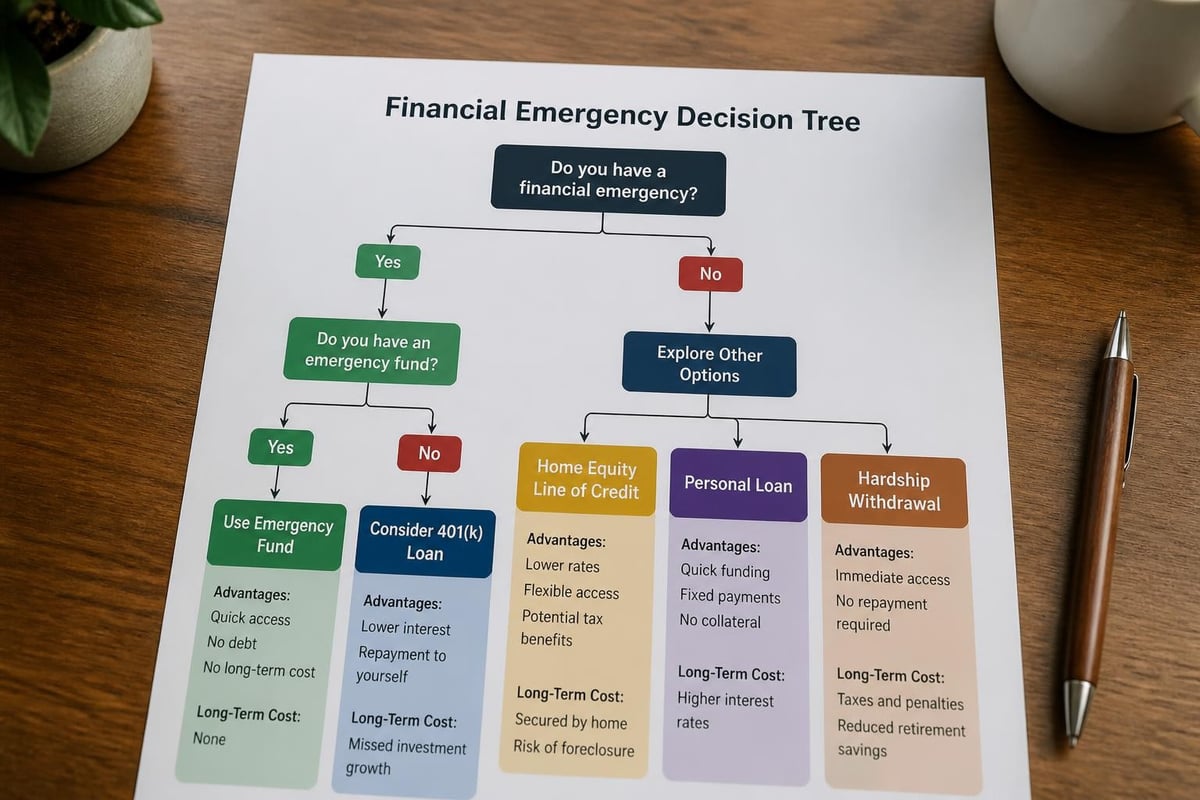
Before proceeding with a voya hardship withdrawal, exploring alternative funding sources may preserve your retirement security while still addressing your financial emergency. Many options exist that carry less severe long-term consequences.
401(k) Loan Options
If your Voya plan permits loans, borrowing from your 401(k) may provide access to funds without the tax consequences and penalties of a hardship withdrawal. Practical advice on avoiding hardship withdrawals emphasizes loans as a preferable alternative when available.
Advantages of 401(k) loans versus hardship withdrawals:
- No taxes or penalties when you repay the loan according to terms
- Interest payments go back into your own account
- No contribution suspension requirements with most plans
- Ability to maintain your full account balance over time
Important considerations for 401(k) loans:
- You must repay the loan typically within five years
- If you leave your employer, the outstanding balance may become due immediately
- Failure to repay converts the loan to a taxable distribution
- You pay interest with after-tax dollars even though the original contribution was pre-tax
The decision between a loan and a hardship withdrawal should account for your employment stability, ability to make regular loan payments, and the specific terms your Voya plan offers.
Emergency Fund and Savings
Building an emergency fund before crisis strikes remains the most effective strategy for avoiding retirement account withdrawals. Financial planning that addresses emergency reserves typically recommends three to six months of essential expenses in readily accessible savings.
If you have any taxable investment accounts, home equity, or other assets, liquidating these resources typically creates less long-term financial damage than withdrawing from tax-advantaged retirement accounts.
Other Borrowing Options
Depending on your credit profile and the nature of your financial need, several borrowing alternatives may prove less costly than a voya hardship withdrawal:
- Home equity lines of credit offer potentially tax-deductible interest and avoid retirement account depletion
- Personal loans from banks or credit unions provide fixed repayment terms without touching retirement savings
- Payment plans with medical providers or educational institutions may eliminate the need for a lump sum
- Short-term assistance programs from nonprofits, government agencies, or employers may provide emergency funds
The Consumer Financial Protection Bureau’s retirement planning resources offer additional guidance on protecting retirement accounts while addressing financial challenges.
Roth IRA Distributions
If you have a Roth IRA in addition to your Voya 401(k), you may withdraw your contributions (but not earnings) at any time without taxes or penalties. This flexibility makes Roth IRAs superior emergency funds compared to traditional retirement accounts, though depleting them still damages long-term retirement readiness.
Working with fiduciary advisors who prioritize your interests can help you evaluate which funding source minimizes total financial impact given your complete situation.
Recent Regulatory Changes Affecting Hardship Withdrawals
The retirement landscape has evolved significantly with recent legislative changes that affect how voya hardship withdrawals function and what alternatives exist.
SECURE 2.0 Act Provisions
Signed into law in late 2022, the SECURE 2.0 Act introduced several provisions affecting hardship withdrawals and emergency distributions. These changes aim to provide limited penalty-free access to retirement funds during specific hardship situations while encouraging long-term retirement savings.
Key SECURE 2.0 provisions affecting hardship access:
Emergency personal expense distributions allow penalty-free withdrawals up to $1,000 per year for unforeseeable or immediate financial needs. Participants can self-certify the emergency, and plans may allow repayment within three years. However, ordinary income taxes still apply to these distributions.
Domestic abuse survivor distributions permit victims of domestic abuse to take up to $10,000 or 50% of their vested balance (whichever is less) without the 10% early withdrawal penalty. This provision recognizes the financial barriers abuse survivors often face when seeking safety.
Terminal illness distributions allow penalty-free access when a physician certifies the participant is terminally ill. This provision acknowledges that traditional retirement planning becomes less relevant when facing life-limiting diagnoses.
Plan-Specific Variations
Not all Voya-administered plans have adopted every provision permitted under federal law. Your employer's plan document determines which hardship reasons are available, whether loans are permitted, and what documentation standards apply.
According to Vanguard’s research on hardship withdrawal trends, hardship withdrawal rates vary significantly based on plan design features, participant demographics, and economic conditions. Plans that offer robust loan provisions typically experience lower hardship withdrawal rates.
Always verify your specific plan's features through Voya's participant services or your human resources department. The general rules provide a framework, but your plan's specific provisions govern what options you actually have available.
Making an Informed Decision About Your Retirement Security
Deciding whether to proceed with a voya hardship withdrawal requires careful consideration of your current emergency, available alternatives, and long-term retirement goals. This decision carries consequences that extend decades into your future financial security.
Questions to Ask Before Proceeding
- Have you exhausted all other reasonable funding sources including savings, borrowing from family, or personal loans?
- Does your plan offer a loan option that would allow you to repay the funds rather than permanently withdrawing them?
- Can you reduce the amount you withdraw by cutting non-essential expenses or finding additional income sources?
- How will this withdrawal affect your projected retirement age and lifestyle?
- What specific steps will you take to rebuild your retirement savings after this withdrawal?
Investment management professionals can model various scenarios to show how different decisions today affect your retirement trajectory. These projections often reveal that sacrifices in current discretionary spending may prove less painful than working additional years before retirement.
Documentation and Record Keeping
If you proceed with a hardship withdrawal, maintain comprehensive records of:
- All documentation submitted to justify the hardship
- Correspondence with Voya and your plan administrator
- Form 1099-R received in January following the distribution year
- Calculations of taxes and penalties paid
- Any subsequent attempts to replace the withdrawn funds
These records become essential for accurate tax filing and may prove valuable if the IRS questions the legitimacy of your hardship withdrawal during an audit. The IRS guidance on hardship distributions emphasizes proper documentation as a requirement for avoiding additional penalties.
Recovery Planning
Once you have taken a voya hardship withdrawal, developing a concrete plan to minimize the long-term damage becomes critical. Consider these recovery strategies:
Immediate actions:
- Resume 401(k) contributions as soon as your plan permits
- Increase your contribution rate to compensate for lost growth if financially feasible
- Redirect any financial windfalls (tax refunds, bonuses, raises) toward retirement savings
- Review and reduce expenses to free up additional savings capacity
Medium-term strategies:
- Work with tax planning professionals to optimize your tax situation and potentially free up more retirement savings
- Consider Roth conversions during lower-income years to create tax-free growth opportunities
- Evaluate catch-up contribution eligibility as you approach age 50
- Reassess your retirement age target based on your updated account balance trajectory
Long-term considerations:
- Adjust your retirement lifestyle expectations if you cannot fully compensate for the withdrawal
- Explore part-time work in early retirement to supplement reduced savings
- Consider delaying Social Security benefits to increase lifetime payouts
- Review estate planning to ensure beneficiaries understand the impact on your legacy
The path forward depends on your age, income trajectory, and overall financial situation. Professional guidance can help you optimize your recovery strategy while balancing current needs with future security.
Understanding Your Rights as a Plan Participant
As a participant in a Voya-administered retirement plan, you have specific rights regarding access to information, fair treatment in the hardship approval process, and appeal procedures if your request is denied.
Plan Documentation Rights
Your employer must provide you with a Summary Plan Description (SPD) that outlines your plan's hardship withdrawal provisions in plain language. This document should specify:
- Which hardship reasons your plan recognizes
- What documentation the plan requires for each hardship category
- Whether your plan offers loans as an alternative
- Contribution suspension periods following hardship withdrawals
- The appeals process if your hardship request is denied
You have the right to request and receive this documentation free of charge. If you identify discrepancies between what Voya representatives tell you and what the plan document states, the plan document governs.
Appeal Procedures
If Voya denies your hardship withdrawal request, you have the right to understand the specific reasons and to appeal the decision. The appeals process typically requires:
- Written notification of denial stating the specific reasons your request did not meet plan criteria
- Opportunity to submit additional documentation addressing the deficiencies identified
- Reconsideration by the plan administrator with a fresh review of your circumstances
- Final determination within a reasonable timeframe as specified in your plan document
The FINRA guidance on retirement account withdrawals emphasizes understanding your rights before taking distributions that could significantly impact your financial future.
Fiduciary Responsibilities
Your plan administrator and Voya as the recordkeeper have fiduciary duties to administer your plan according to its governing documents and to treat all participants fairly. However, these fiduciary duties do not include providing personalized financial advice about whether a hardship withdrawal makes sense for your situation.
For truly fiduciary guidance tailored to your unique circumstances, working with independent fiduciary advisors who are legally obligated to prioritize your best interests provides an additional layer of protection and insight.
Understanding the implications of a voya hardship withdrawal empowers you to make decisions that balance immediate financial needs with long-term retirement security. While hardship distributions provide a critical safety valve during genuine emergencies, they carry substantial costs that extend far beyond the taxes and penalties you pay today. As a fiduciary, virtual-first advisory firm, Brookwood Investment Group offers personalized guidance to help you navigate financial challenges while protecting your retirement goals. Whether you are facing a potential hardship situation or seeking to strengthen your overall financial plan, our team provides the expertise and support you need to make confident, informed decisions aligned with your unique circumstances.
