
Receiving an inherited traditional IRA represents both a financial opportunity and a responsibility that requires careful navigation. Unlike other inherited assets, these retirement accounts come with specific tax obligations and distribution requirements that vary based on your relationship to the original owner and when they passed away. Understanding the rules governing an inherited traditional IRA helps beneficiaries avoid costly penalties while optimizing their long-term financial position. The landscape changed significantly with the SECURE Act of 2019, creating new timelines and strategies that differ from previous inherited IRA regulations.
Understanding What Makes an Inherited Traditional IRA Different
An inherited traditional IRA, also called a beneficiary IRA, is a retirement account passed to a beneficiary after the original owner's death. These accounts maintain their tax-deferred status but operate under distribution rules that differ substantially from accounts you establish yourself.
The fundamental distinction lies in how withdrawals are taxed and when they must occur. While the original owner contributed pre-tax dollars and faced Required Minimum Distributions (RMDs) starting at age 73, beneficiaries inherit both the tax liability and specific withdrawal obligations based on current regulations.
Key Characteristics of Inherited Traditional IRAs
Beneficiaries cannot make additional contributions to an inherited traditional IRA, and they cannot roll the funds into their own retirement accounts in most cases. The account exists solely to distribute the inherited assets according to IRS rules.
Critical features include:
- All distributions are taxed as ordinary income at your current tax rate
- The account must be retitled to reflect the beneficiary status
- Withdrawal penalties for early distribution (before age 59½) do not apply
- Required distribution timelines depend on beneficiary classification
- Assets can continue growing tax-deferred until withdrawn
The tax implications of inherited retirement accounts require careful consideration, as distributions could push beneficiaries into higher tax brackets if not properly managed.
Beneficiary Classifications and Distribution Requirements
The SECURE Act fundamentally changed how most beneficiaries handle inherited traditional IRAs. Your relationship to the deceased and certain personal characteristics determine which distribution rules apply to your situation.
Eligible Designated Beneficiaries
Certain beneficiaries maintain more flexible distribution options and can potentially stretch distributions across their lifetime. This category includes:
- Surviving spouses who have unique options including treating the IRA as their own
- Minor children of the account owner (until they reach majority age)
- Disabled individuals as defined by IRS guidelines
- Chronically ill individuals meeting specific criteria
- Beneficiaries not more than 10 years younger than the deceased owner
These eligible designated beneficiaries can generally use life expectancy distribution methods, allowing them to spread withdrawals over a longer period.

Non-Eligible Designated Beneficiaries
Most adult children and other beneficiaries who don't meet the eligible criteria face the 10-year rule. This requirement mandates that the entire inherited traditional IRA balance must be withdrawn by December 31 of the tenth year following the owner's death.
The 10-year distribution requirement doesn't specify annual withdrawals, offering flexibility in timing distributions within the decade-long window. However, recent IRS guidance has created complexity around whether annual RMDs are required during those ten years if the original owner had already begun taking distributions.
| Beneficiary Type | Distribution Method | Timeline |
|---|---|---|
| Surviving Spouse | Multiple options available | Flexible, can treat as own |
| Eligible Designated | Life expectancy stretch | Based on beneficiary age |
| Non-Eligible Designated | 10-year rule | Complete by year 10 |
| Non-Designated (Estate) | 5-year rule | Complete by year 5 |
Spousal Beneficiary Options and Strategies
Surviving spouses receive the most flexible treatment when inheriting a traditional IRA. They can choose from several options that other beneficiaries cannot access, making strategic planning particularly important.
A spouse can elect to treat the inherited traditional IRA as their own, which essentially erases the "inherited" designation. This option allows the surviving spouse to delay RMDs until they reach age 73 and name their own beneficiaries.
Spouse-specific options include:
- Treat as own IRA: Transfer funds to an existing IRA or rollover to a new account
- Remain as beneficiary: Keep the inherited status and take distributions based on their own life expectancy
- Disclaim the inheritance: Pass the assets to contingent beneficiaries for estate planning purposes
The choice between these options depends on the surviving spouse's age, financial needs, and long-term goals. Younger spouses might benefit from maintaining beneficiary status to access funds before age 59½ without penalties, while older spouses often prefer treating the account as their own to delay distributions.
Working with fiduciary advisors who specialize in estate planning helps spouses evaluate which approach aligns with their comprehensive financial strategy.
Tax Planning Strategies for Inherited Traditional IRAs
Managing the tax burden from an inherited traditional IRA requires strategic planning, particularly under the 10-year rule where beneficiaries have flexibility in timing withdrawals. Every dollar withdrawn from an inherited traditional IRA adds to your taxable income for that year.
Strategic Withdrawal Timing
Beneficiaries subject to the 10-year rule can optimize their tax situation by considering their income fluctuations over the decade. Taking larger distributions in lower-income years and smaller distributions during high-earning years can minimize the overall tax impact.
For example, if you anticipate a career transition or sabbatical year with reduced income, accelerating inherited traditional IRA distributions during that period could result in substantially lower taxes than waiting until later years when you might be in a higher bracket.
The tax considerations for inherited retirement accounts extend beyond federal obligations, as state income taxes also apply to these distributions in most states.
Roth Conversion Opportunities
Some beneficiaries convert portions of their inherited traditional IRA to an inherited Roth IRA, paying taxes now to secure tax-free growth and distributions later. This strategy works best when:
- You're in a relatively low tax bracket currently
- You expect to be in a higher bracket in future years
- You have funds outside the IRA to pay the conversion taxes
- You want to maximize the account value for your own beneficiaries

Charitable Distribution Planning
Beneficiaries aged 70½ or older can make Qualified Charitable Distributions (QCDs) directly from an inherited traditional IRA to eligible charities. These distributions count toward required withdrawals but don't increase your taxable income, offering a tax-efficient way to support causes you value.
| Strategy | Best For | Tax Benefit |
|---|---|---|
| Spread distributions evenly | Consistent income years | Stable tax rate |
| Front-load withdrawals | Early low-income years | Lower bracket initially |
| Back-load withdrawals | Expecting future lower income | Defer taxes |
| Qualified charitable distributions | Charitably inclined 70½+ | Exclude from income |
Common Mistakes to Avoid with Inherited Traditional IRAs
Beneficiaries frequently encounter pitfalls that result in unnecessary taxes, penalties, or missed opportunities when managing an inherited traditional IRA. Awareness of these common errors helps you navigate the process more effectively.
Missing distribution deadlines represents the most costly mistake. Failing to withdraw the required amount by the applicable deadline triggers a 25% excise tax on the amount that should have been distributed (reduced to 10% if corrected within two years). Under the 10-year rule, missing the final year deadline means potentially owing penalties on the entire remaining balance.
Another significant error involves improper account titling. The inherited traditional IRA must be titled correctly to reflect both the original owner's name and your status as beneficiary. Incorrect titling can disqualify the account from inherited IRA treatment, forcing immediate taxation of the entire balance.
Many beneficiaries also overlook state-specific rules that may impose additional requirements or taxes beyond federal regulations. Some states have different timelines or exemptions that affect how you should approach distributions.
Understanding inherited IRA distribution rules and options helps prevent these missteps while optimizing your approach to managing the account.
Coordination with Estate Planning
Inherited traditional IRAs don't exist in isolation from your broader financial picture. Failing to integrate this asset into your comprehensive estate plan can create inefficiencies and missed opportunities.
Beneficiaries should consider how inherited IRA distributions affect:
- Your overall tax bracket and multi-year tax planning
- Social Security benefit taxation
- Medicare premium surcharges (IRMAA)
- Financial aid eligibility for dependents
- Your own estate planning and legacy goals
The interaction between inherited assets and your existing retirement planning strategy deserves careful analysis to ensure all elements work together cohesively.
Special Situations and Complex Scenarios
Certain inheritance situations introduce additional complexity beyond standard beneficiary classifications. These scenarios require specialized knowledge to navigate properly.
Multiple Beneficiaries
When an inherited traditional IRA has multiple beneficiaries, each person's distribution requirements typically align with the least flexible beneficiary unless the account is split into separate inherited IRAs by December 31 of the year following the owner's death.
Creating separate accounts allows each beneficiary to use their own distribution schedule. A surviving spouse could treat their portion as their own, while adult children follow the 10-year rule for their shares.
Inherited Inherited IRAs
The situation becomes more complex when you inherit an IRA that was already inherited by the person who named you as beneficiary. The rules for inheriting an already inherited IRA depend on the original beneficiary's classification and when both deaths occurred.
Generally, successor beneficiaries must continue the distribution schedule the original beneficiary was following, often requiring completion of the remaining timeline rather than starting a new period.
Trust as Beneficiary
When a trust is named as the inherited traditional IRA beneficiary, the distribution requirements depend on whether the trust qualifies as a "see-through" trust under IRS rules. Qualifying trusts allow the IRS to look through to the underlying trust beneficiaries to determine distribution schedules.
Non-qualifying trusts typically face the least favorable distribution rules, often requiring complete distribution within five years. This makes the trust designation decision critical during the original owner's lifetime.
Required Minimum Distribution Calculations
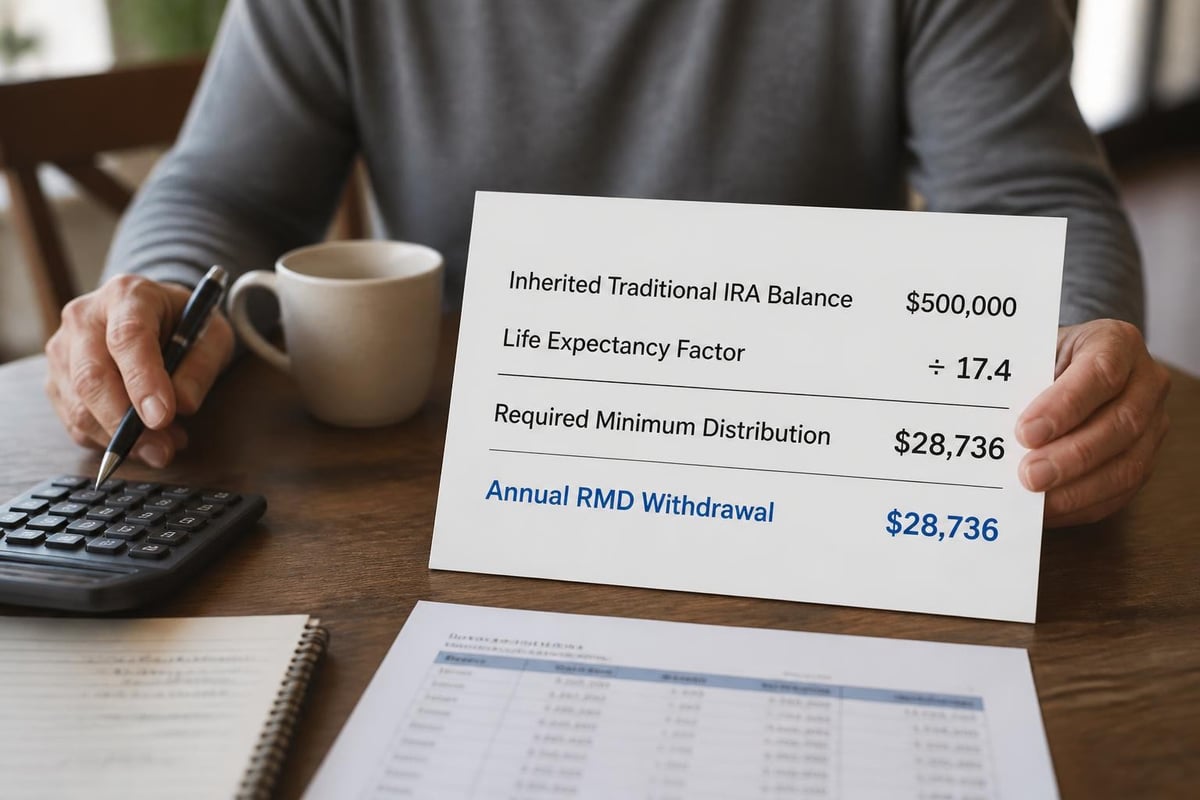
For beneficiaries who must take annual RMDs from their inherited traditional IRA, understanding the calculation methodology prevents errors and ensures compliance with IRS requirements.
Eligible designated beneficiaries using the life expectancy method calculate their RMD by dividing the previous year-end account balance by their life expectancy factor from IRS tables. This factor decreases by one each subsequent year.
The RMD calculation process:
- Determine the account balance as of December 31 of the previous year
- Identify your applicable life expectancy factor from IRS Publication 590-B
- Divide the account balance by the life expectancy factor
- Withdraw at least this amount by December 31 of the current year
The withdrawal rules for inherited IRAs have evolved with recent regulatory changes, making it important to verify current requirements annually.
Recent Regulatory Changes
The IRS issued proposed regulations in 2022 that created confusion about annual RMD requirements during the 10-year period for non-eligible designated beneficiaries. If the original owner had already begun taking RMDs before death, current guidance suggests annual distributions may be required throughout the 10-year period, not just by the end of year ten.
The IRS has provided penalty relief while finalizing these rules, but beneficiaries should stay informed about regulatory developments that might affect their distribution obligations.
Investment Management Within Inherited Traditional IRAs
While distribution rules receive the most attention, how you manage investments inside an inherited traditional IRA significantly impacts the value you ultimately receive. The account can remain invested and continue growing tax-deferred until withdrawn.
Your investment strategy should align with your distribution timeline. Beneficiaries facing the 10-year rule might adopt a more conservative approach as the final deadline approaches, gradually shifting assets to preserve capital as large distributions near.
Investment considerations include:
- Time horizon: Match investment risk to your distribution schedule
- Liquidity needs: Ensure sufficient liquid assets to meet required distributions
- Tax efficiency: Since all distributions are taxed as ordinary income, focus on total return rather than tax-advantaged investment types
- Beneficiary goals: Align the portfolio with your broader financial objectives
Working with comprehensive investment management services ensures your inherited traditional IRA investments support your overall financial plan while meeting distribution requirements.
Rebalancing and Asset Allocation
As you take distributions from an inherited traditional IRA, maintaining your target asset allocation becomes more complex. Some beneficiaries strategically withdraw from overweighted positions to rebalance the portfolio while satisfying distribution requirements.
This approach serves dual purposes: meeting regulatory obligations while optimizing portfolio positioning. However, this requires careful monitoring and potentially more frequent adjustments than standard retirement accounts.
Coordination with Other Retirement Assets
Most beneficiaries inherit traditional IRAs while managing their own retirement accounts and other financial assets. Coordinating these elements creates opportunities for enhanced tax efficiency and strategic planning.
Consider the sequence of withdrawals across all your retirement accounts. You might prioritize inherited traditional IRA distributions to avoid the 10-year deadline while delaying withdrawals from your own accounts to maximize their growth period.
Some beneficiaries use inherited traditional IRA distributions to fund Roth conversions in their own accounts or to make maximum contributions to their workplace retirement plans, effectively transforming the inherited tax-deferred assets into different vehicles aligned with their long-term strategy.
The comprehensive approach to retirement and tax planning considers how inherited assets integrate with your existing financial ecosystem to optimize outcomes across all accounts.
Documentation and Record-Keeping Requirements
Proper documentation becomes critical when managing an inherited traditional IRA, both for ensuring compliance and for supporting your tax filings. The IRS requires specific information, and maintaining thorough records protects you in case of questions or audits.
Essential documents to retain include:
- Death certificate of the original owner
- Account statements showing the inheritance and all subsequent transactions
- Distribution records and tax forms (1099-R) for each year
- Beneficiary designation forms
- Documentation of account retitling
- Records of any conversions or transfers
- Correspondence with financial institutions regarding the account
Financial institutions issue Form 1099-R annually, reporting distributions from the inherited traditional IRA. This form indicates the distribution amount and whether it came from an inherited account, which affects how it's reported on your tax return.
You should also document your RMD calculations and the basis for your distribution timing decisions, particularly if you're subject to complex rules or made strategic choices about withdrawal schedules.
When Professional Guidance Becomes Essential
While some inherited traditional IRA situations are straightforward, many scenarios benefit from professional financial and tax advice. The interaction between tax regulations, estate planning, and long-term financial strategy often creates complexity beyond what most individuals can navigate alone.
Consider seeking professional guidance when:
- The inherited traditional IRA represents a significant portion of your overall wealth
- You're uncertain about your beneficiary classification or distribution requirements
- Multiple beneficiaries are involved requiring account splits
- You're considering Roth conversions or other tax strategies
- The inheritance affects other financial goals like retirement or education funding
- You've inherited an already inherited IRA with unclear timelines
The potential cost of mistakes-whether through excessive taxes, penalties, or missed opportunities-typically far exceeds the investment in proper planning and advice. Understanding the specific beneficiary rules and taxation implications helps you recognize when expert input would be beneficial.
Professional advisors can model different distribution scenarios, project tax impacts over multiple years, and integrate the inherited traditional IRA into your comprehensive financial plan. This holistic approach ensures decisions about the inherited account support your broader financial objectives rather than creating conflicts or inefficiencies.
Managing an inherited traditional IRA requires understanding complex rules, strategic tax planning, and coordination with your broader financial picture to maximize the value while meeting regulatory requirements. Whether you're navigating the 10-year rule, calculating required distributions, or determining the optimal withdrawal strategy for your situation, professional guidance helps you avoid costly mistakes and identify opportunities you might otherwise miss. Brookwood Investment Group provides personalized financial guidance tailored to your unique circumstances, helping you integrate inherited assets into a comprehensive strategy that supports your long-term goals. Schedule a consultation to discuss how we can help you navigate your inherited traditional IRA with confidence.
