
Facing a financial emergency can create significant stress, especially when traditional savings have been exhausted. For many Americans with 401(k) accounts managed through Fidelity, understanding hardship withdrawal options becomes crucial during challenging times. A hardship withdrawal fidelity process allows participants to access retirement funds early under specific circumstances, though this decision carries important financial implications that require careful consideration. This comprehensive guide examines the requirements, procedures, tax consequences, and alternatives that individuals should evaluate before tapping into their retirement savings.
Understanding Hardship Withdrawal Fidelity Requirements
The Internal Revenue Service establishes strict criteria that govern when participants can access their 401(k) funds through hardship withdrawals. These regulations apply regardless of the plan administrator, though specific plan rules may vary between employers.
Qualifying Events for Hardship Withdrawals
The IRS defines specific situations that qualify as immediate and heavy financial needs. These circumstances include:
- Medical expenses for yourself, spouse, dependents, or primary beneficiaries
- Costs directly related to purchasing a primary residence (excluding mortgage payments)
- Tuition and educational fees for the next 12 months of post-secondary education
- Payments needed to prevent eviction from your primary residence or foreclosure on your mortgage
- Funeral and burial expenses for family members
- Certain expenses to repair damage to your principal residence that would qualify for casualty deduction
Under current 2026 regulations, participants must demonstrate that the financial need cannot be satisfied through other reasonably available resources. This includes checking accounts, insurance reimbursements, or borrowing from commercial sources on reasonable terms.

Documentation Requirements
When pursuing a hardship withdrawal fidelity process, participants must provide substantial evidence of their financial hardship. The documentation typically includes:
Medical expenses: Bills, statements from healthcare providers, and insurance explanation of benefits showing the amount owed.
Home purchase: Purchase agreement, closing documents, and proof that other financing options have been explored.
Education costs: Tuition statements from accredited institutions showing amounts due for the upcoming academic period.
Eviction or foreclosure: Legal notices, court documents, or official communications from landlords or mortgage servicers.
The hardship withdrawal process through Fidelity requires thorough documentation to ensure compliance with both IRS regulations and employer plan rules. Processing times can vary based on documentation completeness and plan-specific requirements.
Financial Implications of Early 401(k) Access
Withdrawing funds from a 401(k) before retirement age creates multiple financial consequences that extend beyond the immediate cash received. Understanding these impacts helps individuals make informed decisions about their financial futures.
Tax Consequences and Penalties
| Tax Impact | Rate/Amount | Notes |
|---|---|---|
| Federal Income Tax | Your marginal tax rate | Withdrawal added to ordinary income |
| State Income Tax | Varies by state | Some states exempt retirement withdrawals |
| Early Withdrawal Penalty | 10% | Applies if under age 59½ |
| Mandatory Withholding | 20% federal | May result in refund or additional tax owed |
The hardship withdrawal fidelity taxation structure means that accessing $10,000 might result in receiving only $7,000 after withholding, with potential additional taxes owed when filing your annual return. These tax implications can significantly reduce the amount available to address the underlying financial emergency.
Long-Term Retirement Impact
Beyond immediate taxes, hardship withdrawals create lasting effects on retirement readiness. The withdrawn amount loses the opportunity for compound growth over potentially decades of investment returns.
Consider this scenario: A 35-year-old withdrawing $15,000 from their 401(k) not only pays immediate taxes and penalties but also forfeits the potential growth of those funds over 30 years. Assuming a 7% annual return, that $15,000 could have grown to approximately $114,000 by retirement age.
Additionally, many employers previously suspended employee contributions for six months following a hardship withdrawal, though recent regulatory changes have eliminated this requirement for most plans. However, the combination of reduced account balance and missed contribution periods can create significant gaps in retirement savings.
The Hardship Withdrawal Fidelity Application Process
Navigating the application process requires understanding both Fidelity's administrative procedures and your specific plan's requirements. The timeline and complexity can vary based on individual circumstances.
Step-by-Step Application Procedure
- Review plan documents to confirm hardship withdrawal provisions and specific plan rules
- Gather required documentation proving the immediate and heavy financial need
- Contact Fidelity through their website, phone service, or mobile app to initiate the request
- Complete the hardship withdrawal application with detailed information about the financial need
- Submit supporting documentation through Fidelity's secure upload system
- Wait for review and approval which typically takes 3-7 business days
- Receive funds via direct deposit or check, depending on selected distribution method
The processing timeline for hardship withdrawals depends on documentation completeness and plan administrator responsiveness. Incomplete applications or missing documentation can extend this timeframe significantly.
Withdrawal Amount Limitations
Participants can only withdraw the amount necessary to satisfy the immediate financial need, plus amounts needed to pay taxes and penalties on the distribution. You cannot take excess funds beyond what's required to address the hardship.
The available amount may also be limited by:
- Plan-specific restrictions on which account sources are eligible
- Vested balance requirements limiting access to only vested employer contributions
- Account type limitations where some plans only allow hardship withdrawals from employee deferrals
Working with a fiduciary advisor can help you understand these limitations and explore whether a hardship withdrawal represents the most appropriate solution for your circumstances. Brookwood Investment Group provides personalized guidance for individuals facing complex financial decisions regarding retirement accounts.

Alternatives to Consider Before Withdrawing
Before pursuing a hardship withdrawal fidelity distribution, exploring alternative funding sources can help preserve retirement savings and avoid unnecessary taxes and penalties.
401(k) Loan Options
Many 401(k) plans offer loan provisions that allow participants to borrow from their accounts without tax consequences. Key features include:
- Loan amounts up to 50% of vested balance or $50,000, whichever is less
- Repayment terms typically five years for general purposes, longer for home purchases
- Interest payments that go back into your own account
- No credit check required since you're borrowing your own money
While 401(k) loans avoid immediate taxes, they carry their own risks. Outstanding loan balances may become taxable distributions if you leave your employer before repayment. Additionally, loan payments are made with after-tax dollars that will be taxed again upon retirement withdrawal.
Personal Loans and Credit Options
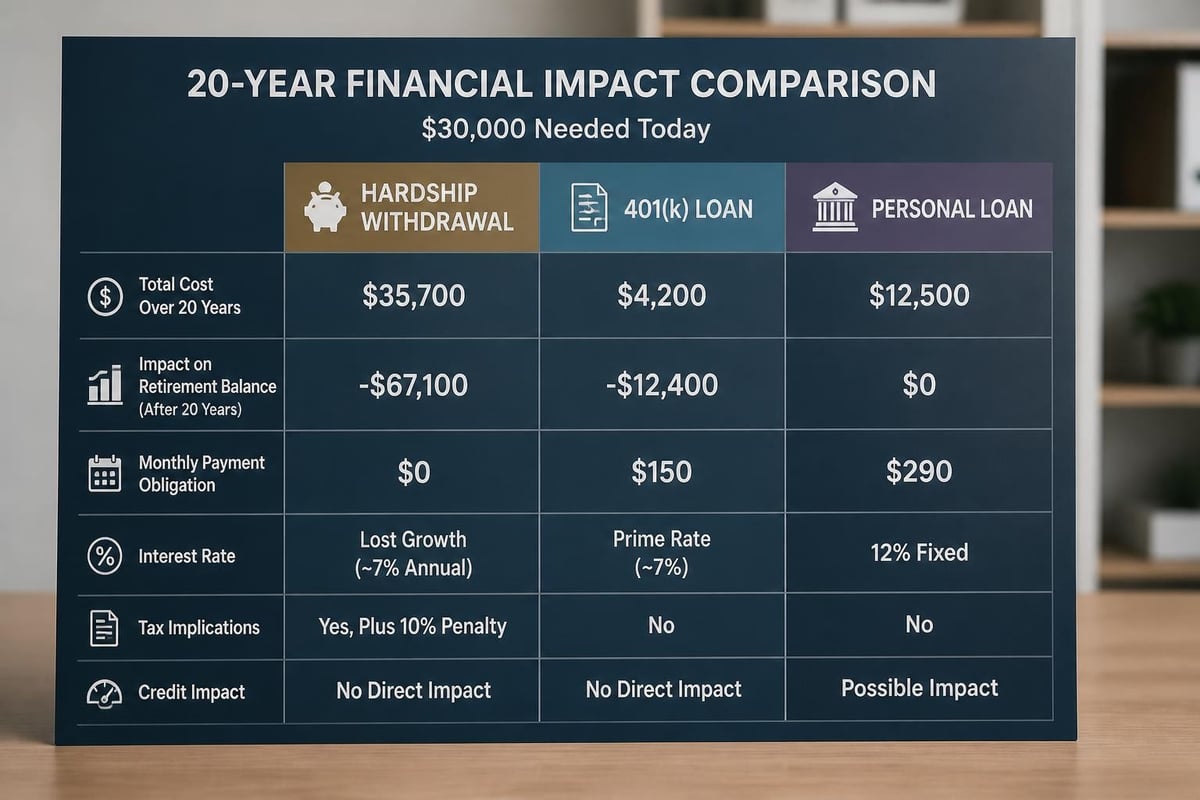
Depending on creditworthiness, personal loans or credit cards might provide necessary funds without jeopardizing retirement savings. Although interest rates may be higher than 401(k) loans, these options preserve retirement account growth potential and avoid early withdrawal penalties.
| Funding Source | Pros | Cons |
|---|---|---|
| 401(k) Loan | No credit check, interest to yourself | Must repay if leaving job, reduces retirement growth |
| Personal Loan | Preserves retirement savings | Requires credit approval, higher interest rates |
| Home Equity | Lower interest rates, tax-deductible interest | Risks home equity, closing costs |
| Hardship Withdrawal | No repayment required | Taxes, penalties, permanent retirement reduction |
Community and Government Assistance Programs
Before tapping retirement funds, research available assistance programs that might address specific needs:
Medical expenses: Hospital financial assistance programs, Medicaid, prescription assistance programs, and medical bill negotiation services.
Housing costs: HUD counseling, emergency rental assistance, mortgage forbearance programs, and local nonprofit housing aid.
Education expenses: Federal student aid, grants, scholarships, and work-study programs that don't require retirement fund withdrawals.
The potential risks of early 401(k) withdrawals often outweigh the immediate benefits when alternative solutions exist. Consulting with a financial advisor helps identify options you might not have considered.
Special Considerations for Fidelity Account Holders
Fidelity manages millions of 401(k) accounts with varying plan features and provisions. Understanding platform-specific processes and resources helps streamline the hardship withdrawal experience if this option becomes necessary.
Fidelity's Digital Tools and Resources
Fidelity provides comprehensive online resources for account holders considering hardship withdrawals:
- Online calculators that estimate tax implications and penalties
- Educational materials explaining 401(k) hardship withdrawal rules
- Secure messaging with retirement specialists
- Mobile app access for document submission and application tracking
These tools help participants understand the full financial impact before initiating a withdrawal request. However, online resources should complement, not replace, personalized financial advice from qualified professionals.
Plan-Specific Variations
While IRS regulations establish baseline requirements, individual employer plans administered by Fidelity may include additional restrictions or provisions. These variations might include:
Contribution source limitations: Some plans only allow hardship withdrawals from employee deferrals, excluding employer matching contributions or profit-sharing amounts.
Approval hierarchies: Certain employers require additional internal approval beyond Fidelity's administrative review.
Suspension periods: Though no longer required by law, some plans may still impose temporary contribution suspensions following hardship withdrawals.
Documentation standards: Employers may require more extensive documentation than IRS minimum standards.
Reviewing your Summary Plan Description provides specific details about your plan's hardship withdrawal provisions. This document, accessible through your Fidelity account, outlines the exact rules governing your particular 401(k) plan.
Making an Informed Decision About Hardship Withdrawals
Evaluating whether to pursue a hardship withdrawal fidelity distribution requires comprehensive analysis of your complete financial situation, not just the immediate crisis at hand.
Questions to Ask Before Withdrawing
- Have I exhausted all other reasonably available resources, including emergency savings, insurance coverage, and family assistance?
- What are the total costs including taxes, penalties, and lost investment growth over time?
- Could a 401(k) loan satisfy the need while preserving more retirement savings?
- Am I within 5-10 years of retirement, where this withdrawal could significantly impact my retirement readiness?
- Have I consulted with a fiduciary financial advisor about my specific situation?
These questions help frame the decision within your broader financial picture. The alternative options worth considering may provide solutions that better protect your long-term financial health.
Working with Financial Professionals
Navigating hardship withdrawal fidelity requirements and evaluating alternatives benefits significantly from professional guidance. A fiduciary advisor can:
Analyze your complete financial situation including assets, debts, income, and expenses to identify all available options.
Calculate the true cost of hardship withdrawals including immediate taxes, long-term opportunity costs, and retirement readiness impact.
Explore alternative strategies that might address the financial need while minimizing retirement account disruption.
Develop recovery plans for rebuilding retirement savings after a financial emergency, whether you withdraw funds or pursue other solutions.
Professional advisors familiar with retirement planning strategies can provide objective analysis during stressful financial situations when emotional decision-making might lead to suboptimal choices.
Creating Financial Resilience
Experiencing a financial hardship that prompts consideration of retirement fund withdrawals often highlights the need for improved financial resilience. Whether or not you ultimately pursue a hardship withdrawal fidelity distribution, use this experience to strengthen your financial foundation:
- Build an emergency fund covering 3-6 months of essential expenses in readily accessible accounts
- Review insurance coverage ensuring adequate protection against medical, disability, and property risks
- Develop a debt reduction strategy that decreases reliance on credit during emergencies
- Increase financial literacy about available resources and assistance programs before crises occur
These steps create buffers that reduce the likelihood of needing hardship withdrawals in the future. Comprehensive financial planning services help individuals build resilience while pursuing retirement goals.
Regulatory Updates and Future Considerations
The regulatory environment governing retirement account access continues to evolve. Staying informed about changes helps participants make decisions based on current rules rather than outdated information.
Recent Regulatory Changes
The SECURE 2.0 Act, implemented in phases beginning in 2023, introduced several provisions affecting hardship withdrawals:
- Elimination of contribution suspension requirements for most plans
- Expanded definition of qualified expenses including certain disaster-related costs
- Enhanced self-certification options reducing documentation burdens in specific circumstances
- Emergency savings accounts linked to retirement plans for easier access to small amounts
These changes generally make accessing funds easier while still protecting retirement savings. However, understanding current hardship distribution requirements remains essential for compliance and optimal decision-making.
State-Specific Considerations
Beyond federal regulations, state laws may impact the hardship withdrawal experience:
State income taxes: Nine states have no income tax, potentially reducing the total tax burden on withdrawals. Other states may offer exemptions or reduced rates for retirement distributions.
Creditor protections: Some states provide stronger protection for retirement accounts against creditors, which might influence whether withdrawing funds exposes them to collection actions.
Community property laws: In community property states, spousal consent might be required for hardship withdrawals depending on plan provisions.
Working with advisors familiar with your state's specific regulations ensures compliance and optimal tax treatment. Virtual advisory firms like those offering personalized financial guidance can provide state-specific expertise regardless of your location.
Planning for Future Financial Emergencies
Whether you proceed with a hardship withdrawal or find alternative solutions, creating a proactive plan for future emergencies protects both immediate needs and long-term retirement goals. This forward-looking approach includes:
Regular financial reviews assessing emergency fund adequacy, insurance coverage gaps, and potential vulnerability areas.
Coordination with tax professionals ensuring optimal tax strategies for both regular years and years with extraordinary expenses.
Estate planning updates reflecting current financial circumstances and ensuring appropriate beneficiary designations on all accounts.
Retirement projection adjustments accounting for any withdrawals or contribution changes to maintain retirement readiness.
These ongoing planning activities create financial clarity and confidence, reducing stress when unexpected expenses arise. Whether you're evaluating a hardship withdrawal fidelity distribution or planning to avoid future needs for early retirement account access, professional guidance supports better outcomes.
Understanding hardship withdrawal rules and evaluating all available options protects both your immediate financial needs and long-term retirement security. The decision to access retirement funds early carries significant implications that extend far beyond the immediate crisis, making comprehensive analysis essential. Brookwood Investment Group provides fiduciary guidance tailored to your unique circumstances, helping you navigate financial emergencies while maintaining focus on your long-term goals. Contact Brookwood Investment Group to discuss your specific situation and explore personalized strategies that align with your financial objectives.
