
Accessing funds from your retirement account requires careful planning and a thorough understanding of the rules governing these transactions. Whether you're facing financial hardship, approaching retirement age, or considering an early distribution, the decisions you make regarding 401k money withdrawal can significantly impact your long-term financial security. The tax implications, penalties, and timing considerations make this a complex topic that deserves thoughtful analysis before taking action.
Understanding 401k Withdrawal Basics
The fundamental rules governing 401k money withdrawal are established by the Internal Revenue Service and vary depending on your age, employment status, and the specific circumstances prompting your need to access funds. Traditional 401k accounts receive tax-deferred contributions during your working years, meaning you'll owe income taxes on withdrawals regardless of when you take them.
Age plays a critical role in determining your withdrawal options:
- Before age 59½, withdrawals typically trigger a 10% early withdrawal penalty plus ordinary income taxes
- Between ages 59½ and 72, you can withdraw funds penalty-free but must pay income taxes
- After age 73 (as of 2026), you must begin taking Required Minimum Distributions annually
The IRS provides specific guidance on taking money from your 401k, which outlines various scenarios and their associated tax consequences.
Early Withdrawal Exceptions
Several exceptions allow you to avoid the 10% early withdrawal penalty before reaching age 59½, though you'll still owe ordinary income taxes on the distribution amount. These exceptions include separation from service after age 55, qualified domestic relations orders, and substantially equal periodic payments calculated using IRS-approved methods.
Medical expenses exceeding 7.5% of your adjusted gross income, permanent disability, and certain military reservist distributions also qualify for penalty exemptions. Understanding these nuances can help you minimize the financial impact of early 401k money withdrawal when circumstances necessitate accessing your retirement savings.

Tax Implications of Withdrawals
Every dollar withdrawn from a traditional 401k account gets added to your taxable income for the year, potentially pushing you into a higher tax bracket. This reality makes strategic planning essential when determining the timing and amount of your distributions. Understanding 401k taxes helps you anticipate the true cost of accessing these funds.
| Withdrawal Scenario | Federal Tax Treatment | Additional Penalty |
|---|---|---|
| Age 58, employed | Ordinary income rates | 10% early withdrawal |
| Age 60, retired | Ordinary income rates | None |
| Age 74, retired | Ordinary income rates (RMD) | None |
| Hardship withdrawal | Ordinary income rates | Generally 10% |
State income taxes add another layer of complexity to 401k money withdrawal planning. Some states offer favorable treatment for retirement income, while others tax distributions at their standard income tax rates. California, for example, taxes 401k withdrawals at rates up to 13.3%, while states like Florida and Texas impose no state income tax on these distributions.
Strategic Tax Planning
Spreading withdrawals across multiple tax years can help manage your tax liability by keeping you in lower marginal tax brackets. This approach works particularly well during the years between retirement and when Required Minimum Distributions begin at age 73.
Converting traditional 401k funds to a Roth IRA during low-income years represents another strategy worth considering. While you'll pay taxes on the conversion amount, qualified Roth withdrawals in retirement are tax-free. Working with a fiduciary planning professional helps you evaluate whether this strategy aligns with your overall financial goals.
Hardship Withdrawals and Loans
Financial emergencies sometimes necessitate accessing retirement funds before reaching retirement age. The IRS permits hardship withdrawals for immediate and heavy financial needs, but the criteria are strict and the consequences significant. Hardship withdrawal rules specify qualifying events including medical expenses, home purchase costs, tuition payments, and prevention of foreclosure or eviction.
Qualifying hardship reasons include:
- Unreimbursed medical expenses for you, your spouse, or dependents
- Costs directly related to purchasing your primary residence
- Tuition and educational fees for the next 12 months
- Payments to prevent eviction or foreclosure
- Funeral expenses for family members
- Certain expenses for repair of damage to your principal residence
Before approving a hardship withdrawal, employers must verify you've exhausted other available resources including plan loans, if offered. Unlike loans, hardship withdrawals cannot be repaid to your account, permanently reducing your retirement savings and losing the benefit of future tax-deferred growth on those funds.
401k Loans as an Alternative
Many plans offer loan provisions allowing you to borrow up to 50% of your vested balance or $50,000, whichever is less. These loans require repayment with interest, typically over five years, though the interest goes back into your own account. The primary advantage is avoiding taxes and penalties while maintaining your retirement savings trajectory.
The significant risk with 401k loans emerges if you separate from your employer before full repayment. The outstanding balance becomes a taxable distribution, triggering income taxes and potentially the 10% early withdrawal penalty if you're under age 59½. This scenario has caught many people off guard during unexpected job changes or layoffs.
Required Minimum Distributions
Once you reach age 73, the IRS mandates annual withdrawals from traditional 401k accounts based on life expectancy tables. These Required Minimum Distributions ensure the government eventually collects income taxes on funds that received tax-deferred treatment during accumulation. Failure to withdraw the required amount triggers a substantial penalty equal to 25% of the shortfall amount.

RMD calculation factors:
- December 31 account balance from the previous year
- IRS life expectancy factor based on your age
- Division of balance by life expectancy factor
- Separate calculations for each tax-deferred retirement account
The timing of your first RMD offers slight flexibility. You can delay the initial distribution until April 1 of the year following the year you turn 73, though this means taking two distributions in one tax year and potentially facing a higher tax burden. Subsequent RMDs must occur by December 31 annually.
RMD Planning Strategies
Strategic 401k money withdrawal planning in the years before RMDs begin can reduce future required distributions and their associated tax liability. Gradual withdrawals or Roth conversions during lower-income years create tax diversification and potentially lower lifetime tax obligations.
Some individuals still working past age 73 can delay RMDs from their current employer's 401k plan if they don't own 5% or more of the company. This exception doesn't apply to IRAs or 401k accounts from previous employers, making consolidation strategies worth evaluating with qualified financial professionals offering retirement planning services.
Withdrawal Strategies for Different Life Stages
Your optimal approach to 401k money withdrawal varies significantly depending on your current age, employment status, and overall financial situation. A 45-year-old facing unexpected medical bills faces entirely different considerations than a 65-year-old entering retirement or a 75-year-old managing RMDs.
Pre-Retirement (Under Age 59½)
Accessing 401k funds during your working years should generally represent a last resort after exhausting emergency savings, reducing expenses, and exploring other financing options. The combination of income taxes, early withdrawal penalties, and lost compound growth creates a significant long-term cost that can derail retirement security.
If withdrawal becomes necessary, consider whether you qualify for any penalty exceptions. Separation from service after age 55 allows penalty-free withdrawals from that employer's plan, providing valuable flexibility for those facing early or unexpected job transitions. This option doesn't apply to IRA rollovers, making it important to understand the comprehensive withdrawal rules before moving funds.
Early Retirement (Ages 59½ to 73)
This window offers maximum flexibility for 401k money withdrawal without penalties or mandatory distributions. Strategic withdrawals during these years can manage tax brackets, fund gap years before Social Security begins, or facilitate Roth conversions during lower-income periods.
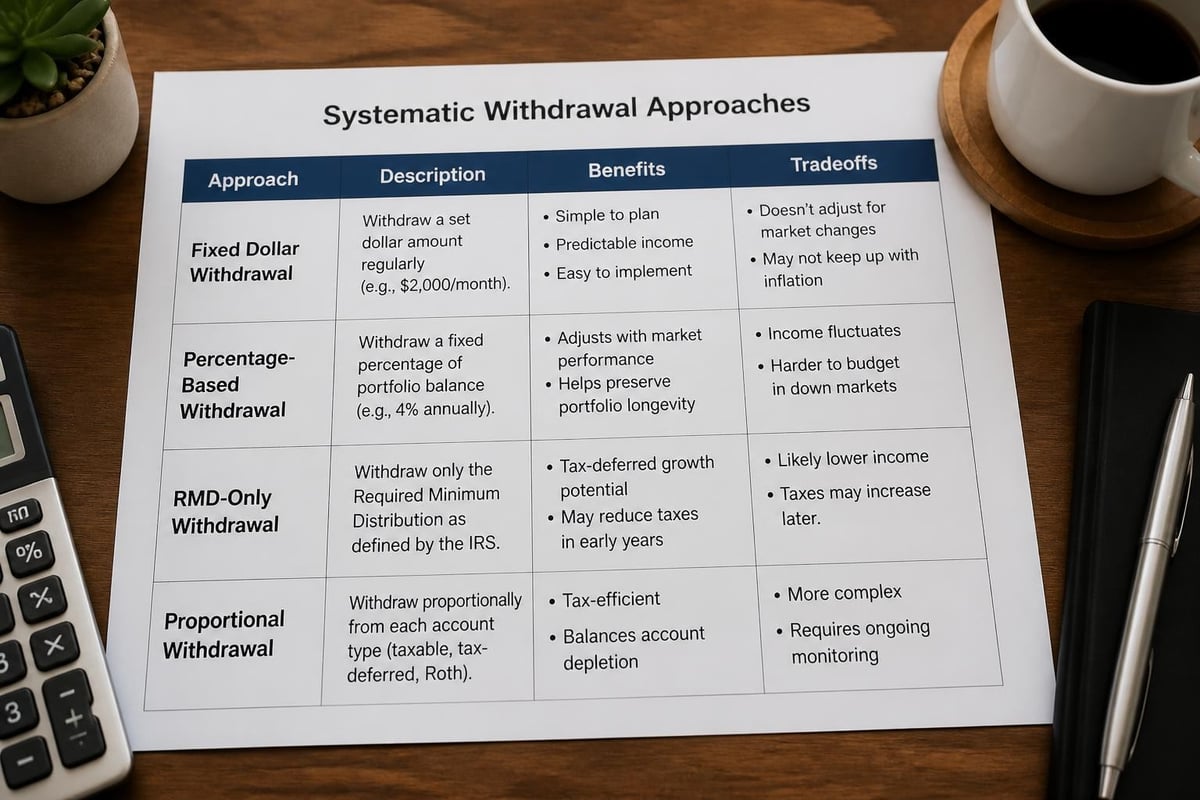
Many retirees benefit from a systematic withdrawal strategy that considers multiple income sources including Social Security timing, pension payments, and taxable investment accounts. The sequence of withdrawals from different account types can significantly impact lifetime tax obligations and legacy wealth.
| Withdrawal Strategy | Primary Benefit | Key Consideration |
|---|---|---|
| Fixed dollar amount | Predictable income | Ignores market performance |
| Percentage of balance | Adjusts to portfolio value | Income varies annually |
| Required minimum only | Maximizes tax deferral | May not meet spending needs |
| Systematic proportional | Maintains asset allocation | Requires ongoing rebalancing |
Post-RMD Age (73 and Beyond)
Managing required distributions while maintaining sufficient portfolio growth requires careful coordination between withdrawal amounts, investment allocation, and tax planning. Some retirees find their RMDs exceed their spending needs, creating opportunities for charitable giving through Qualified Charitable Distributions that satisfy RMD requirements while avoiding income taxes on distributions up to $105,000 annually in 2026.
Estate planning considerations become increasingly important during this stage. Traditional 401k accounts pass to beneficiaries with embedded tax liabilities, while Roth conversions during earlier retirement years can provide tax-free inheritance options for your heirs.
Coordination with Other Retirement Income Sources
Optimizing 401k money withdrawal requires understanding how these distributions interact with Social Security benefits, pension income, and investment portfolio withdrawals. The combined income from these sources determines your marginal tax rate and potentially affects Social Security taxation and Medicare premium surcharges.
Social Security taxation thresholds:
- Single filers with combined income over $25,000 may owe taxes on up to 50% of benefits
- Single filers with combined income over $34,000 may owe taxes on up to 85% of benefits
- Joint filers face similar taxation at $32,000 and $44,000 thresholds respectively
Strategic withdrawal planning can minimize Social Security taxation by managing your combined income calculation, which includes half of Social Security benefits plus other income including 401k distributions. Some retirees benefit from delaying Social Security while drawing down 401k accounts, while others find the opposite approach more advantageous depending on their specific circumstances.
Medicare Premium Considerations
Income-Related Monthly Adjustment Amounts (IRMAA) increase Medicare Part B and Part D premiums for individuals whose modified adjusted gross income exceeds certain thresholds. Large 401k money withdrawal amounts can push you into higher IRMAA brackets, increasing healthcare costs by several thousand dollars annually.
The two-year lookback period for IRMAA calculations means your 2024 income determines your 2026 Medicare premiums. This lag creates both challenges and opportunities for strategic planning around lumpy income events like Roth conversions or property sales. Understanding these complex retirement planning interactions helps optimize your overall financial strategy.
Special Circumstances and Considerations
Recent legislative changes, employment transitions, and personal financial situations create unique scenarios requiring specialized knowledge of 401k money withdrawal rules. Staying informed about evolving regulations helps you make optimal decisions as circumstances change.
The SECURE 2.0 Act Changes
Legislative updates continue reshaping retirement account rules, with the SECURE 2.0 Act implementing numerous changes affecting withdrawals. The increase in RMD age from 72 to 73 in 2023, with further increases to age 75 by 2033, provides additional years of tax-deferred growth for those who don't need immediate distributions.
New provisions also reduced RMD penalties from 50% to 25% of the shortfall amount, with potential reduction to 10% if corrected promptly. Emergency withdrawal provisions now allow penalty-free access to limited amounts for specific situations, though income taxes still apply. These evolving rules make regular consultation with financial professionals increasingly valuable as retirement planning options become more complex.
Job Transitions and Rollovers
Leaving an employer triggers important decisions about your 401k account. Options include leaving funds in the former employer's plan, rolling over to your new employer's plan, rolling over to an IRA, or taking a distribution. Each choice carries distinct implications for investment options, fees, creditor protection, and withdrawal flexibility.
Direct rollovers avoid the mandatory 20% withholding that occurs with indirect rollovers, where you receive a check and must deposit the full amount including the withheld portion into a qualified account within 60 days. Missing this deadline converts the distribution to taxable income plus potential penalties.
Account Protection and Creditor Considerations
Federal law provides 401k accounts with strong protection from creditors in bankruptcy proceedings under ERISA regulations. This protection generally exceeds what IRAs receive, making the decision to roll over funds from a 401k to an IRA worth careful evaluation if asset protection concerns exist in your situation.
State laws vary regarding creditor protection for retirement accounts outside bankruptcy, creating another factor in rollover decisions. Consulting with both financial and legal professionals helps ensure you understand the full implications of moving funds between account types, particularly if you work in professions with elevated liability risks or face potential financial challenges.
Beneficiary Planning
Your 401k beneficiary designations supersede instructions in your will, making regular review of these forms essential as life circumstances change through marriage, divorce, births, and deaths. The SECURE Act eliminated stretch IRA provisions for most non-spouse beneficiaries, generally requiring full distribution within ten years of the account owner's death.
Spouse beneficiaries retain more favorable options including treating the inherited 401k as their own, allowing continued tax deferral and RMDs based on their own life expectancy. These rules significantly impact estate planning strategies and the legacy value of retirement accounts. Professional guidance on estate planning advantages helps optimize these important decisions.
Documentation and Compliance Requirements
Proper documentation of 401k money withdrawal transactions protects you in potential IRS audits and ensures you receive appropriate tax treatment for distributions. Keeping detailed records of withdrawal dates, amounts, and purposes proves particularly important for hardship withdrawals or penalty exception claims.
Essential documentation includes:
- Form 1099-R received annually for all distributions
- Written hardship withdrawal approval from plan administrator
- Medical expense receipts supporting penalty exceptions
- Substantially equal periodic payment calculations and supporting documentation
- Beneficiary designation forms and any updates
The complexity of retirement account regulations means small errors can result in significant penalties. Working with experienced professionals who understand both the technical requirements and strategic implications of different withdrawal approaches helps protect your financial interests while optimizing your retirement income strategy. For personalized guidance tailored to your unique situation, consider scheduling a consultation with qualified financial advisors.
Understanding 401k money withdrawal rules, tax implications, and strategic options helps you make informed decisions that protect your retirement security while meeting current financial needs. Whether you're planning for retirement income, facing unexpected expenses, or managing required distributions, professional guidance can help you navigate these complex decisions while minimizing taxes and penalties. Brookwood Investment Group LLC offers personalized retirement planning services designed to help you develop comprehensive withdrawal strategies aligned with your unique financial goals and circumstances, providing the fiduciary guidance you need to make confident decisions about accessing your retirement savings.
