
Retirees with traditional IRA accounts often face required minimum distributions that increase their taxable income, even when they don't need the funds for living expenses. At the same time, many individuals wish to support charitable organizations but find the standard deduction limits the tax benefits of giving. Charitable giving from IRA accounts through Qualified Charitable Distributions offers a strategy that addresses both challenges, allowing account holders to satisfy distribution requirements while supporting meaningful causes in a tax-efficient manner.
Understanding Qualified Charitable Distributions
A Qualified Charitable Distribution represents a direct transfer of funds from your traditional IRA to a qualified charity. This strategy allows IRA owners aged 70½ or older to donate up to $105,000 annually (as of 2024, indexed for inflation in subsequent years) to eligible organizations without the distribution counting as taxable income.
The mechanics differ fundamentally from traditional charitable giving. Instead of withdrawing funds, paying income tax, and then donating the after-tax amount, charitable giving from IRA accounts bypasses your adjusted gross income entirely. The transfer goes directly from your IRA custodian to the charitable organization, never passing through your hands.
Key Eligibility Requirements
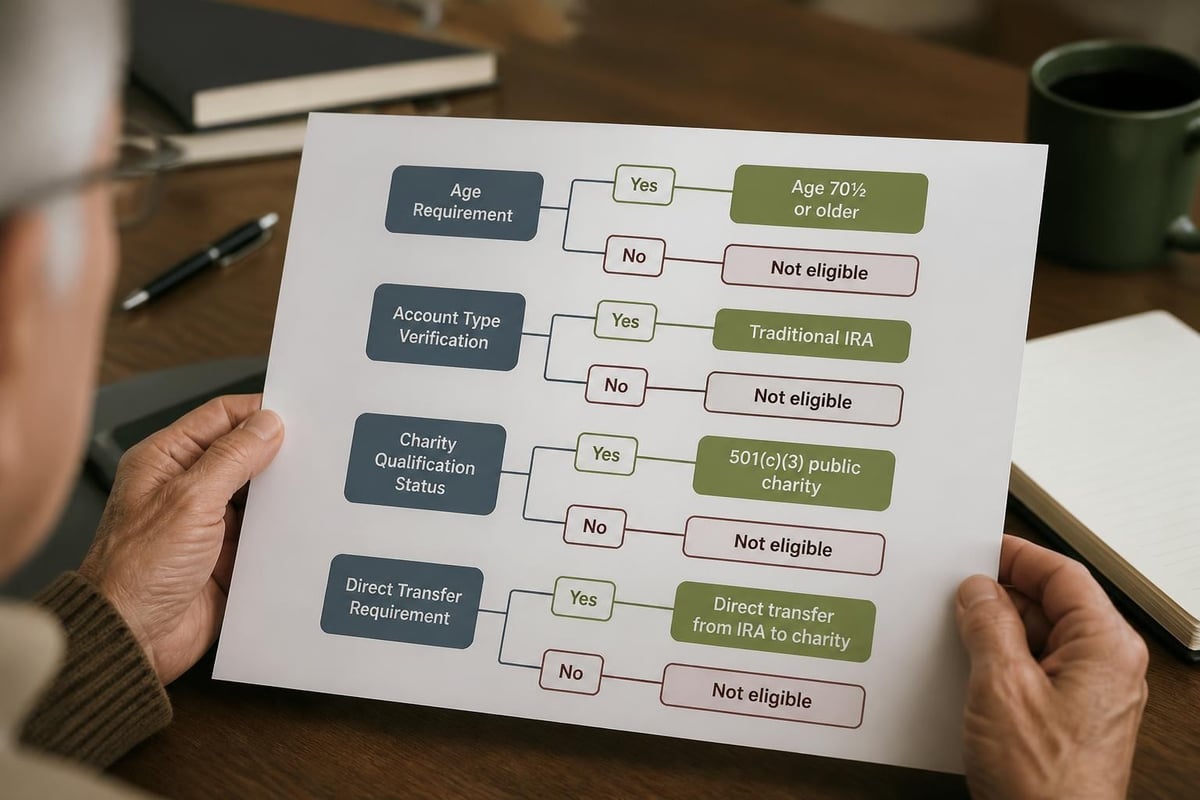
Before implementing this strategy, several requirements must be satisfied:
- Age threshold: You must be at least 70½ years old when the distribution occurs
- Account type: Only traditional IRAs qualify (SEP-IRAs and INACTIVE SIMPLE IRAs also qualify)
- Direct transfer: Funds must go directly from the IRA custodian to the charity
- Qualified organization: The recipient must be a 501(c)(3) organization eligible to receive tax-deductible contributions
Notably, donor-advised funds, private foundations, and supporting organizations do not qualify as eligible recipients for QCDs. Vanguard Charitable provides detailed guidance on how QCDs interact with different charitable vehicles and why certain entities are excluded from eligibility.
Tax Advantages of IRA Charitable Giving
The tax benefits of charitable giving from IRA accounts extend beyond simple deduction strategies. This approach offers multiple layers of tax efficiency that become particularly valuable under current tax law.
When you take a traditional IRA distribution, the amount increases your adjusted gross income. This higher AGI can trigger several negative consequences: increased Medicare Part B and Part D premiums, reduced Social Security benefits due to taxation thresholds, and limitations on various tax credits and deductions that phase out at higher income levels.
QCDs eliminate these cascading tax effects because the distribution never appears as income. According to IRS Publication 590-B, which provides comprehensive guidance on IRA distributions, QCDs are excluded from gross income entirely when properly executed.
Comparison: QCD vs. Standard Deduction
| Strategy | Tax Treatment | AGI Impact | Itemization Required |
|---|---|---|---|
| QCD from IRA | Excluded from income | No increase | No |
| Cash donation (itemized) | Deductible if itemizing | Full distribution increases AGI | Yes |
| Cash donation (standard deduction) | No tax benefit | Full distribution increases AGI | No |
The standard deduction for 2026 ($15,000 for single filers, $30,000 for married filing jointly) means many retirees receive no tax benefit from charitable contributions using traditional methods. Charitable giving from IRA accounts provides tax benefits regardless of whether you itemize deductions.
Satisfying Required Minimum Distributions
For individuals aged 73 and older (the current RMD starting age), required minimum distributions represent mandatory taxable income. Fidelity’s overview of QCDs and RMDs explains how these strategies work together to manage tax liability.
QCDs count toward your RMD for the year, potentially satisfying the entire requirement if your distribution equals or exceeds your RMD amount. This approach is particularly valuable for retirees who:
- Have sufficient income from other sources (pensions, Social Security, taxable accounts)
- Want to preserve their IRA balance for heirs while meeting RMD obligations
- Face Medicare premium increases from additional taxable income
- Support charitable causes regularly
Consider a practical example: Maria, age 75, has a traditional IRA valued at $600,000. Her 2026 RMD is approximately $24,600. She doesn't need this income and typically donates $15,000 annually to various charities. By directing $15,000 as a QCD, she reduces her taxable RMD to $9,600 rather than taking the full $24,600 distribution and donating separately.
Strategic Timing Considerations
The timing of your QCD affects both tax outcomes and recordkeeping:
- Complete transfers before year-end: QCDs must be completed by December 31 to count for that tax year
- Front-load early in the year: Taking QCDs in January or February ensures they're applied to your RMD before taking any other distributions
- Coordinate with RMD calculations: Work with your custodian to ensure proper application to your annual requirement
- Document immediately: Obtain written acknowledgment from the charity promptly
Implementation Process and Documentation
Executing charitable giving from IRA accounts requires coordination between you, your IRA custodian, and the receiving charity. Vanguard’s FAQ on taking a QCD outlines custodian-specific procedures that generally follow this framework.
Step-by-Step QCD Execution
- Contact your IRA custodian and request a QCD distribution form
- Provide the charity's name, tax identification number, and mailing address
- Specify the exact distribution amount (up to annual limits)
- Indicate this is a Qualified Charitable Distribution for tax purposes
- Submit the form with sufficient processing time before year-end
Your custodian will issue payment directly to the charity, typically by check. Some custodians send the check to you for forwarding to the charity, but you must not endorse or deposit it personally for the transfer to qualify.

Required Documentation
Proper recordkeeping protects the tax benefits of your charitable giving from IRA. You need:
- Written acknowledgment from the charity: Must include the organization's name, donation amount, date received, and a statement that no goods or services were provided in exchange
- 1099-R form from your custodian: Will show the distribution amount, though it may not indicate the QCD designation
- Your own records: Keep copies of the distribution request, custodian confirmation, and charity receipt
IRS Publication 526 provides detailed guidance on charitable contribution recordkeeping requirements that complement QCD-specific rules.
Your 1099-R will typically show the distribution in box 1 (Gross distribution), but the taxable amount in box 2a should be reduced by your QCD amount. You report the QCD on Form 1040 by entering the total IRA distributions on line 4a and the taxable amount (after QCD exclusion) on line 4b, with "QCD" written next to the line.
Strategic Planning Considerations
Integrating charitable giving from IRA accounts into your broader financial plan requires careful consideration of multiple factors. This strategy intersects with retirement planning, tax management, estate planning, and philanthropic goals.
Multi-Year Planning Opportunities
Rather than viewing QCDs as annual decisions, consider multi-year charitable giving strategies:
Consolidating irregular giving: If you typically make larger charitable gifts every few years, QCDs allow you to spread these contributions across multiple tax years while maintaining lower AGI annually.
Legacy planning integration: QCDs reduce your IRA balance over time, which may align with estate planning goals if you prefer charitable organizations to receive funds during your lifetime rather than beneficiaries inheriting a tax-deferred account.
Tax bracket management: Coordinating QCDs with other income sources (such as Roth conversions or Social Security timing) can optimize your lifetime tax situation.
Limitations and Restrictions to Consider
While powerful, charitable giving from IRA accounts has specific constraints:
| Limitation | Details | Planning Implications |
|---|---|---|
| Annual cap | $105,000 per person (2024 limit, indexed) | Spouses can each contribute up to the limit from their own IRAs |
| Age minimum | Must be 70½ or older | Consider other giving strategies for younger donors |
| Account types | Traditional IRA, inactive SIMPLE, SEP only | Roth IRAs do not qualify for QCDs |
| Eligible charities | 501(c)(3) organizations only | Excludes donor-advised funds, private foundations, supporting organizations |
| No benefit exchange | Cannot receive goods or services | Athletic tickets, gala dinners, merchandise reduce or eliminate QCD eligibility |
The CFP Board’s guidance on Qualified Charitable Distributions emphasizes how these limitations affect financial planning recommendations and when alternative strategies may be more appropriate.
Coordinating With Other Tax Strategies
Charitable giving from IRA accounts works best when integrated with your complete tax picture. Several common strategies intersect with QCD planning.
Roth Conversion Coordination
Roth conversions increase taxable income in the conversion year, while QCDs reduce it. Strategic coordination might involve:
- Using QCDs to offset conversion income: Convert $50,000 from traditional to Roth IRA while directing $30,000 as QCDs, resulting in net taxable income of only $20,000 from these transactions
- Creating multi-year tax brackets: Spread conversions across years while using QCDs to stay within desired tax brackets
- Managing IRMAA thresholds: Use QCDs to prevent Medicare premium surcharges that trigger at specific income levels
Estate Planning Integration
Your IRA represents a potentially tax-inefficient asset for heirs, who will owe income tax on distributions they receive. Charitable giving from IRA during your lifetime can be part of comprehensive estate planning strategies that:
- Reduce the taxable IRA balance passing to beneficiaries
- Support causes during your lifetime when you can see the impact
- Preserve more favorable assets (like Roth accounts or low-basis stock) for heirs
- Simplify estate administration by reducing account complexity

Common Mistakes and How to Avoid Them
Even experienced investors encounter challenges when implementing charitable giving from IRA accounts. Understanding common errors helps ensure you maximize the tax benefits.
Taking Personal Distribution First
If you withdraw money from your IRA before completing your QCD in a given year, the personal distribution satisfies your RMD first. Subsequent QCDs cannot retroactively count toward your RMD for that year.
Solution: Complete QCDs early in the year, before any other IRA distributions. If you need regular income from your IRA, structure monthly distributions to begin after your annual QCD is processed.
Incorrect Charity Selection
Not all charitable organizations qualify for QCD treatment. Charity Navigator offers donor basics on verifying eligible organizations and understanding giving requirements.
Private foundations, donor-advised funds, and supporting organizations are specifically excluded. Additionally, contributions to charitable gift annuities or charitable remainder trusts don't qualify as QCDs, despite these vehicles being legitimate charitable giving tools.
Solution: Verify the organization's 501(c)(3) status and confirm it's not a disqualified entity type before requesting the distribution. Contact the charity directly or use IRS resources to confirm eligibility.
Inadequate Documentation
Failing to obtain proper written acknowledgment from the charity jeopardizes your tax exclusion. The acknowledgment must include specific information and meet timing requirements.
Solution: Request acknowledgment immediately after the charity receives your QCD. The letter should explicitly state the contribution amount, date received, and that no goods or services were provided. Maintain these records with your tax documents.
Double-Claiming Tax Benefits
You cannot claim a charitable deduction for amounts distributed as QCDs. Attempting to do so violates tax rules and may trigger penalties upon audit.
Solution: Keep clear records distinguishing QCD contributions from other charitable giving. Provide your tax preparer with detailed documentation of all QCDs so they're properly excluded from both income and deduction calculations.
Recent Legislative Changes and Future Considerations
The tax treatment of charitable giving from IRA accounts has evolved significantly in recent years. Tax Foundation analysis examines how legislative changes affect charitable deduction strategies and the context in which QCDs provide value.
The SECURE Act of 2019 raised the RMD age from 70½ to 72, while SECURE 2.0 (2022) further increased it to 73 for individuals turning 72 after 2022. However, the QCD age threshold remained at 70½, creating a window where individuals can use charitable giving from IRA accounts for tax benefits before RMDs begin.
Current Planning Environment
Several factors make QCDs particularly valuable in 2026:
- Elevated standard deduction: Fewer taxpayers itemize deductions, reducing traditional charitable deduction benefits
- State and local tax deduction caps: The $10,000 SALT cap increases the attractiveness of tax strategies that reduce AGI rather than increase deductions
- Medicare premium income thresholds: Retiree tax breaks including QCD strategies help manage modified adjusted gross income to avoid premium surcharges
Potential Future Changes
Tax policy remains subject to legislative modification. While current QCD rules provide significant benefits, stay informed about potential changes to:
- Annual contribution limits (currently indexed for inflation)
- Age thresholds for eligibility
- Eligible charity definitions
- RMD age requirements and calculation methods
Working with experienced financial advisors who monitor legislative developments helps ensure your charitable giving from IRA strategy adapts to changing rules while continuing to meet your philanthropic and tax planning objectives.
Maximizing Impact Through Strategic Giving
Beyond tax benefits, charitable giving from IRA accounts enables thoughtful philanthropy aligned with your values and goals. Strategic approaches can amplify your impact while maintaining tax efficiency.
Concentrated vs. Diversified Giving
You can structure QCDs to support a single organization or split contributions among multiple charities. Each approach offers distinct advantages:
Concentrated giving: Directing larger amounts to one organization may:
- Qualify you for recognition levels that provide greater involvement
- Enable funding of specific programs or initiatives
- Build deeper relationships with the organization's mission
- Simplify recordkeeping and acknowledgment tracking
Diversified giving: Supporting multiple causes allows:
- Broader community impact across various needs
- Flexibility to adjust priorities annually
- Testing relationships with new organizations
- Balancing different family members' charitable interests
Multi-Generational Philanthropy
Charitable giving from IRA can serve as a teaching tool and legacy for younger family members. Consider:
- Involving children or grandchildren in selecting recipient organizations
- Documenting your charitable values and decision-making process
- Creating a family giving plan that continues your priorities
- Using QCDs to establish or support scholarship funds in your family name
These approaches extend the value of your IRA charitable contributions beyond immediate tax benefits to create lasting family traditions and community impact.
Charitable giving from IRA accounts through Qualified Charitable Distributions offers a powerful strategy for reducing taxable income while supporting meaningful causes. Understanding the rules, timing requirements, and integration with broader financial plans helps maximize both tax efficiency and philanthropic impact. The team at Brookwood Investment Group specializes in retirement planning and tax strategies tailored to your unique goals, helping you navigate QCD implementation, coordinate with RMD requirements, and align charitable giving with your comprehensive financial plan. Schedule a consultation to explore how charitable giving from IRA accounts might fit your retirement and legacy objectives.
