
Managing retirement savings effectively requires understanding the mechanisms available for moving funds between accounts. When leaving an employer or consolidating retirement assets, a direct rollover IRA offers a tax-advantaged method to transfer funds from employer-sponsored plans into an individual retirement account. This transfer method helps preserve retirement savings by avoiding immediate taxation and potential penalties. Understanding the rules, benefits, and procedures surrounding direct rollovers can significantly impact your long-term financial outcomes and retirement readiness.
What Is a Direct Rollover IRA
A direct rollover IRA involves transferring funds from an employer-sponsored retirement plan-such as a 401(k), 403(b), or 457(b)-directly into an individual retirement account without the funds passing through your hands. The trustee of your current plan sends the money directly to the trustee of your IRA, which distinguishes this from an indirect rollover where you receive a check made payable to you personally.
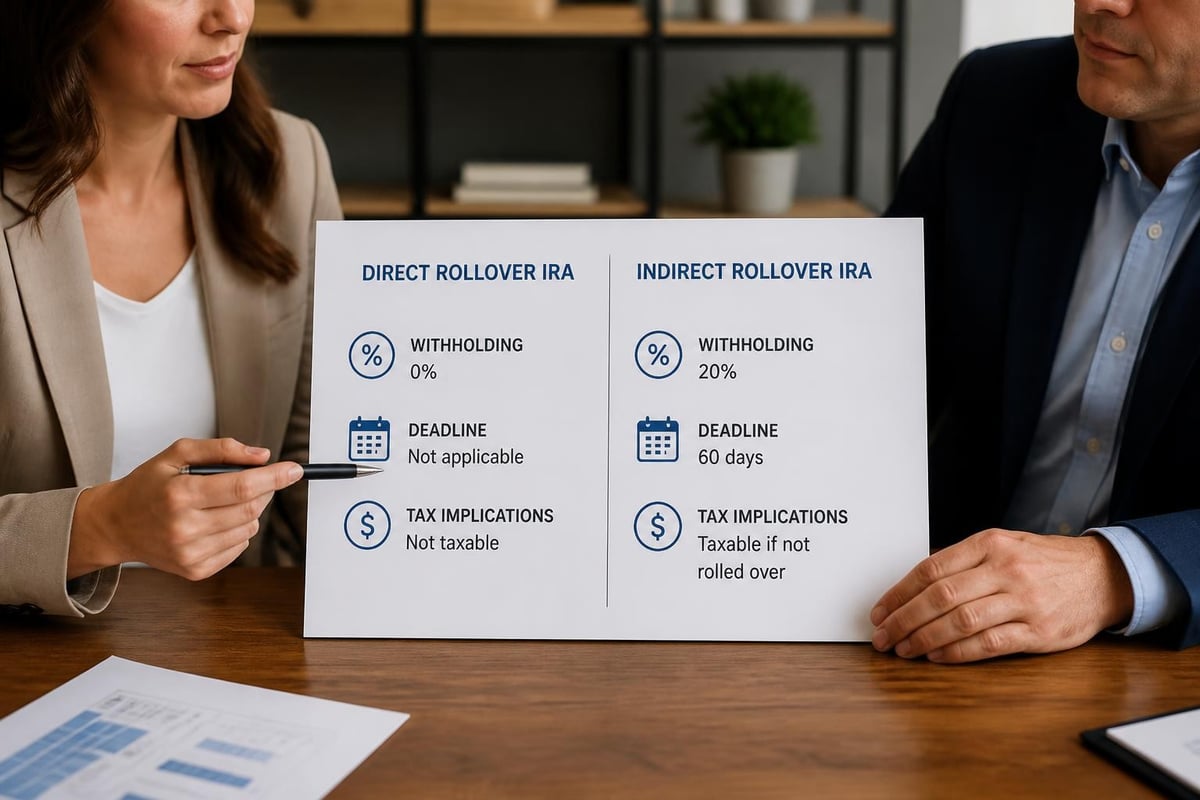
This trustee-to-trustee transfer provides significant advantages over other distribution methods. Since you never take possession of the funds, the IRS does not require mandatory withholding, and you avoid the 60-day rollover deadline that applies to indirect rollovers.
Key Characteristics of Direct Rollovers
Direct rollovers maintain several important features:
- Funds transfer directly between financial institutions
- No mandatory 20% federal tax withholding applies
- No 60-day deadline to complete the transfer
- Preserves tax-deferred status of retirement savings
- Eligible for both pre-tax and Roth account rollovers
The IRS provides detailed guidance on rollovers that outlines eligible distributions and specific rules governing these transfers. Working with professionals who understand these regulations can help navigate the process smoothly.

Benefits of Choosing a Direct Rollover IRA
Selecting a direct rollover IRA over other distribution methods offers numerous advantages that protect your retirement savings and provide greater control over your investments.
Tax Efficiency and Protection
The primary benefit centers on tax treatment. Unlike indirect rollovers or cash distributions, a direct rollover IRA avoids the mandatory 20% federal withholding that applies when you receive retirement funds directly. This means 100% of your retirement savings transfers to the new account, maintaining the full value of your nest egg.
Additionally, you avoid potential early withdrawal penalties. If you're under age 59½ and take a distribution rather than executing a direct rollover, you may face a 10% early withdrawal penalty on top of ordinary income taxes.
Investment Flexibility and Control
Moving funds through a direct rollover IRA typically expands your investment options beyond what employer plans offer. While 401(k) plans often limit participants to a curated selection of mutual funds, IRAs generally provide access to:
- Individual stocks and bonds
- Exchange-traded funds (ETFs)
- Real estate investment trusts (REITs)
- Certificates of deposit
- A broader range of mutual funds
This expanded universe allows for more personalized portfolio construction aligned with your specific risk tolerance, time horizon, and financial objectives. Understanding how retirement planning strategies integrate with investment selection can help optimize outcomes.
Consolidation and Simplified Management
Many individuals accumulate multiple retirement accounts throughout their careers. A direct rollover IRA enables consolidation of these scattered accounts into a single, centrally managed portfolio. This consolidation offers several practical benefits:
| Benefit | Description |
|---|---|
| Simplified tracking | Monitor all retirement assets in one location |
| Reduced fees | Eliminate duplicate account maintenance charges |
| Coordinated strategy | Implement unified asset allocation across holdings |
| Easier beneficiary management | Update designations in fewer locations |
Direct Rollover IRA vs. Indirect Rollover
Understanding the distinction between direct and indirect rollovers helps avoid costly mistakes and ensures compliance with IRS regulations.
Structural Differences
A direct rollover IRA proceeds without your involvement in handling funds. The distribution check is made payable to the receiving IRA custodian for your benefit, and it transfers directly between institutions. This method eliminates opportunities for errors or missed deadlines.
In contrast, an indirect rollover involves the plan administrator issuing a check payable to you personally. The IRS mandates 20% federal withholding from this distribution. You then have 60 days to deposit the funds (including the withheld 20% from other sources) into an IRA to avoid taxation and penalties.
Compliance and Reporting Requirements
Recent IRS guidance on rollovers between retirement plans emphasizes standardized procedures and documentation. Direct rollovers simplify reporting because the transaction appears as a non-taxable trustee-to-trustee transfer rather than a distribution requiring Form 1099-R reconciliation.
The one-rollover-per-year limitation applies to indirect rollovers between IRAs but does not apply to direct rollovers from employer plans. This regulatory distinction provides greater flexibility for those executing multiple transfers within a 12-month period.
Risk Mitigation
Direct rollovers eliminate several risks inherent in indirect transfers:
- Missing the 60-day deadline due to unforeseen circumstances
- Failing to replace the 20% withheld amount, resulting in partial taxation
- Violating the one-rollover-per-year rule inadvertently
- Processing delays that could trigger unnecessary tax consequences
Step-by-Step Direct Rollover IRA Process
Executing a direct rollover IRA involves coordinated steps between you, your current plan administrator, and your IRA custodian. Following a systematic approach helps ensure a smooth transfer.
Initial Planning and Documentation
Before initiating the rollover, gather essential information:
- Contact your current plan administrator to request rollover paperwork
- Verify the exact balance and any employer contributions subject to vesting
- Determine whether your distribution includes after-tax contributions or Roth components
- Open an IRA with your chosen custodian if you don't already have one
- Obtain the receiving IRA account number and institution details
Recent regulatory updates provide standardized rollover forms and procedures that many plan administrators are adopting, which may streamline the documentation process.
Executing the Transfer
The rollover execution follows these sequential steps:
- Complete rollover request forms – Submit paperwork to your current plan administrator specifying direct rollover to your IRA
- Specify account designation – Indicate whether funds should transfer to a traditional IRA, Roth IRA, or both (if applicable)
- Provide receiving institution details – Include the IRA custodian's name, address, and your account number
- Confirm distribution timing – Plan administrators typically process rollovers within 30 days, though timelines vary
- Verify receipt – Monitor your IRA account to confirm the transfer completes successfully
Working with experienced financial advisors during this process can help identify potential complications before they arise and ensure proper execution.
Post-Transfer Verification
Once the direct rollover IRA completes, verify several critical details:
- Confirm the transferred amount matches your expected distribution
- Review your tax documents (Form 1099-R and Form 5498) for accuracy
- Ensure the rollover code on Form 1099-R correctly indicates a direct rollover
- Implement your investment strategy with the newly rolled-over funds
Tax Implications and Reporting Requirements
While direct rollovers avoid immediate taxation, understanding the reporting requirements and long-term tax treatment remains essential for comprehensive retirement planning.
Form 1099-R and Distribution Codes
Your former plan administrator will issue Form 1099-R reporting the distribution. For a direct rollover IRA, this form should show distribution code "G" (direct rollover to an IRA) or "H" (direct rollover to a qualified plan). These codes signal to the IRS that the distribution was not a taxable event.
The IRA custodian receiving the funds will issue Form 5498 showing the rollover contribution. These forms work together to document the non-taxable transfer for IRS purposes.
Pre-Tax and After-Tax Considerations
Different contribution types require specific handling:
| Contribution Type | Rollover Destination | Tax Treatment |
|---|---|---|
| Pre-tax 401(k) | Traditional IRA | Tax-deferred until withdrawal |
| Roth 401(k) | Roth IRA | Tax-free growth and qualified distributions |
| After-tax contributions | Traditional or Roth IRA | Basis tracked separately; no taxation on original contributions |
When employer plans contain both pre-tax and after-tax contributions, you may execute a split rollover-directing pre-tax amounts to a traditional IRA and after-tax amounts to a Roth IRA. This strategy, when executed properly, can optimize long-term tax outcomes.
Required Minimum Distribution Considerations
Understanding how direct rollover IRAs affect required minimum distributions (RMDs) helps avoid penalties. If you're turning 73 in 2026 (or have already reached that age), you must take your RMD from your employer plan before executing a direct rollover IRA transfer. Failure to satisfy the RMD prior to rolling over can result in the distributed RMD being included in the rollover, creating excess contribution issues.
Consulting IRS Publication 590-A provides detailed guidance on contribution rules, distribution requirements, and the interaction between rollovers and RMDs.

Special Situations and Rollover Options
Certain retirement accounts and employment situations present unique considerations when executing a direct rollover IRA.
403(b) and Governmental 457(b) Plans
Tax-sheltered annuity plans used by educational institutions and nonprofit organizations follow similar rollover rules as 401(k) plans but may have additional restrictions based on when contributions were made. IRS Publication 571 addresses specific considerations for these plan types.
Governmental 457(b) plans offer unique advantages because distributions are not subject to the 10% early withdrawal penalty regardless of age. However, rolling these funds into a traditional IRA subjects future distributions to the standard early withdrawal penalty if taken before age 59½.
Inherited Retirement Accounts
Direct rollovers for inherited accounts follow different rules depending on your relationship to the deceased:
- Spouse beneficiaries – May execute a direct rollover into their own IRA, treating it as their own account
- Non-spouse beneficiaries – Must transfer to an inherited IRA and cannot execute a direct rollover into their own IRA
- SECURE Act implications – Most non-spouse beneficiaries must deplete inherited IRAs within 10 years
SIMPLE IRAs and SEP IRAs
SIMPLE IRAs require a two-year waiting period before you can roll funds into a traditional IRA without penalty. Direct rollovers from SIMPLE IRAs to other SIMPLE IRAs can occur at any time, but transfers to traditional or Roth IRAs within the first two years of participation trigger a 25% early withdrawal penalty.
SEP IRAs function as traditional IRAs for rollover purposes, allowing direct rollovers to and from other traditional IRAs or eligible employer plans without special restrictions.
Common Mistakes to Avoid
Even with proper planning, several pitfalls can complicate direct rollover IRA transactions or create unintended tax consequences.
Failing to Coordinate Multiple Account Rollovers
When consolidating several retirement accounts simultaneously, coordination becomes critical. Ensure each rollover is properly designated and tracked separately. Mixing Roth and traditional account funds, or failing to properly document after-tax contributions, can create tax complications that take years to unravel.
Neglecting Investment Timeline and Market Exposure
During the rollover process, funds may be out of the market for several weeks. This gap in investment exposure could impact your portfolio during volatile market periods. Consider these strategies:
- Time rollovers during historically less volatile periods if possible
- Maintain a cash reserve to deploy quickly once funds arrive
- Have your investment allocation strategy prepared in advance
- Consider whether partial rollovers might reduce market timing risk
Overlooking State Tax Implications
While federal tax treatment of direct rollover IRAs is straightforward, state tax rules vary considerably. Some states offer preferential treatment for distributions from in-state employer plans or impose recapture taxes on previous deductions when funds leave the state. Understanding these nuances becomes especially important for individuals relocating in retirement.
Assuming All Employer Plan Assets Are Eligible
Certain employer plan assets may not be eligible for direct rollover. Employer stock held in a 401(k) may qualify for special net unrealized appreciation (NUA) tax treatment if distributed in-kind rather than rolled over. Life insurance contracts held in retirement plans cannot be rolled into IRAs and must be distributed or converted. Evaluating these special assets before initiating a rollover prevents missed opportunities for tax optimization.
Selecting the Right IRA Custodian
The institution you choose to hold your direct rollover IRA significantly impacts your investment options, costs, and service quality.
Evaluating Custodian Options
Consider multiple factors when comparing IRA custodians:
- Investment selection – Breadth of available investment vehicles and access to alternative assets
- Fee structure – Account maintenance fees, transaction costs, and advisory fees
- Technology platform – User interface, mobile access, and reporting capabilities
- Customer service – Availability of support, account representatives, and educational resources
- Research and tools – Portfolio analysis, retirement calculators, and investment research
Major brokerage firms, banks, robo-advisors, and independent custodians each offer different advantages depending on your investment approach and service preferences.
Integration with Comprehensive Financial Planning
Choosing a custodian that integrates with broader financial planning can enhance outcomes. When your IRA custodian coordinates with your financial advisor, you benefit from:
- Coordinated tax planning across all accounts
- Unified reporting showing complete financial picture
- Streamlined beneficiary designation updates
- Integrated estate planning strategies
Understanding how different providers align with your complete financial strategy helps ensure your direct rollover IRA supports rather than complicates your overall retirement plan.
Direct Rollovers and Financial Advisory Support
Navigating the technical requirements and strategic implications of a direct rollover IRA often benefits from professional guidance. Fiduciary advisors can provide objective recommendations aligned with your specific circumstances rather than product sales.
When Professional Guidance Adds Value
Several situations particularly benefit from advisory support:
- Complex account structures – Multiple employer plans, after-tax contributions, or company stock holdings
- Significant account balances – Larger portfolios warrant more sophisticated tax planning and investment strategies
- Approaching retirement – Coordination between rollover timing, retirement date, and distribution planning
- Multi-state considerations – Relocations involving different state tax treatment of retirement assets
- Legacy planning concerns – Integrating rollover decisions with estate planning and beneficiary strategies
The latest IRA rules and rollover options continue evolving with legislative changes, making ongoing professional relationships valuable for maintaining compliance and optimizing strategies.
Operational Transfer Support
Beyond strategic planning, advisors can facilitate the operational aspects of direct rollover IRAs. This includes coordinating with plan administrators, ensuring proper documentation, verifying transfer completion, and implementing investment strategies once funds arrive. Understanding FINRA rules governing account transfers helps ensure compliance with regulatory expectations.
Direct Rollover IRA and Long-Term Retirement Success
Successfully executing a direct rollover IRA represents one component of comprehensive retirement planning. How these rolled-over funds integrate into your broader strategy determines their ultimate impact on your financial security.
Portfolio Construction After Rollover
Once your direct rollover IRA is funded, thoughtful portfolio construction becomes paramount. Consider how this account coordinates with other retirement savings, taxable investments, and income sources. Asset location strategies-placing tax-inefficient investments in tax-deferred accounts and tax-efficient investments in taxable accounts-can enhance after-tax returns over time.
Ongoing Management and Rebalancing
Rolled-over retirement funds require active management:
- Regular rebalancing to maintain target asset allocation
- Tax-loss harvesting in coordinated taxable accounts
- Strategic Roth conversion opportunities when in lower tax brackets
- Required minimum distribution planning as you approach age 73
These ongoing decisions significantly impact long-term outcomes and benefit from regular review and adjustment as circumstances change.
Integration with Estate Planning
Direct rollover IRAs become part of your estate and require coordination with your overall legacy planning. Proper beneficiary designations, consideration of inherited IRA rules under the SECURE Act, and potential charitable giving strategies all intersect with how you structure and manage rolled-over retirement assets.
Understanding the mechanics, benefits, and strategic considerations surrounding a direct rollover IRA enables more informed decisions when consolidating retirement savings or leaving an employer. The tax efficiency, investment flexibility, and simplified management these transfers provide make them an attractive option for many individuals approaching or in retirement. If you're considering a direct rollover or need guidance on optimizing your retirement assets, Brookwood Investment Group offers personalized, fiduciary advice tailored to your unique financial situation and long-term goals.
