
Understanding the mandatory retirement distribution process has become increasingly important for Americans approaching their retirement years. These required withdrawals from tax-deferred retirement accounts represent a significant tax planning consideration that affects millions of retirees annually. While these distributions ensure that tax-deferred retirement savings eventually generate tax revenue, they also require careful planning to minimize their impact on your overall financial situation and tax liability.
What Is a Mandatory Retirement Distribution
A mandatory retirement distribution, formally known as a Required Minimum Distribution (RMD), represents the minimum amount you must withdraw annually from certain tax-deferred retirement accounts once you reach a specific age. The IRS retirement plan guidelines establish these requirements to ensure that funds in tax-advantaged accounts don't remain sheltered indefinitely.
Key accounts subject to mandatory retirement distribution requirements include:
- Traditional IRAs
- SEP IRAs
- SIMPLE IRAs
- 401(k) plans
- 403(b) plans
- 457(b) plans
- Other defined contribution plans
Roth IRAs represent a notable exception during the account owner's lifetime, though beneficiaries of inherited Roth IRAs must generally take distributions. This distinction makes Roth conversions a valuable strategy for some retirees looking to manage their future distribution obligations.
Current Age Requirements for 2026
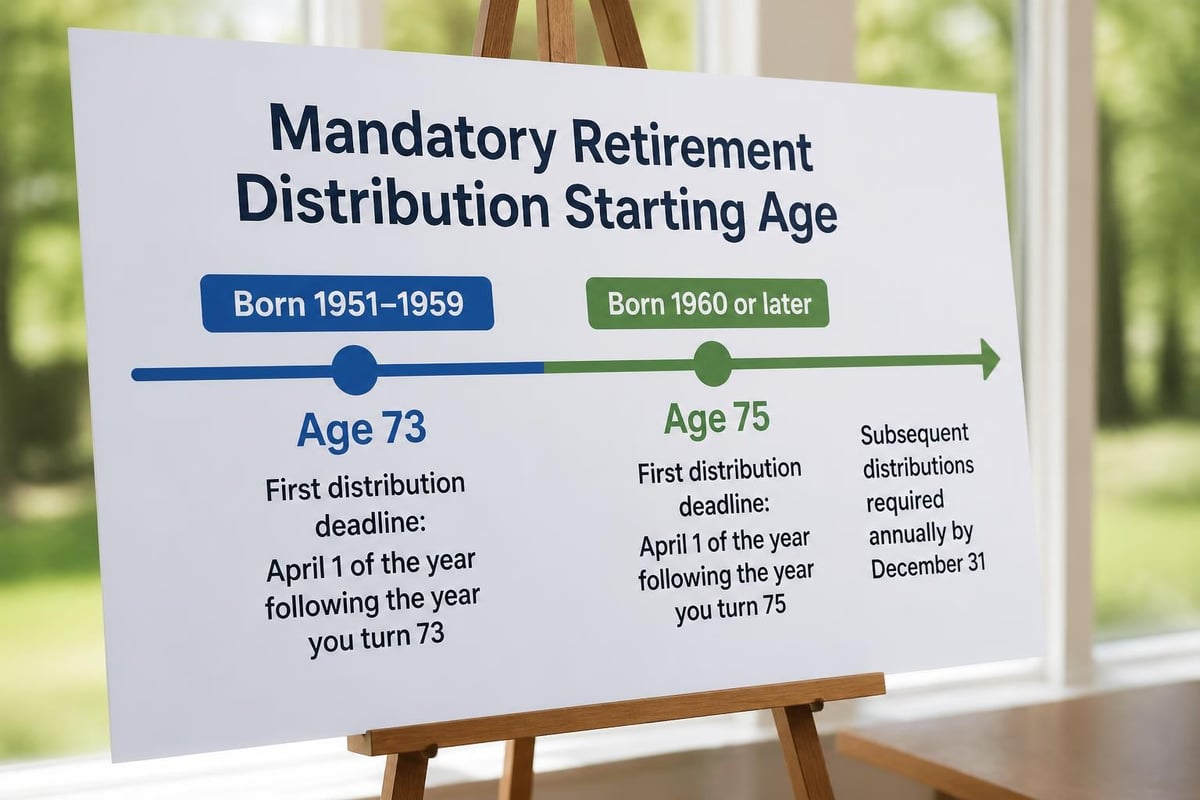
The SECURE 2.0 Act changed the landscape significantly. For individuals who turned 73 in 2024 or later, the mandatory retirement distribution age increased to 73. This change provides an additional window for tax planning and strategic withdrawals before distributions become mandatory.
Understanding when your first mandatory retirement distribution becomes due requires attention to specific timing rules that can affect your tax liability significantly.
Calculating Your Mandatory Retirement Distribution
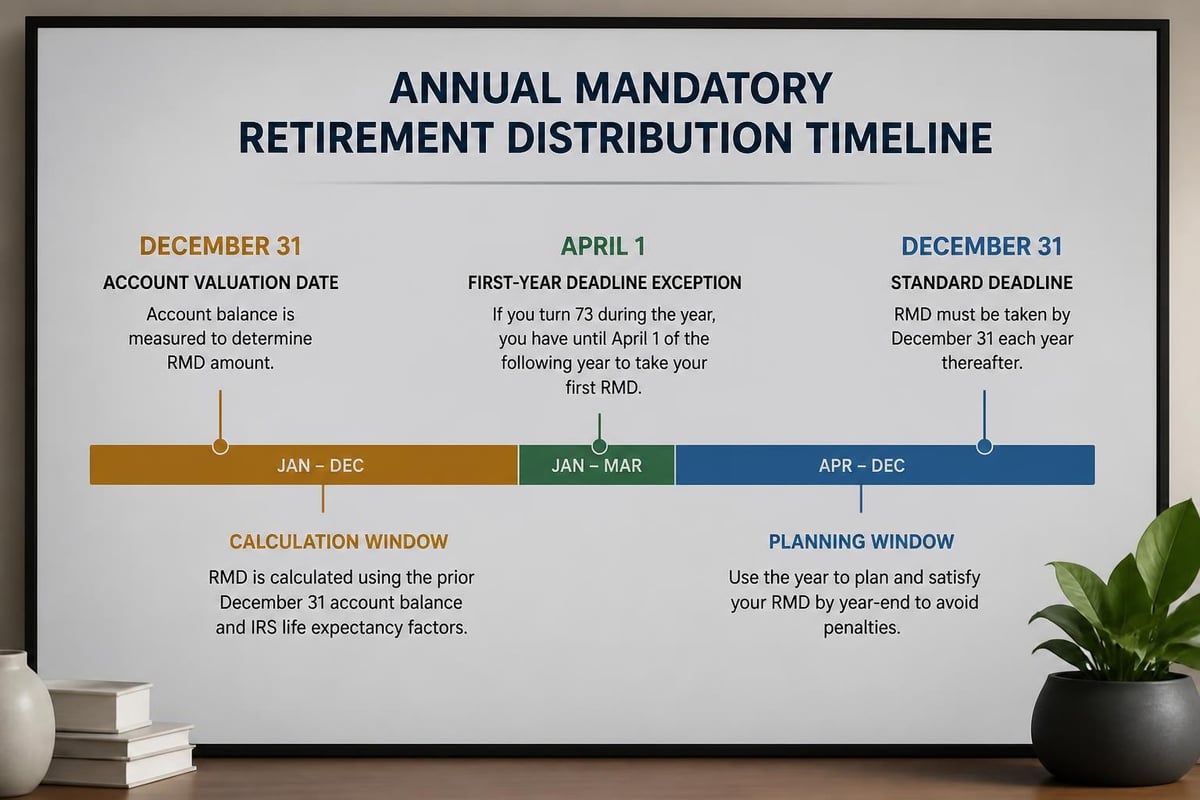
The calculation methodology for determining your mandatory retirement distribution amount follows a straightforward formula, though the details matter considerably. You divide your retirement account balance as of December 31 of the previous year by a life expectancy factor published by the IRS.
The IRS provides several life expectancy tables depending on your situation:
| Table Type | When to Use | Typical Life Expectancy Factor at Age 73 |
|---|---|---|
| Uniform Lifetime Table | Most common scenarios | 26.5 years |
| Joint Life and Last Survivor Expectancy Table | Spouse beneficiary more than 10 years younger | Varies significantly |
| Single Life Expectancy Table | Inherited IRA beneficiaries | Depends on beneficiary age |
Step-by-Step Calculation Process
- Determine your account balance on December 31 of the previous year
- Identify the appropriate life expectancy table for your situation
- Locate your age on the selected table to find your distribution period
- Divide the account balance by the distribution period
- Repeat this calculation for each tax-deferred retirement account you own
For those seeking detailed calculation guidance, Kiplinger’s RMD calculation guide provides comprehensive examples and worksheets. Working with a fiduciary planning professional ensures accuracy and helps identify optimization strategies.
The distribution period decreases each year, which means your mandatory retirement distribution percentage increases as you age, even if your account balance remains stable.
Critical Deadlines and Timing Considerations
Timing represents one of the most consequential aspects of mandatory retirement distribution compliance. Missing deadlines triggers severe penalties that can significantly erode your retirement savings.
First Distribution Deadline: You have until April 1 of the year following the year you turn 73 to take your first mandatory retirement distribution. This delayed deadline applies only to your first distribution.
Subsequent Years: All future distributions must be completed by December 31 each year. If you delay your first distribution until April 1, you'll need to take two distributions in that calendar year, which can push you into a higher tax bracket.
Distribution Timing Strategy
| Strategy | Advantage | Consideration |
|---|---|---|
| December distribution | Spreads income across two tax years | Requires early planning |
| April deadline (first year only) | Provides additional planning time | Creates double distribution year |
| Monthly distributions | Smooths cash flow and tax impact | Requires disciplined tracking |
| Annual lump sum | Simplifies administration | May create tax inefficiencies |
The FINRA insights on RMDs emphasize the importance of establishing a systematic approach to meet these deadlines consistently.
Tax Implications and Planning Strategies
Your mandatory retirement distribution adds to your taxable income for the year, potentially affecting multiple aspects of your tax situation. Understanding these implications helps you develop strategies to minimize the overall impact on your financial picture.
Direct Tax Consequences:
- Distributions taxed as ordinary income at your marginal tax rate
- May push you into a higher tax bracket
- Can trigger additional Medicare premiums through IRMAA
- Affects the taxation of Social Security benefits
- Impacts eligibility for certain tax credits and deductions
Withholding and Estimated Tax Payments
Financial institutions typically withhold 10% for federal taxes unless you specify otherwise. This default withholding may not align with your actual tax liability, potentially resulting in underpayment penalties or excessive withholding throughout the year.
Consider these withholding strategies:
- Calculate your expected total tax liability including the distribution
- Adjust withholding percentages to match your actual tax bracket
- Make quarterly estimated tax payments if withholding proves insufficient
- Coordinate with other income sources to optimize cash flow
Those seeking to avoid overpaying taxes in retirement should review their withholding strategy annually as account balances and distribution amounts change.
Common Mistakes and How to Avoid Them
The mandatory retirement distribution rules contain numerous pitfalls that can result in substantial penalties and unnecessary tax burdens. The penalty for failing to take your full required amount equals 25% of the shortfall (reduced from the previous 50% under SECURE 2.0), though this penalty can be further reduced to 10% if corrected within a correction window.
Frequent Errors to Watch For
Multiple Account Aggregation Errors: While you can aggregate mandatory retirement distribution calculations for multiple traditional IRAs and take the total from one or more accounts, this aggregation doesn't apply across different account types. 401(k) distributions must be calculated and withdrawn separately from each plan.
Inherited Account Confusion: Beneficiaries face different rules for inherited retirement accounts. The common RMD tax mistakes article highlights how these special situations require careful attention to avoid compliance issues.
Roth Conversion Timing: Some retirees mistakenly believe that converting traditional IRA funds to a Roth IRA satisfies their mandatory retirement distribution requirement. Conversions don't count toward your RMD, and you must take your required distribution before converting funds.
| Mistake | Consequence | Prevention Strategy |
|---|---|---|
| Missing December 31 deadline | 25% penalty on shortfall | Set calendar reminders in November |
| Calculating based on current year balance | Incorrect distribution amount | Use prior December 31 balance |
| Forgetting an old 401(k) | Penalty on missed distribution | Consolidate accounts or maintain comprehensive records |
| Taking spouse's RMD from own account | IRS violation | Each person must withdraw from their own accounts |
Strategic Approaches to Managing Distributions
While mandatory retirement distribution requirements are inflexible regarding minimum amounts, you maintain considerable flexibility in how you manage these distributions within your broader financial strategy. Working with professionals experienced in retirement planning and estate planning helps identify opportunities others might overlook.
Qualified Charitable Distributions
One powerful strategy involves directing your mandatory retirement distribution to qualified charities through a Qualified Charitable Distribution (QCD). This approach allows you to satisfy your distribution requirement while excluding the amount from taxable income, up to $105,000 annually in 2026 (adjusted for inflation).
QCD Benefits:
- Reduces adjusted gross income
- Satisfies mandatory retirement distribution requirements
- Supports charitable causes
- Doesn't require itemizing deductions
- Helps manage Medicare premium calculations
The QCD must transfer directly from your IRA custodian to the qualified charity. Taking the distribution yourself and subsequently donating it doesn't qualify for this tax treatment.

Coordinating With Other Income Sources
Strategic timing of your mandatory retirement distribution relative to other income sources can significantly impact your tax efficiency. Consider how these distributions interact with:
- Social Security benefit timing and taxation
- Pension income if applicable
- Part-time employment earnings
- Investment income from taxable accounts
- Capital gains realizations
Some retirees benefit from taking distributions early in retirement years when income from other sources remains lower, even before the mandatory age. This voluntary distribution strategy, while not reducing your future mandatory retirement distribution requirements, can help manage your lifetime tax burden more effectively.
Special Situations and Exceptions
Certain circumstances create exceptions or modifications to standard mandatory retirement distribution rules. Understanding these special situations helps you plan appropriately if they apply to your circumstances.
Still-Working Exception
If you continue working past age 73 and participate in your current employer's retirement plan, you may defer distributions from that specific plan until you actually retire. This exception doesn't apply to IRAs or retirement plans from previous employers, and you cannot use this exception if you own 5% or more of the company.
Inherited Retirement Accounts
Beneficiaries face different mandatory retirement distribution rules depending on their relationship to the deceased account owner and the account owner's age at death. The SECURE Act substantially changed these rules for most non-spouse beneficiaries, generally requiring account depletion within 10 years rather than allowing lifetime stretch distributions.
Beneficiary Categories:
- Eligible Designated Beneficiaries (surviving spouses, minor children, disabled individuals, chronically ill individuals, and beneficiaries not more than 10 years younger than the deceased) maintain more favorable distribution options
- Non-Eligible Designated Beneficiaries generally must deplete accounts within 10 years
- Non-Designated Beneficiaries (estates, most trusts) face accelerated distribution requirements
The Thomson Reuters RMD guide provides detailed information about these complex beneficiary situations and their distribution requirements.
Impact on Medicare and Social Security
Your mandatory retirement distribution amount directly affects your Modified Adjusted Gross Income (MAGI), which determines various aspects of your retirement benefits and costs. This indirect impact often surprises retirees who focus solely on income tax implications.
Medicare Premium Adjustments
Income-Related Monthly Adjustment Amounts (IRMAA) increase Medicare Part B and Part D premiums for higher-income beneficiaries. These adjustments use tax return information from two years prior, creating a delayed effect from distribution increases.
For 2026, IRMAA thresholds create additional monthly premiums at various income levels. A distribution that pushes you over a threshold can cost hundreds or thousands of dollars annually in additional Medicare premiums.
| 2024 MAGI (affects 2026 premiums) | Individual Part B Premium | Married Filing Jointly Part B Premium |
|---|---|---|
| $103,000 or less | Standard premium | Standard premium |
| $103,001 – $129,000 | Standard + $69.90 | Standard + $69.90 |
| $129,001 – $161,000 | Standard + $174.70 | Standard + $174.70 |
| $161,001 – $193,000 | Standard + $279.50 | Standard + $279.50 |
| Above $500,000 | Standard + $419.30 | Standard + $419.30 |
Social Security Taxation
Up to 85% of Social Security benefits become taxable based on combined income calculations that include your mandatory retirement distribution. Managing distribution amounts in conjunction with other income sources can sometimes reduce the taxable portion of Social Security benefits.
Working With Financial Professionals
The complexity of mandatory retirement distribution rules, combined with their interaction with other aspects of retirement planning, makes professional guidance valuable for most retirees. A comprehensive approach considers not just compliance but optimization across multiple financial planning dimensions.
Financial planning professionals can help you:
- Develop multi-year tax projection models
- Coordinate distribution strategies with estate planning goals
- Implement Roth conversion strategies during lower-income years
- Structure charitable giving for maximum tax efficiency
- Navigate beneficiary designation complexities
- Coordinate with tax professionals for comprehensive planning
The comprehensive guide to getting started with RMDs emphasizes the value of starting this planning process well before your first distribution becomes due. Beginning conversations about distribution strategies in your 60s provides more flexibility than waiting until the year you turn 73.
Documentation and Record Keeping
Maintaining thorough records of your mandatory retirement distribution activity protects you in case of IRS inquiries and helps you track compliance across multiple accounts and years. Financial institutions report distributions on Form 1099-R, but you remain responsible for ensuring the correct amounts were withdrawn.
Essential Documentation:
- Annual statements showing December 31 account balances
- Distribution confirmations from each account
- Form 1099-R from each custodian
- Calculation worksheets showing how you determined required amounts
- Correspondence with financial institutions regarding distributions
- Records of any corrections made for missed or insufficient distributions
Some retirees benefit from creating a spreadsheet tracking all retirement accounts, their balances, calculated distributions, and actual withdrawals. This centralized record simplifies annual planning and helps prevent oversights, particularly when managing accounts at multiple institutions.
The legal requirements outlined in federal regulations establish the formal rules governing these distributions, though most retirees find summary guidance more accessible for practical planning purposes.
Account Consolidation Considerations
Managing mandatory retirement distribution requirements becomes simpler when you consolidate retirement accounts rather than maintaining multiple small accounts across various institutions. This consolidation strategy offers several advantages beyond administrative convenience.
Consolidation Benefits:
- Simplified distribution calculations and tracking
- Reduced likelihood of overlooking an account
- Potentially lower total fees across fewer accounts
- Easier coordination of investment strategy
- Streamlined beneficiary designation management
However, consolidation requires careful evaluation of each account's specific characteristics. Some employer plans offer institutional pricing on investments not available through IRAs. Others may provide creditor protection advantages in certain states. Additionally, the still-working exception only applies to your current employer's plan, making premature consolidation potentially disadvantageous if you plan to continue working.
Rolling multiple old 401(k) plans into a single IRA generally simplifies mandatory retirement distribution management while preserving investment flexibility. Consulting with advisors who understand both the investment management and tax implications ensures consolidation decisions support your overall financial objectives.
Future Mandatory Retirement Distribution Changes
The retirement planning landscape continues evolving through legislative changes. The SECURE 2.0 Act included provisions that will further increase the mandatory retirement distribution starting age to 75 for individuals born in 1960 or later. This delayed timeline provides younger workers with additional years of tax-deferred growth.
Anticipated Changes:
- Age 75 RMD starting age for those born in 1960 or later (effective for distributions required in 2033 and later)
- Potential further penalty reductions for missed distributions
- Continued adjustment of QCD limits for inflation
- Possible expansion of exceptions and special provisions
These evolving rules underscore the importance of staying informed about regulatory changes that affect your specific situation. What applies today may change before you reach distribution age, making periodic reviews with knowledgeable professionals valuable for long-term planning.
Staying current with changes helps you adapt strategies proactively rather than reactively responding after changes take effect.
Understanding mandatory retirement distribution requirements represents a critical component of successful retirement tax planning that extends far beyond simple compliance. These distributions interact with Medicare premiums, Social Security taxation, estate planning objectives, and overall financial security in retirement. Brookwood Investment Group provides personalized guidance on navigating these complex requirements while developing comprehensive strategies aligned with your unique goals and circumstances. Their fiduciary approach ensures recommendations prioritize your interests, helping you manage distributions efficiently while coordinating with broader retirement, investment, and estate planning objectives.
