
Inheriting an IRA can feel overwhelming during an already difficult time. The decisions you make about cashing out an inherited IRA carry significant tax implications and require careful consideration of current regulations. With changes to distribution rules over recent years, understanding your options as a beneficiary has become increasingly complex. Whether you're a spouse, adult child, or other designated beneficiary, the path forward depends on multiple factors including your relationship to the original account owner, the type of IRA inherited, and your personal financial situation.
Understanding the Basics of Inherited IRA Distributions
When you inherit an IRA, you're stepping into a set of rules that differ substantially from those governing retirement accounts you might own personally. The IRS treats inherited IRAs differently, and knowing your options as a beneficiary is essential before making any distribution decisions.
The original owner's age at death matters significantly. If they had already begun taking required minimum distributions (RMDs), certain rules may apply that wouldn't otherwise affect your withdrawal strategy. Additionally, the type of IRA inherited-traditional or Roth-creates different tax scenarios when cashing out an inherited IRA.
Beneficiary Categories and Their Impact
The IRS classifies beneficiaries into specific categories, each with distinct distribution requirements:
- Spousal beneficiaries enjoy the most flexible options
- Non-spouse designated beneficiaries face stricter timelines
- Eligible designated beneficiaries receive special consideration
- Non-designated beneficiaries encounter the shortest distribution windows
Eligible designated beneficiaries include minor children of the deceased (until they reach majority), disabled individuals, chronically ill individuals, and beneficiaries not more than ten years younger than the deceased. This classification can significantly affect your distribution timeline and strategy when managing these inherited assets.
The 10-Year Rule Explained
For most non-spouse beneficiaries who inherited IRAs after December 31, 2019, the 10-year distribution rule applies. This regulation eliminated the "stretch IRA" strategy that previously allowed beneficiaries to extend distributions over their lifetime.
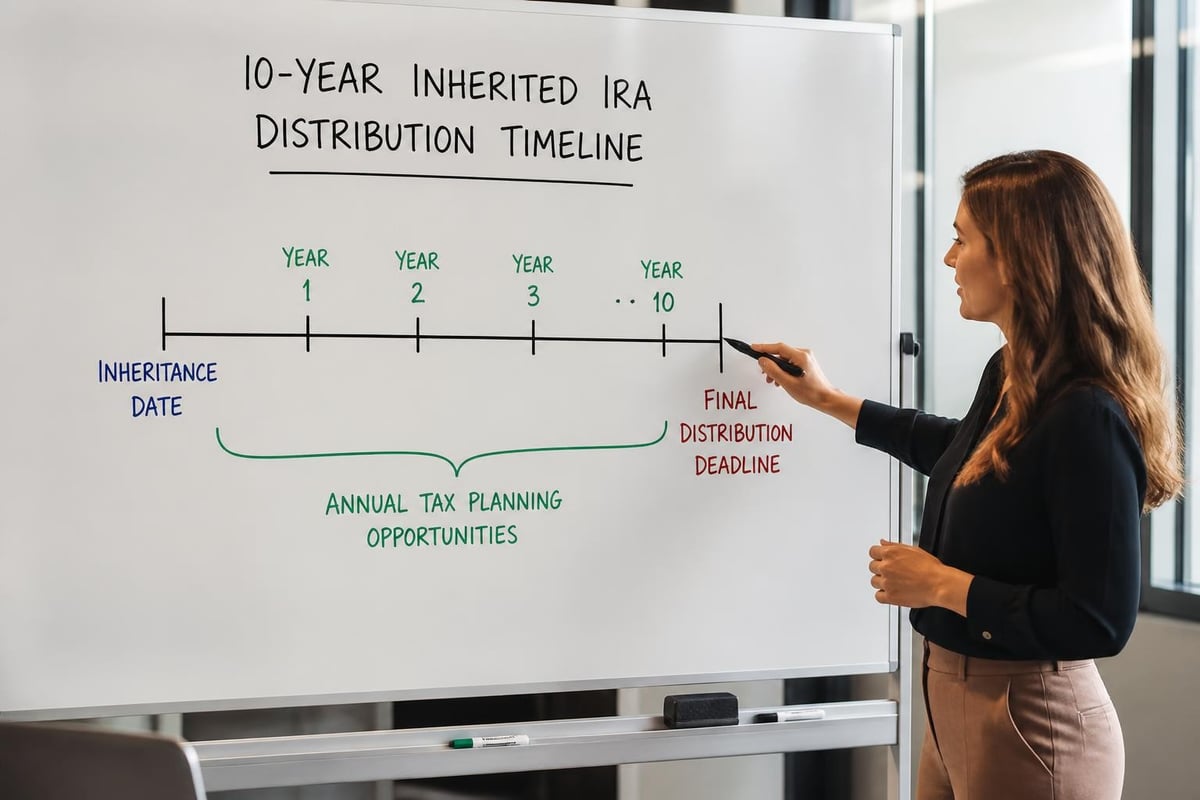
Under this rule, you must withdraw all funds from the inherited IRA by December 31 of the tenth year following the original owner's death. However, the IRS doesn't require annual minimum distributions during those ten years-you control the timing and amount of withdrawals within that decade.
Strategic Timing Considerations
This flexibility creates planning opportunities. You might choose to:
- Take equal distributions annually to spread tax liability
- Defer all withdrawals until year ten to maximize tax-deferred growth
- Adjust distributions based on annual income fluctuations
- Accelerate withdrawals during lower-income years
Each approach carries different tax consequences. If you're in a high tax bracket currently but expect lower income in coming years, deferring distributions might reduce your overall tax burden. Conversely, if you anticipate higher earnings ahead, accelerating withdrawals could prove beneficial.
Tax Implications of Cashing Out
When cashing out an inherited IRA, understanding the tax treatment is crucial for effective planning. Traditional inherited IRAs carry ordinary income tax on distributions, while Roth inherited IRAs typically offer tax-free withdrawals if the account was held for at least five years.
| IRA Type | Tax on Distributions | Timing Flexibility | RMD Requirements |
|---|---|---|---|
| Traditional | Ordinary income tax rates | Within 10-year window | Yes (for certain beneficiaries) |
| Roth | Generally tax-free | Within 10-year window | Account age dependent |
| Inherited as spouse | Depends on treatment choice | Most flexible | Age dependent |
The tax impact can be substantial. A $500,000 inherited traditional IRA could generate $185,000 or more in federal taxes if withdrawn in a single year at high tax brackets. Spreading distributions over the allowable period often reduces the total tax liability significantly.
Avoiding Common Tax Pitfalls
Tax traps with inherited IRAs often catch beneficiaries unprepared. One frequent mistake involves taking large distributions without considering how they'll push income into higher tax brackets. Another involves missing the 10-year deadline entirely, which triggers penalties and accelerated taxation.
Working with professionals who understand retirement planning complexities can help you navigate these challenges. Tax planning around inherited retirement accounts requires coordination between your overall financial picture and distribution timing.
Spousal Beneficiary Options
Surviving spouses receive unique treatment when inheriting an IRA. You can choose to treat the inherited IRA as your own, which provides maximum flexibility. Alternatively, you might maintain it as an inherited IRA, which can offer advantages in specific situations.
Treating the IRA as your own allows you to:
- Delay RMDs until you reach age 73 (as of 2026)
- Name your own beneficiaries
- Make additional contributions if you have earned income
- Avoid the 10-year distribution rule
Maintaining it as an inherited IRA might make sense when:
- You're under age 59½ and need penalty-free access to funds
- The original owner was already taking RMDs and you're younger
- You want to preserve the account for your own beneficiaries
The choice between these options depends heavily on your age, financial needs, and long-term planning goals. Many spouses benefit from consulting with advisors who specialize in estate planning strategies to determine the optimal path.
Non-Spouse Beneficiary Strategies
For adult children, grandchildren, and other non-spouse beneficiaries, cashing out an inherited IRA requires careful planning within the constraints of current regulations. The withdrawal rules for inherited IRAs have become more restrictive, making strategic planning increasingly important.

Consider your current and projected tax situation carefully. If you're in your peak earning years, accelerating distributions from an inherited traditional IRA could prove costly. Conversely, if you're between jobs, taking a career break, or experiencing a lower-income year, that might represent an ideal time for larger withdrawals.
Coordinating with Other Income Sources
Think holistically about how inherited IRA distributions interact with your other income. Capital gains from investments, business income, and other retirement account withdrawals all combine to determine your marginal tax rate. Strategic distribution timing can help you avoid pushing income into higher brackets unnecessarily.
For example, if you expect a significant bonus in 2027, you might minimize inherited IRA distributions that year and increase them in 2026 or 2028. This type of multi-year tax planning often saves thousands in unnecessary tax payments.
Required Minimum Distributions for Certain Beneficiaries
Some beneficiaries must take annual RMDs even under the 10-year rule. If the original owner died after their required beginning date (when they would have started taking RMDs), and you inherited the account after 2019, you may need to take annual distributions during the 10-year period.
Recent IRS guidance has created some confusion around this requirement. The agency has provided transition relief while finalizing regulations, but beneficiaries should stay informed about their obligations to avoid penalties.
| Beneficiary Type | Annual RMD Required? | Distribution Deadline | Penalty for Missed RMD |
|---|---|---|---|
| Eligible designated beneficiary | Yes (life expectancy method) | December 31 annually | 25% of shortfall |
| Non-spouse (owner died post-RBD) | Potentially (pending final rules) | December 31 of year 10 | 25% of shortfall |
| Spousal beneficiary | Depends on election | Varies | 25% of shortfall |
The penalty for missing an RMD is severe-25% of the amount that should have been withdrawn. However, the IRS may waive this penalty if you can demonstrate reasonable cause and promptly correct the shortfall.
Alternative Options Beyond Cash Withdrawals
Cashing out an inherited IRA doesn't necessarily mean taking cash distributions. Several alternatives might better serve your financial objectives:
- In-kind distributions: Transfer securities directly from the inherited IRA to a taxable account
- Qualified charitable distributions: Direct transfers to charity (if eligible)
- Roth conversions: Convert traditional inherited IRA assets to Roth (for spousal beneficiaries)
- Strategic reinvestment: Plan how distributed funds will be redeployed
In-kind distributions can be particularly valuable when the inherited IRA holds appreciated securities you want to keep. Rather than selling investments to generate cash for a distribution, you transfer the securities directly, maintaining your investment positions while satisfying distribution requirements.

Documentation and Administrative Requirements
Proper handling of an inherited IRA begins with correct documentation. You'll need to provide the financial institution with a certified death certificate and proof of your beneficiary status. The account must be retitled appropriately-typically as "[Deceased Owner's Name] IRA, inherited by [Your Name], beneficiary."
Essential administrative steps include:
- Obtaining multiple certified copies of the death certificate
- Notifying all financial institutions holding IRA assets
- Requesting proper account retitling
- Understanding the institution's distribution procedures
- Maintaining records of all distributions for tax purposes
Failing to retitle the account correctly can create complications and potentially disqualify the inherited IRA status, triggering immediate taxation of the entire balance. Financial institutions have specific procedures for inherited accounts, and following them precisely protects your options.
Integrating Inherited Assets Into Your Financial Plan
When cashing out an inherited IRA, consider how these assets fit within your broader financial strategy. An inheritance represents a meaningful financial event that can accelerate goals, provide security, or create new opportunities.
Managing an inheritance effectively requires coordination across multiple financial areas. The tax implications of inherited IRA distributions affect your overall tax planning. The timing of withdrawals influences investment strategies. The ultimate use of these funds should align with your life goals and values.
Some beneficiaries use inherited IRA funds to:
- Eliminate high-interest debt
- Build emergency reserves
- Fund education expenses
- Accelerate retirement savings in their own accounts
- Make strategic charitable contributions
- Invest in real estate or business opportunities
Balancing Multiple Financial Priorities
If you're managing several financial priorities simultaneously, inherited IRA distributions can help or hinder progress depending on how you structure them. Taking large distributions to pay off a mortgage might make emotional sense but could prove costly from a tax perspective compared to smaller, strategic withdrawals.
Consider working with professionals who provide comprehensive financial guidance to evaluate these trade-offs objectively. The interaction between inherited assets, your existing resources, and your goals deserves careful analysis.
Special Considerations for Large Inherited IRAs
Inherited IRAs exceeding $500,000 require particularly careful planning. The tax implications of cashing out an inherited IRA of this size can easily reach six figures if not managed strategically. Large inherited accounts often benefit from sophisticated planning techniques that minimize tax drag while preserving wealth.
For substantial inheritances, consider:
- Multi-year tax projection modeling
- Coordination with estate planning for your own beneficiaries
- Charitable giving strategies that provide tax benefits
- State tax implications if you live in or might move to high-tax states
- Impact on Medicare premiums and other means-tested benefits
Distributions from inherited IRAs count as ordinary income and can trigger higher Medicare Part B and Part D premiums through the Income-Related Monthly Adjustment Amount (IRMAA). For beneficiaries approaching or in retirement themselves, this creates an additional planning layer.
Working with Financial Professionals
The complexity of inherited IRA rules, combined with their significant financial impact, makes professional guidance valuable for many beneficiaries. Fiduciary advisors work in your best interest, helping you navigate distribution decisions that align with your overall financial picture.
Professional support becomes particularly important when:
- The inherited IRA represents a substantial portion of your net worth
- You're uncertain about tax implications and distribution timing
- You need to coordinate inherited assets with estate planning
- Multiple beneficiaries create complex family dynamics
- You're managing inherited IRAs from multiple deceased individuals
Quality financial guidance considers not just the inherited IRA in isolation but how distribution decisions affect your complete financial situation. This holistic perspective often reveals opportunities and risks that aren't apparent when focusing solely on the inherited account.
State-Specific Considerations
While federal tax rules for cashing out an inherited IRA apply uniformly, state tax treatment varies considerably. Some states don't tax retirement account distributions at all, while others impose rates exceeding 10%. If you live in a high-tax state or are considering relocation, state taxes deserve careful attention in your distribution planning.
Additionally, some states offer estate or inheritance taxes that could affect the transfer of IRA assets, though IRAs themselves typically pass outside of probate. Understanding your state's complete tax landscape helps optimize the timing and structure of distributions.
Updating Your Own Estate Plan
Inheriting an IRA serves as a powerful reminder to review your own estate planning documents. Proper estate planning ensures your assets transfer according to your wishes and minimizes complications for your beneficiaries.
After inheriting an IRA, consider:
- Reviewing your own IRA beneficiary designations
- Updating estate planning documents to reflect new assets
- Discussing inheritance strategies with your beneficiaries
- Considering whether trusts might benefit your estate plan
- Evaluating whether your current planning reflects your values and goals
Many people discover gaps in their estate planning when experiencing the inheritance process from a beneficiary's perspective. Use this experience to strengthen your own planning and reduce future burdens on those you'll leave behind.
Navigating the complexities of cashing out an inherited IRA requires careful attention to distribution rules, tax implications, and strategic timing. These decisions carry long-term financial consequences that deserve thoughtful planning aligned with your broader objectives. At Brookwood Investment Group, we help clients integrate inherited assets into comprehensive financial strategies through personalized guidance tailored to your unique situation. Whether you're managing a recent inheritance or planning for the future, our fiduciary advisors provide the expertise you need to make confident, informed decisions. Connect with Brookwood Investment Group to explore how we can support your financial journey.
