
Setting a clear financial goal serves as the foundation for building wealth and securing your future. Whether you're planning for retirement, saving for a major purchase, or building an emergency fund, having specific objectives transforms vague aspirations into actionable strategies. In 2026, the financial landscape continues to evolve, making it more important than ever to establish well-defined targets that align with your personal circumstances and timeline. Understanding how to create, prioritize, and pursue meaningful objectives enables you to make informed decisions about your money and measure progress along the way.
Understanding What Defines a Financial Goal
A financial goal represents a specific monetary objective you aim to achieve within a defined timeframe. Unlike general wishes about money, a properly structured target includes concrete numbers, deadlines, and actionable steps. Setting financial goals requires clarity about what you want to accomplish and why it matters to you.
The specificity of your objective directly impacts your likelihood of success. Rather than stating "I want to save more money," an effective financial goal would be "I will save $15,000 for a down payment within 24 months by contributing $625 monthly to a high-yield savings account."
Short-Term Financial Objectives
Short-term targets typically span from immediate needs to accomplishments within one year. These might include:
- Building an emergency fund covering three to six months of expenses
- Paying off a specific credit card balance
- Saving for a vacation or holiday expenses
- Creating a budget and tracking spending for 90 consecutive days
Short-term wins provide momentum and confidence. They demonstrate your capability to manage money effectively while establishing habits that support larger ambitions. Each completed objective reinforces your commitment to financial wellness.
Mid-Term Financial Planning
Mid-term objectives generally extend from one to five years. These represent substantial achievements requiring sustained effort and discipline. Common examples include saving for a vehicle purchase, accumulating a down payment for real estate, or funding a child's education expenses.
The mid-term horizon allows for strategic investment approaches that balance growth potential with relative stability. Financial planning strategies for this timeframe often incorporate diversified portfolios designed to outpace inflation while managing risk appropriately.

Long-Term Wealth Accumulation
Long-term financial objectives extend beyond five years and frequently focus on retirement security, generational wealth transfer, and legacy planning. These ambitious targets benefit most from compound growth, tax-advantaged accounts, and professional guidance.
Working with a fiduciary advisory firm ensures your long-term strategies align with your best interests rather than product sales quotas. Professional advisors help navigate complex decisions about asset allocation, tax efficiency, and estate planning considerations.
The Framework for Establishing Effective Objectives
Creating a meaningful financial goal requires more than selecting a number and deadline. The process involves self-reflection, data gathering, and honest assessment of your current situation. Understanding money management fundamentals provides the foundation for setting realistic yet challenging targets.
Begin by evaluating your current financial position. Calculate your net worth by subtracting total liabilities from total assets. Review income sources, fixed expenses, variable costs, and existing savings or investment accounts. This baseline assessment reveals opportunities and constraints that shape your planning.
Connecting Goals to Personal Values
The most powerful financial objective connects directly to what you value most in life. Money serves as a tool for achieving deeper purposes, whether that's security, freedom, family support, or philanthropic impact. When you understand the "why" behind each target, you're more likely to maintain discipline during challenging periods.
Consider how each potential objective serves your broader life vision. Does early retirement enable you to pursue passion projects? Does education funding reflect your commitment to family advancement? Does charitable giving express your values and community connection? Alignment between financial targets and personal values creates intrinsic motivation.
SMART Goal Methodology
Applying the SMART framework transforms vague intentions into achievable objectives:
| SMART Element | Definition | Example Application |
|---|---|---|
| Specific | Clearly defined with precise details | Save $50,000 for retirement |
| Measurable | Quantifiable with trackable progress | Increase 401(k) contributions by 2% annually |
| Achievable | Realistic given your resources | Based on current income and expenses |
| Relevant | Aligned with broader priorities | Supports desired retirement lifestyle |
| Time-bound | Has a specific deadline | Achieve by December 31, 2029 |
This structured approach provides clarity and accountability. Each element answers critical questions about what you're pursuing and how you'll know when you've succeeded.
Prioritizing Multiple Financial Objectives
Most individuals juggle several competing financial objectives simultaneously. The challenge lies in determining which deserves primary focus and how to allocate limited resources effectively. Deciding whether to save or pay debt represents one common prioritization dilemma.
Creating a Financial Hierarchy
Establish a priority framework based on urgency, impact, and timeline considerations:
- Emergency fund establishment – Foundational security protecting against unexpected expenses
- High-interest debt elimination – Reducing financial drag from costly obligations
- Employer retirement match capture – Securing immediate guaranteed returns
- Additional retirement contributions – Building long-term wealth systematically
- Other savings objectives – Funding discretionary goals after core needs are addressed
This hierarchy isn't rigid. Your personal circumstances might require adjustments. Someone with stable employment and low living costs might accelerate retirement savings, while another person facing job uncertainty should prioritize emergency reserves.
Balancing Competing Demands
Resource allocation requires thoughtful trade-offs. You might split available funds across multiple objectives rather than focusing exclusively on one target. A balanced approach might involve:
- Contributing enough to retirement accounts to capture full employer matching
- Making minimum payments on low-interest debt while aggressively paying high-interest balances
- Simultaneously building emergency savings even while carrying manageable debt
- Setting aside smaller amounts for medium-term objectives alongside priority targets
The optimal balance depends on interest rates, tax considerations, timeline urgency, and personal risk tolerance. Professional financial guidance helps navigate these complex decisions with personalized strategies.

Developing Actionable Implementation Strategies
A financial goal without an implementation plan remains merely a wish. Creating actionable plans transforms intentions into reality through systematic execution. Break down each objective into specific steps, milestones, and behavioral changes.
Automation and Systems
Behavioral finance research demonstrates that automation significantly improves success rates. When savings happen automatically before you have opportunities to spend, you remove willpower from the equation. Effective automation strategies include:
- Direct deposit splitting between checking and savings accounts
- Automatic retirement contribution increases aligned with salary raises
- Scheduled transfers to investment accounts on specific dates
- Bill payment automation ensuring on-time payments and avoiding fees
These systems create a "set and forget" approach that builds wealth passively while you focus on other priorities. Review automated processes quarterly to ensure they continue serving your evolving needs.
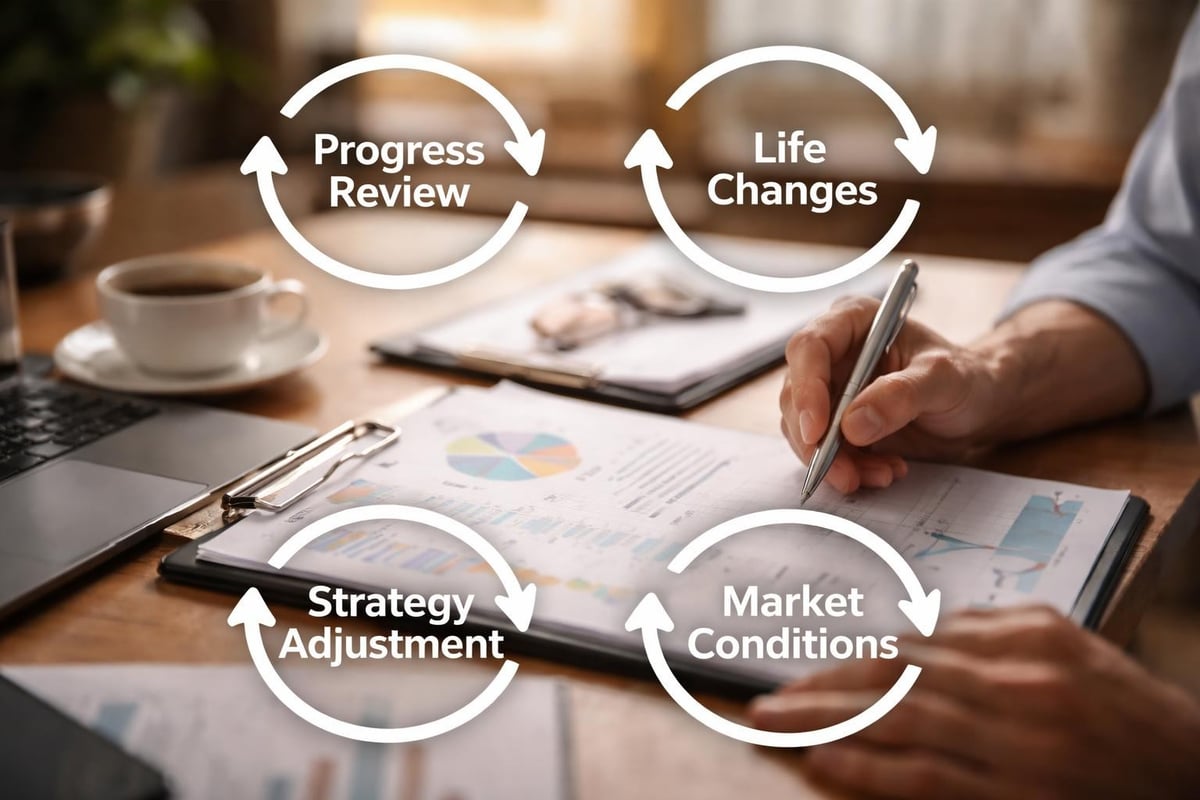
Milestone Tracking and Adjustments
Divide larger objectives into smaller milestones that provide regular feedback about progress. If your financial goal involves saving $30,000 over three years, establish quarterly targets of $2,500. This granular approach enables course corrections before small deviations become significant problems.
Regular reviews should assess:
- Progress toward each milestone compared to the planned timeline
- Changes in income, expenses, or life circumstances affecting feasibility
- Market performance impacting investment-based objectives
- Opportunities to accelerate progress through windfalls or expense reductions
Flexibility matters. When circumstances change, adjust your strategies while maintaining commitment to core objectives. A temporary setback doesn't represent failure if you adapt and continue forward.
Common Obstacles and Strategic Solutions
Even well-crafted financial objectives face challenges during implementation. Recognizing potential obstacles in advance enables proactive problem-solving rather than reactive crisis management. Understanding typical difficulties helps you prepare appropriate responses.
Income Volatility Management
Variable income creates planning challenges for entrepreneurs, commission-based professionals, and gig economy workers. Strategic approaches for managing this volatility include:
- Calculating average monthly income over the past 12-24 months
- Building larger emergency reserves (six to twelve months instead of three to six)
- Basing contribution amounts on conservative income estimates
- Making additional contributions during high-income periods
- Maintaining flexible timelines that accommodate income fluctuations
Working with advisors experienced in business owner finances provides specialized guidance for irregular income patterns and unique tax considerations.
Lifestyle Inflation Prevention
As income increases, spending often rises proportionally, leaving little additional capacity for pursuing financial objectives. This "lifestyle creep" undermines wealth accumulation despite growing earnings. Combat this tendency through conscious choices:
Predetermined allocation rules – Commit to directing a specific percentage of raises toward savings before adjusting spending levels
Value-based spending – Increase expenditures only in categories that genuinely enhance life satisfaction
Delayed gratification – Wait 30-90 days before making discretionary purchases over certain thresholds
Regular financial reviews – Schedule quarterly assessments of spending patterns and alignment with stated priorities
These practices maintain the gap between earning and spending that enables wealth building regardless of income level.
Leveraging Professional Guidance for Complex Objectives
While simple savings targets might not require professional assistance, complex financial objectives benefit significantly from expert input. Investment management strategies, tax optimization, and estate planning considerations often exceed typical consumer knowledge.
When to Seek Advisory Services
Consider engaging professional guidance when facing:
- Retirement planning requiring portfolio construction and withdrawal strategies
- Tax-loss harvesting opportunities and tax-efficient asset location decisions
- Estate planning needs involving trusts, beneficiary designations, and legacy objectives
- Major life transitions such as inheritance, divorce, or business sale
- Coordination between multiple financial accounts and objectives
A fiduciary advisor provides personalized recommendations aligned with your specific circumstances rather than standardized products. The virtual-first model eliminates geographic limitations, providing access to specialized expertise regardless of location.
Maximizing Advisory Relationships
To gain maximum value from professional relationships, approach them as collaborative partnerships. Provide complete financial information, communicate openly about concerns and priorities, and ask questions when recommendations aren't clear. The most successful client-advisor relationships feature:
| Client Responsibility | Advisor Contribution | Outcome |
|---|---|---|
| Transparent communication about goals | Customized strategy development | Personalized action plan |
| Prompt response to information requests | Proactive market updates and insights | Timely decision-making |
| Honest discussion of risk tolerance | Appropriate portfolio construction | Aligned investment approach |
| Regular review meeting participation | Performance monitoring and adjustments | Optimized results over time |
This collaborative approach ensures strategies remain relevant as circumstances evolve and markets fluctuate.
Measuring Progress and Celebrating Success
Tracking advancement toward each financial goal provides essential feedback and motivation. Setting benchmarks creates accountability while highlighting both achievements and areas requiring additional attention. Measurement approaches vary based on objective type and timeline.
Quantitative Progress Indicators
Financial objectives lend themselves to precise numerical tracking. Establish dashboard systems that display:
- Current account balances relative to target amounts
- Percentage completion for each objective
- Monthly contribution amounts and consistency
- Investment performance compared to benchmarks
- Debt reduction progress and projected payoff dates
Many financial institutions and personal finance applications provide automated tracking tools. Consolidating information in one location simplifies monitoring and pattern recognition.
Qualitative Milestone Recognition
Beyond numbers, acknowledge behavioral changes and habit development. Completing three consecutive months of consistent savings, negotiating a salary increase, or successfully rebalancing your portfolio represents meaningful progress worthy of recognition. These behavioral victories often predict long-term success more reliably than short-term numerical results.
Build reward systems that reinforce positive behaviors without undermining financial progress. Celebrate major milestones with meaningful but modest expenditures that honor achievements while maintaining commitment to ongoing objectives.
Tax Considerations for Strategic Goal Setting
Tax efficiency significantly impacts your ability to achieve financial objectives within desired timeframes. Understanding how different accounts and strategies affect tax obligations enables more effective planning and wealth preservation. Tax considerations influence contribution limits, withdrawal timing, and overall strategy selection.
Account Type Selection
Different financial goal timelines align with specific account structures:
Tax-deferred accounts (Traditional 401(k), Traditional IRA) reduce current taxable income while allowing tax-free growth until withdrawal. These serve long-term retirement objectives well, particularly for individuals currently in higher tax brackets who anticipate lower rates during retirement.
Tax-free accounts (Roth 401(k), Roth IRA, HSA) require after-tax contributions but provide tax-free growth and qualified withdrawals. These benefit younger investors with decades of tax-free compounding ahead and those anticipating higher future tax rates.
Taxable accounts provide maximum flexibility without contribution limits or withdrawal restrictions. These work well for mid-term objectives where retirement account penalties would apply or when you've maximized tax-advantaged options.
Strategic coordination between account types creates flexibility and tax diversification. Comprehensive financial planning considers how different account combinations optimize both accumulation and distribution phases.
Strategic Withdrawal Sequencing
The order in which you access different accounts during distribution phases significantly impacts tax efficiency and portfolio longevity. Consider required minimum distributions, capital gains rates, ordinary income taxation, and state tax implications when developing withdrawal strategies.
Professional guidance proves particularly valuable during this complex phase. Small decisions about which accounts to tap first can result in substantial differences in after-tax income and estate values over retirement decades.
Adapting Goals Through Life Stages
Your financial goal priorities naturally shift as you progress through different life phases. What matters most at 25 differs substantially from priorities at 45 or 65. Recognizing these transitions enables proactive strategy adjustments rather than reactive scrambling when circumstances change.
Early Career Focus
Young professionals typically prioritize emergency fund establishment, student loan management, and retirement contribution initiation. The power of compound growth makes even modest early retirement contributions disproportionately valuable. A dollar invested at 25 has roughly three times the retirement purchasing power of a dollar invested at 45, assuming typical growth rates.
This phase also offers opportunities to establish financial habits and systems that serve you for decades. Automation, budgeting discipline, and continuous financial education create foundations supporting future wealth accumulation.
Mid-Career Priorities
As income increases and careers stabilize, attention often shifts toward maximizing retirement contributions, funding children's education, and purchasing real estate. These competing demands require careful prioritization and resource allocation.
This stage frequently involves the most intense financial pressure as individuals simultaneously support current household needs, save for future retirement, and possibly assist aging parents. Strategic planning becomes essential for balancing these obligations without sacrificing long-term security.
Pre-Retirement Transition
The decade preceding retirement requires particular attention to portfolio risk management, Social Security optimization, healthcare planning, and withdrawal strategy development. Retirement planning services address the complex transition from accumulation to distribution phases.
This period offers the final opportunity to course-correct if earlier savings fell short of targets. Catch-up contributions in retirement accounts, aggressive debt elimination, and lifestyle adjustments can significantly improve retirement readiness.
Establishing and pursuing a well-defined financial goal transforms abstract aspirations into concrete achievements through systematic planning and disciplined execution. Whether you're building emergency reserves, saving for major purchases, or planning for retirement security, clarity about objectives and strategies increases your likelihood of success. Brookwood Investment Group provides personalized, fiduciary guidance to help you develop comprehensive strategies aligned with your unique circumstances and priorities, offering virtual-first advisory services that bring professional expertise directly to you regardless of location.
