
Making the decision to tap into retirement savings before reaching retirement age can have significant financial implications. A 401k early withdrawal might seem like an accessible solution during times of financial stress, but the costs often extend far beyond the immediate tax consequences. Understanding the rules, penalties, and available exceptions can help you make informed decisions about your retirement accounts and explore alternatives that may better serve your long-term financial goals.
Understanding the Fundamentals of 401k Early Withdrawal
The Internal Revenue Service establishes strict guidelines governing when and how you can access funds from your 401k account. Generally, withdrawals made before age 59½ are considered early and subject to both ordinary income tax and an additional 10% penalty. This double taxation can significantly reduce the amount you ultimately receive.
When you contribute to a traditional 401k, those contributions reduce your taxable income in the year you make them. The government defers taxation until you withdraw the funds, typically during retirement when you may be in a lower tax bracket. An early withdrawal disrupts this tax-advantaged structure and triggers immediate tax consequences.
The True Cost of Early Access
The financial impact of a 401k early withdrawal extends beyond the initial penalty and taxes. Consider the following breakdown:
| Cost Component | Impact | Example (on $20,000) |
|---|---|---|
| 10% Penalty | Federal penalty for early withdrawal | $2,000 |
| Federal Income Tax | Based on your tax bracket (22% example) | $4,400 |
| State Income Tax | Varies by state (5% example) | $1,000 |
| Lost Growth | Opportunity cost over 20 years at 7% | $57,434 |
| Total Cost | Combined financial impact | $64,834 |
This illustration demonstrates how the costs associated with early 401k withdrawals can compound over time. The immediate reduction from penalties and taxes is substantial, but the long-term opportunity cost from lost compound growth often represents the largest financial setback.

Penalty Exceptions and Special Circumstances
The IRS provides specific circumstances under which you may avoid the 10% early withdrawal penalty, though you'll still owe ordinary income taxes on the distribution. Understanding these exceptions can help you minimize costs when facing genuine financial hardship.
Qualifying Hardship Withdrawals
Your 401k plan may permit hardship withdrawals for immediate and heavy financial needs. The IRS defines specific situations that qualify:
- Medical expenses exceeding 7.5% of your adjusted gross income
- Costs directly related to purchasing a principal residence (down payment, closing costs)
- Tuition and related educational fees for the next 12 months of post-secondary education
- Payments to prevent eviction or foreclosure on your primary residence
- Funeral expenses for family members
- Certain expenses for repair of damage to your principal residence
While these situations may waive the 10% penalty in some cases, your plan administrator determines whether to allow hardship withdrawals and which expenses qualify. Not all plans offer this option, and the rules governing hardship distributions have specific documentation requirements.
The Rule of 55 Exception
For individuals who separate from service during or after the year they turn 55, the Rule of 55 provides penalty-free access to their current employer's 401k. This exception applies only to the 401k held with the employer you're leaving, not to IRAs or 401k accounts from previous employers.
Key considerations for the Rule of 55:
- The separation from service must occur during or after the calendar year you turn 55
- Public safety employees may qualify as early as age 50
- Funds must remain in the employer's 401k plan (rolling over to an IRA eliminates this option)
- You still owe ordinary income taxes on distributions
Alternative Withdrawal Strategies
Several structured approaches allow access to retirement funds before age 59½ while minimizing or eliminating penalties. These methods require careful planning and adherence to specific IRS regulations.
Substantially Equal Periodic Payments (SEPP)
The IRS allows penalty-free early withdrawals through SEPP 72(t) arrangements, which require you to take substantially equal periodic payments based on your life expectancy. This method offers flexibility but demands strict compliance.
SEPP 72(t) requirements and considerations:
- Payments must continue for at least five years OR until you reach age 59½, whichever is longer
- The calculation method (RMD, fixed amortization, or fixed annuitization) locks in your annual distribution amount
- Modifying the payment schedule triggers retroactive penalties on all previous distributions
- Payments must follow one of three IRS-approved calculation methods
- You cannot contribute to the account while receiving SEPP distributions
This approach works best for individuals committed to early retirement who need consistent income streams. However, the inflexibility and long-term commitment make it less suitable for temporary financial needs.

401k Loans as an Alternative
Many 401k plans permit participants to borrow from their accounts rather than taking permanent withdrawals. This option allows you to access funds without triggering taxes or penalties, provided you repay according to the loan terms.
| Feature | 401k Loan | Early Withdrawal |
|---|---|---|
| Tax Treatment | No immediate taxes if repaid | Ordinary income tax applies |
| Penalty | None if repaid on time | 10% penalty (unless exception applies) |
| Repayment | Required within 5 years typically | Not applicable |
| Maximum Amount | Lesser of $50,000 or 50% of vested balance | Full vested balance available |
| Credit Check | Not required | Not applicable |
| Interest | Paid to yourself | Not applicable |
The loan approach preserves your retirement savings while providing temporary liquidity. However, if you separate from your employer before repaying the loan, the outstanding balance typically becomes due within 60-90 days. Failure to repay converts the loan to a taxable distribution subject to penalties.
Tax Implications and Withholding Requirements
Understanding the tax treatment of a 401k early withdrawal helps you anticipate the net amount you'll receive and your tax obligations. The distribution triggers mandatory federal withholding and potential state withholding, depending on your location.
Federal Tax Withholding
Your plan administrator must withhold 20% of your distribution for federal income taxes. This withholding represents an estimate of your tax liability, which may be higher or lower depending on your actual tax bracket. At tax filing, you'll reconcile the amount withheld against your total tax obligation.
If your marginal tax rate exceeds 20%, you'll owe additional taxes when filing your return. Conversely, if your effective rate is lower, you may receive a refund. The 10% early withdrawal penalty is not withheld automatically-you must account for this separately when calculating your total tax liability.
State Tax Considerations
Most states tax 401k distributions as ordinary income, applying their standard income tax rates. Some states mandate withholding at the time of distribution, while others require you to pay estimated taxes quarterly or settle the balance when filing your annual return.
States with no income tax on retirement distributions:
- Alaska, Florida, Nevada, South Dakota, Tennessee, Texas, Washington, Wyoming
- New Hampshire (taxes only interest and dividends, not retirement income)
Understanding penalties on early IRA and 401k payouts in conjunction with your state's tax policies provides a complete picture of the financial impact.
Impact on Long-Term Retirement Security
The decision to pursue a 401k early withdrawal carries consequences that extend decades into the future. Evaluating these long-term effects against short-term financial needs represents a critical component of retirement planning and investment management strategy.
Compound Growth Opportunity Cost
Retirement accounts benefit from decades of tax-deferred compound growth. Each dollar withdrawn early loses the potential to generate returns over your remaining working years and throughout retirement.
Consider a 40-year-old withdrawing $30,000 from their 401k:
- Immediate cost: $3,000 penalty + $6,600 federal tax (22% bracket) + $1,500 state tax = $11,100
- Net received: $18,900
- Future value of $30,000 at age 65 (7% annual return): $162,857
- Total opportunity cost: $162,857 in lost retirement assets
This calculation assumes no additional contributions to replace the withdrawn amount. The impact becomes even more significant when you consider that many individuals who take early withdrawals reduce or suspend retirement contributions during the same period.
Retirement Readiness Assessment
Before deciding to access retirement funds early, conducting a comprehensive retirement readiness assessment can help you understand how the withdrawal affects your ability to meet long-term goals. Working with fiduciary advisory services ensures you receive guidance aligned with your best interests rather than commission-based product sales.
Questions to consider:
- What percentage of your retirement goal does this withdrawal represent?
- How many additional working years do you have to recover the loss?
- Are you contributing enough to receive full employer matching?
- What alternative income sources could address your immediate need?
- How does this withdrawal affect your projected retirement age?
Exploring Alternatives to 401k Early Withdrawal
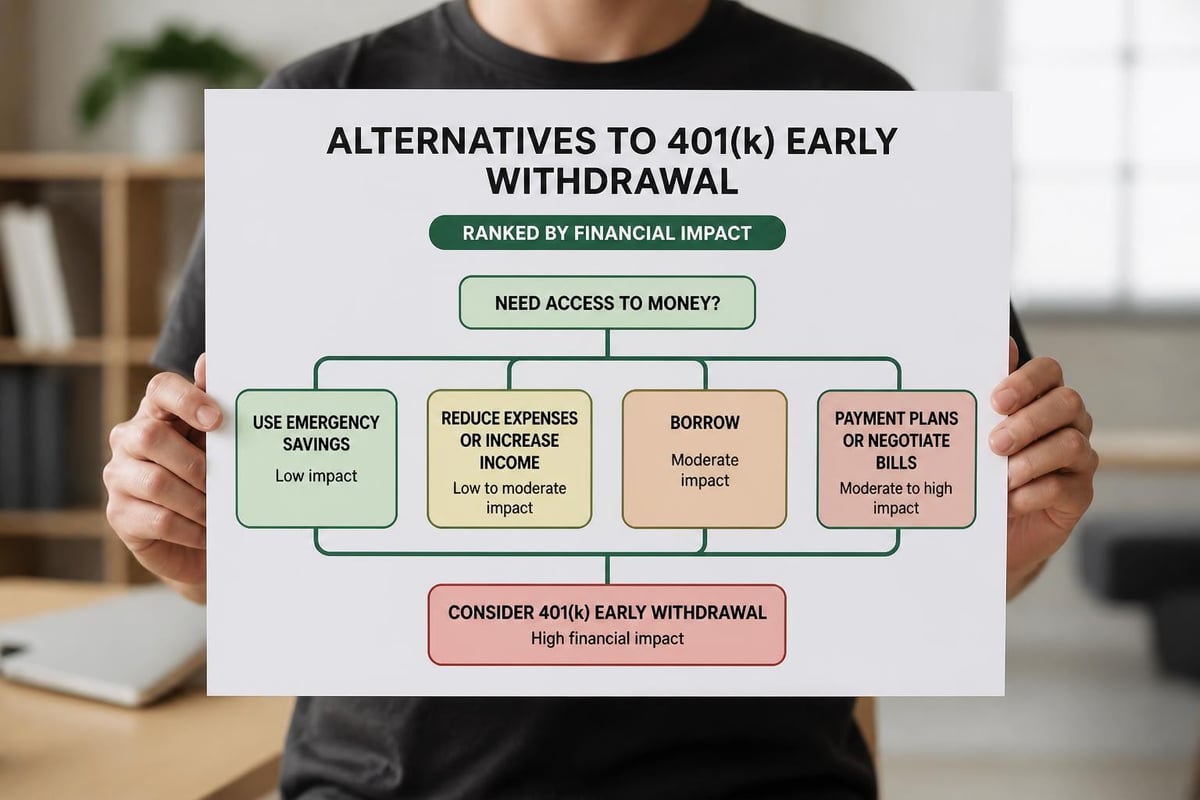
Thinking twice before tapping your 401k early often leads to discovering alternative solutions that better preserve your retirement security. Several options may provide the funds you need without the significant long-term costs.
Emergency Savings and Credit Options
Building adequate emergency savings represents the first line of defense against unexpected expenses. Financial advisors typically recommend maintaining three to six months of living expenses in accessible accounts.
Alternative funding sources ranked by financial impact:
- Emergency fund or savings accounts – No penalties, no interest charges
- Low-interest personal loans – Preserves retirement savings, predictable payments
- Home equity line of credit – Potentially tax-deductible interest, lower rates
- Balance transfer credit cards – 0% introductory APR periods can provide interest-free financing
- 401k loan – Repay yourself, no penalties if repaid on time
- Negotiated payment plans – Direct arrangements with creditors or service providers
- 401k early withdrawal – Should be last resort due to penalties and lost growth
Income Adjustments and Budget Restructuring
Sometimes addressing the root cause of financial pressure provides a more sustainable solution than accessing retirement funds. Comprehensive financial strategy planning examines both income and expense sides of your financial equation.
Consider these approaches:
- Temporary income increases through additional part-time work or freelancing
- Expense reduction strategies by analyzing discretionary spending categories
- Asset liquidation of non-retirement investments or personal property
- Family assistance through loans from relatives with formal repayment agreements
- Community resources including nonprofit assistance programs and government benefits
Plan-Specific Rules and Procedures
Each 401k plan establishes its own rules within the framework of IRS regulations. Your plan document and summary plan description outline specific procedures, waiting periods, and restrictions that apply to your account.
In-Service Withdrawals
Some plans permit in-service withdrawals while you remain employed, though this typically applies only to certain types of contributions or after reaching specific age milestones. Common in-service withdrawal provisions include:
- Age-based withdrawals – Many plans allow penalty-free access at age 59½ even if still employed
- After-tax contribution withdrawals – Distributions of after-tax contributions (not Roth) without penalty
- Rollover contributions – Some plans permit withdrawals of amounts rolled in from previous employers
- Profit-sharing or employer contributions – May become available after a specified vesting period
Contact your plan administrator or human resources department to understand which provisions apply to your specific situation. Using an early withdrawal calculator can help estimate the financial impact before initiating the process.
Distribution Processing Timeline
Once you request a 401k early withdrawal, the processing timeline varies by plan administrator. Most distributions occur within 7-10 business days, though some plans may require additional time for approval and processing.
Typical distribution process steps:
- Request distribution forms from plan administrator (1-2 days)
- Complete required documentation including beneficiary acknowledgment if married (1-3 days)
- Submit forms and wait for processing approval (3-7 days)
- Receive distribution via direct deposit or check (1-5 days)
- Plan administrator issues 1099-R tax form following year (January/February)
Roth 401k Withdrawal Considerations
Roth 401k accounts follow different rules for early withdrawals compared to traditional 401k accounts. Because you contribute to Roth accounts with after-tax dollars, the tax treatment of early distributions varies based on what you withdraw.
Contribution vs. Earnings Withdrawals
Roth 401k distributions follow a pro-rata rule, meaning each withdrawal contains a proportional mix of contributions and earnings. This differs from Roth IRAs, which allow you to withdraw contributions first without penalty or tax.
The ordering rules for Roth 401k withdrawals mean you cannot simply access your contribution basis without also withdrawing earnings. This makes early Roth 401k withdrawals potentially more costly than you might expect, as the earnings portion faces both taxes and penalties if you don't meet qualified distribution requirements.
Qualified distribution requirements for Roth 401k:
- Account open for at least five years
- Distribution occurs after age 59½, due to disability, or to your beneficiary after death
If your distribution doesn't meet these requirements, the earnings portion is subject to ordinary income tax plus the 10% early withdrawal penalty (unless an exception applies). Understanding these nuances within the context of retirement planning and estate planning helps you make informed decisions about which accounts to access during financial emergencies.
Required Documentation and Record Keeping
Maintaining thorough documentation of your 401k early withdrawal supports accurate tax filing and provides evidence if the IRS questions your return. The documentation requirements vary depending on whether you claim an exception to the 10% penalty.
Standard Withdrawal Documentation
For all 401k distributions, you'll receive Form 1099-R from your plan administrator, typically by January 31st following the year of distribution. This form reports:
- Total distribution amount
- Taxable amount
- Distribution code indicating the type of distribution
- Federal and state tax withholding amounts
You must include this information on your tax return, reporting the distribution on Form 1040 and calculating any additional taxes owed. If you claim an exception to the 10% penalty, you'll also complete Form 5329 to document the exception.
Exception-Specific Documentation
When claiming an exception to the early withdrawal penalty, maintain supporting documentation that substantiates your claim. The type of documentation varies by exception:
| Exception Type | Required Documentation |
|---|---|
| Medical expenses | Itemized bills, insurance EOBs, proof of payment |
| Disability | Physician's statement, Social Security determination letter |
| Higher education | Tuition bills, enrollment verification, receipts for qualified expenses |
| First home purchase | Purchase contract, closing statement, proof of first-time buyer status |
| IRS levy | IRS levy notice and correspondence |
Retaining these records for at least seven years protects you in case of an audit. Detailed guidance on 401k withdrawal rules can help you understand which documentation applies to your specific situation.
Professional Guidance and Financial Planning
Making decisions about retirement account access represents a complex intersection of tax planning, retirement readiness, and immediate financial needs. Professional guidance from fiduciary financial advisors can provide objective analysis tailored to your unique circumstances.
A fiduciary advisor is legally obligated to act in your best interest, providing recommendations based on your complete financial picture rather than earning commissions on product sales. This distinction becomes particularly important when evaluating whether a 401k early withdrawal serves your long-term interests or if alternative solutions better align with your goals.
Comprehensive financial guidance examines your situation holistically, considering factors such as:
- Current cash flow and budget structure
- Emergency fund adequacy
- Other available assets and credit sources
- Tax bracket implications of withdrawal timing
- Long-term retirement income projections
- Estate planning considerations
- Risk management through proper insurance coverage
Understanding comprehensive 401k withdrawal rules and penalties provides the foundation for informed decision-making, but applying those rules to your specific circumstances benefits from professional analysis.
A 401k early withdrawal can provide immediate financial relief, but the long-term costs often outweigh short-term benefits. Understanding the penalties, exceptions, and alternatives helps you make informed decisions that protect your retirement security. If you're facing a situation where accessing retirement funds seems necessary, Brookwood Investment Group LLC can provide personalized guidance to explore all available options and develop strategies aligned with your long-term financial goals.
