
Building wealth for retirement represents only half the challenge. The other half involves protecting that wealth from unnecessary tax erosion during your retirement years. A comprehensive retirement tax strategy can make the difference between a comfortable retirement and one constrained by tax obligations. Understanding how different account types are taxed, when to take distributions, and how to coordinate multiple income sources requires careful planning and a proactive approach to tax management.
Understanding Tax-Advantaged Account Types
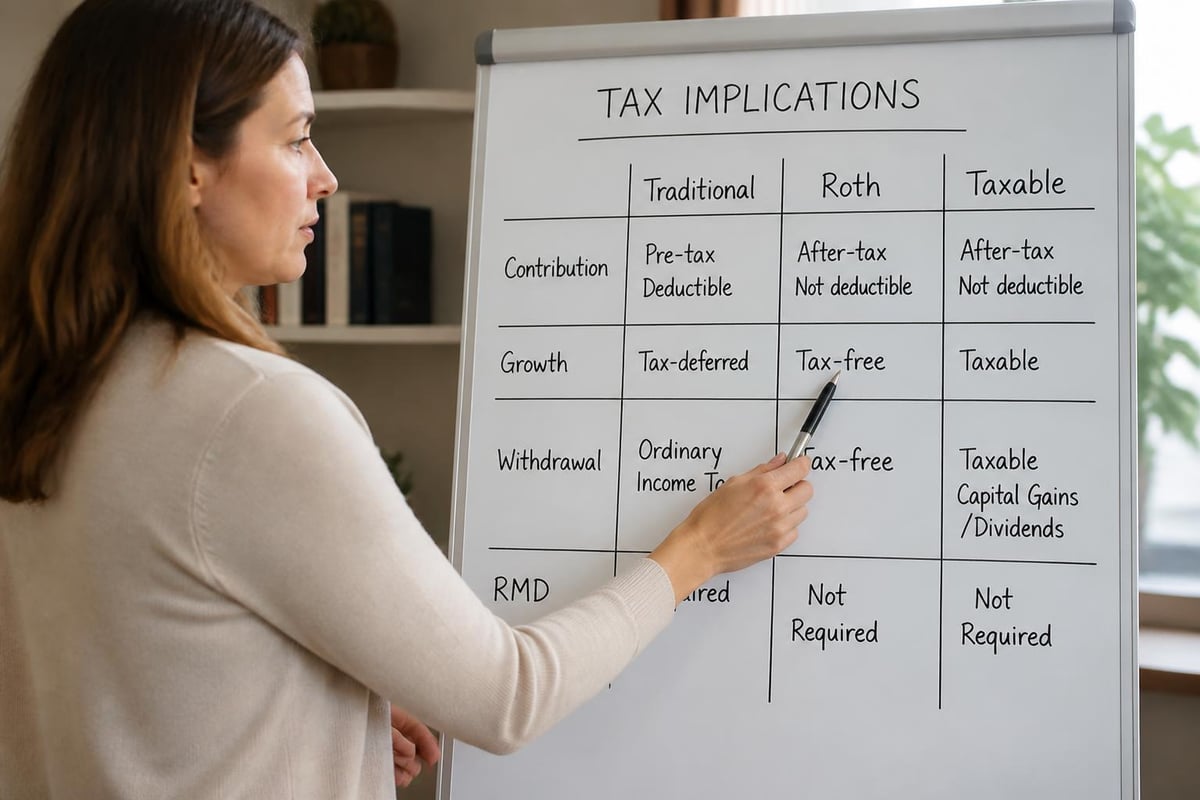
The foundation of any effective retirement tax strategy begins with understanding the three primary tax categories of retirement accounts. Each category offers distinct advantages and creates different tax obligations during retirement.
Tax-deferred accounts include traditional IRAs, 401(k)s, and 403(b)s. Contributions to these accounts typically reduce your taxable income in the year you make them, allowing your investments to grow without annual tax obligations. However, withdrawals during retirement are taxed as ordinary income at your current tax rate.
Tax-free accounts, primarily Roth IRAs and Roth 401(k)s, work inversely. You contribute after-tax dollars today, but qualified withdrawals in retirement are completely tax-free. This includes both contributions and investment growth, provided you meet the age and holding period requirements.
Taxable brokerage accounts offer the most flexibility but lack upfront tax benefits. You pay taxes on dividends and interest annually, and capital gains taxes apply when you sell investments. However, these accounts have no required minimum distributions and can benefit from favorable long-term capital gains rates.
| Account Type | Contribution Tax Treatment | Growth Tax Treatment | Withdrawal Tax Treatment | RMD Required |
|---|---|---|---|---|
| Traditional IRA/401(k) | Tax-deductible | Tax-deferred | Ordinary income | Yes, at 73 |
| Roth IRA/401(k) | After-tax | Tax-free | Tax-free (qualified) | No (Roth IRA) |
| Taxable Brokerage | After-tax | Taxable annually | Capital gains rates | No |
Strategic Withdrawal Sequencing
One of the most powerful elements of a retirement tax strategy involves determining the optimal order for withdrawing from different account types. The conventional wisdom of spending taxable accounts first, then tax-deferred, and finally tax-free accounts doesn't always produce the best results.
The Traditional Approach
The standard withdrawal sequence suggests depleting taxable accounts first to allow tax-advantaged accounts to continue growing. Next, you would tap tax-deferred accounts, and finally preserve Roth accounts for last since they provide tax-free growth.
This approach offers simplicity and allows maximum compounding in protected accounts. However, it can create problems by forcing large required minimum distributions later in retirement when your tax-deferred accounts have grown substantially.
Tax-Bracket Management Strategy
A more sophisticated approach involves managing your tax bracket strategically throughout retirement. Rather than completely depleting one account type before moving to the next, you coordinate withdrawals to stay within favorable tax brackets.
For example, you might take enough from tax-deferred accounts to fill up the 12% or 22% federal tax bracket, then supplement remaining income needs from Roth or taxable accounts. This strategy prevents bracket creep while maintaining flexibility.
Key benefits of bracket management include:
- Controlling marginal tax rates year by year
- Preventing large RMD-driven tax spikes
- Preserving flexibility for unexpected expenses
- Optimizing lifetime tax payments rather than annual taxes
Working with a fiduciary advisor can help you model different scenarios and determine the most tax-efficient withdrawal sequence for your specific situation.
Roth Conversion Opportunities
Roth conversions represent one of the most underutilized tools in retirement tax planning. By converting traditional IRA or 401(k) funds to a Roth IRA, you pay taxes now in exchange for tax-free withdrawals later.
The key to successful Roth conversions lies in timing and amount. Converting when your income temporarily drops, such as in early retirement before Social Security begins or required minimum distributions start, can significantly reduce the tax cost.
Optimal Conversion Windows
Several life circumstances create ideal opportunities for Roth conversions:
- Early retirement years before age 70 when you're no longer earning wages but haven't started Social Security or RMDs
- Market downturns when account values are temporarily depressed, allowing you to convert more shares for the same tax cost
- Lower-income years following a job change, sabbatical, or temporary business slowdown
- Before Medicare enrollment to avoid income-related premium adjustments
The strategy works particularly well when implemented gradually over multiple years. Rather than converting a large amount in one year and jumping into a higher tax bracket, spreading conversions allows you to fill up lower brackets systematically.
| Conversion Timing | Tax Rate Paid | Long-term Benefit | Considerations |
|---|---|---|---|
| During high-income years | High | Lower | Generally unfavorable |
| Early retirement (60-72) | Moderate | Higher | Optimal window |
| After RMDs begin | Variable | Moderate | More complex planning |
| During market decline | Same rate, more shares | Highest | Requires available cash |
Required Minimum Distribution Planning
Once you reach age 73, the IRS requires you to withdraw minimum amounts from tax-deferred retirement accounts annually. These required minimum distributions can create significant tax obligations and impact other retirement decisions.

Calculating and Managing RMDs
RMDs are calculated by dividing your account balance by a life expectancy factor determined by the IRS. The percentage starts around 3.8% at age 73 and increases each year as life expectancy shortens.
Strategies to minimize RMD impact:
- Begin Roth conversions years before RMDs start to reduce future account balances
- Coordinate RMD timing with other income sources to manage brackets
- Consider qualified charitable distributions if charitably inclined
- Consolidate multiple IRAs to simplify calculations and withdrawals
For those who don't need RMD income for living expenses, qualified charitable distributions allow you to donate up to $105,000 annually (in 2026) directly from your IRA to charity, satisfying the RMD without increasing taxable income.
Social Security Taxation Strategies
Many retirees are surprised to learn that Social Security benefits can be taxable. Depending on your combined income, up to 85% of your benefits may be subject to federal income tax. This makes Social Security timing a critical component of your retirement tax strategy.
Combined Income Thresholds
The IRS calculates "combined income" as your adjusted gross income plus nontaxable interest plus half of your Social Security benefits. The taxation thresholds for 2026 are:
- Single filers: Benefits become taxable above $25,000; up to 85% taxable above $34,000
- Married filing jointly: Benefits become taxable above $32,000; up to 85% taxable above $44,000
Understanding these thresholds allows you to coordinate other retirement income sources strategically. Taking distributions from Roth accounts instead of traditional IRAs, for example, doesn't increase combined income since Roth withdrawals aren't counted.
Delaying Social Security Benefits
Retiring at 62 while building a financial bridge to maximize Social Security represents an advanced strategy that can improve lifetime tax efficiency. By drawing from retirement accounts during the delay period, you accomplish multiple objectives simultaneously.
You reduce future RMDs by depleting tax-deferred accounts, potentially perform Roth conversions in lower brackets, and increase your Social Security benefit by 8% annually until age 70. The higher benefit amount provides more inflation-adjusted income later in retirement when portfolio longevity becomes more critical.
Healthcare Cost Considerations
Healthcare expenses and health insurance premiums represent significant retirement costs, and both have important tax implications. Medicare premiums are income-based, creating another reason to manage your adjusted gross income carefully.
Income-Related Monthly Adjustment Amount
High-income Medicare beneficiaries pay surcharges known as IRMAA on both Part B and Part D premiums. These surcharges are determined by modified adjusted gross income from two years prior, creating a planning opportunity.
In 2026, IRMAA thresholds create cliff effects where relatively small income increases can trigger substantially higher premiums. Strategic withdrawal planning and Roth conversion timing can help you stay below these thresholds during critical years.
Additionally, health savings accounts offer triple tax benefits for those eligible. Contributions are tax-deductible, growth is tax-free, and withdrawals for qualified medical expenses are tax-free. For those who can afford to pay current medical expenses from other sources, HSAs function as powerful supplemental retirement accounts.
Tax-Location Strategy for Investments
Beyond which accounts you withdraw from, the types of investments you hold in each account matter significantly. This concept, called tax-location strategy, aims to place the most tax-inefficient investments in tax-advantaged accounts while keeping tax-efficient investments in taxable accounts.
Tax-efficient investments for taxable accounts:
- Index funds with low turnover
- Tax-managed funds
- Municipal bonds
- Individual stocks held long-term
Tax-inefficient investments for tax-advantaged accounts:
- Actively managed funds with high turnover
- Real estate investment trusts (REITs)
- Taxable bonds generating ordinary income
- High-yield dividend stocks

This approach recognizes that you'll eventually pay taxes on tax-deferred accounts anyway, so holding tax-inefficient investments there doesn't create additional tax burden. Meanwhile, tax-efficient investments in taxable accounts benefit from favorable capital gains treatment and step-up in basis at death.
State Tax Considerations
While federal taxes often receive the most attention, state taxes can significantly impact your retirement tax burden. Some states don't tax retirement income at all, while others tax it fully, and many fall somewhere in between.
Nine states have no income tax: Alaska, Florida, Nevada, South Dakota, Tennessee, Texas, Washington, and Wyoming (New Hampshire has no earned income tax). Several other states exempt Social Security benefits or provide generous exemptions for retirement account withdrawals.
Retirement Relocation Planning
If relocating is an option, the potential tax savings can be substantial. However, establishing residency requires more than spending time in a low-tax state. You must demonstrate intent through actions like obtaining a driver's license, registering to vote, and maintaining your primary residence there.
For those maintaining homes in multiple states, domicile determination becomes more complex. Careful planning and documentation become essential to avoid dual-state taxation issues.
Estate Planning Integration
An effective retirement tax strategy doesn't end with your lifetime. Integrating estate planning considerations helps minimize taxes for both you and your beneficiaries.
Traditional IRAs and 401(k)s represent income in respect of a decedent, meaning beneficiaries must pay income tax on distributions. The SECURE Act's elimination of the stretch IRA for most non-spouse beneficiaries now requires inherited retirement accounts to be distributed within 10 years, potentially creating significant tax burdens.
Roth IRAs offer superior estate planning benefits. Beneficiaries receive tax-free distributions and must still follow the 10-year rule, but without the tax burden. This makes Roth conversions during your lifetime particularly valuable if leaving a legacy is important to you.
| Account Type | Spousal Inheritance | Non-Spousal Inheritance | Tax Implications |
|---|---|---|---|
| Traditional IRA | Can treat as own | 10-year distribution | Ordinary income tax |
| Roth IRA | Can treat as own | 10-year distribution | Tax-free |
| Taxable Account | Receives step-up | Receives step-up | Capital gains eliminated |
Charitable Giving Strategies
For charitably inclined retirees, qualified charitable distributions and donor-advised funds offer tax-efficient giving options that complement your overall retirement tax strategy.
QCDs allow you to donate up to $105,000 annually directly from your IRA to qualified charities, counting toward your RMD while excluding the distribution from taxable income. This strategy works particularly well for those who don't itemize deductions under current tax law.
Donor-advised funds provide flexibility by allowing you to make a large charitable contribution in a high-income year, receive the immediate tax deduction, and then recommend grants to charities over multiple years. For retirees with occasional high-income years, perhaps from real estate sales or business windfalls, this strategy can smooth out tax obligations.
Working with Tax Professionals
The complexity of retirement tax planning makes professional guidance valuable for most retirees. Coordinating between a CPA and financial advisor ensures your investment strategy and tax strategy work in harmony rather than at cross purposes.
Tax laws change regularly, and new planning opportunities emerge. The SECURE 2.0 Act introduced numerous changes affecting retirement accounts, RMD ages, and catch-up contributions. Staying current with these changes while managing your specific situation requires ongoing attention.
Professional tax projection modeling can illustrate the long-term impact of different strategies, helping you make informed decisions. These projections should account for Social Security timing, Roth conversions, RMD impacts, and estimated tax liabilities across multiple years.
Implementing Your Strategy
Developing a retirement tax strategy requires analyzing your current situation, projecting future income sources, and creating a coordinated plan. Understanding top withdrawal strategies provides a framework for implementation.
Begin by inventorying all retirement accounts, noting balances, tax treatment, and beneficiary designations. Project your income sources year by year, including Social Security, pensions, RMDs, and any part-time work. Identify your expected tax brackets and potential tax planning opportunities.
Create a withdrawal schedule that coordinates all income sources while managing your tax bracket strategically. Build in flexibility to adjust as circumstances change, markets fluctuate, or tax laws evolve.
Regular reviews ensure your strategy remains optimal as you age through retirement. What works at age 65 may need adjustment at 75 or 85 as account balances, spending needs, and tax situations change.
Tax-Efficient Investment Management
Beyond withdrawal strategies, managing investments tax-efficiently during retirement preserves more wealth. This includes minimizing unnecessary portfolio turnover, tax-loss harvesting in down markets, and coordinating rebalancing across account types.
Tax-loss harvesting involves selling investments with losses to offset gains, reducing current tax obligations. In taxable accounts, you can harvest up to $3,000 in net losses annually to offset ordinary income, with excess losses carrying forward indefinitely.
Strategic rebalancing means considering the tax implications of selling appreciated assets. When possible, rebalance by directing new contributions, taking required distributions from overweighted asset classes, or selling within tax-advantaged accounts where gains don't trigger immediate taxes.
Asset location rebalancing recognizes that your overall asset allocation spans multiple account types. Rather than maintaining identical allocations in each account, coordinate across all accounts to achieve your target allocation while optimizing tax efficiency.
These techniques require careful tracking and coordination but can save thousands of dollars annually for retirees with substantial portfolios across multiple account types.
Developing and implementing an effective retirement tax strategy requires understanding complex rules, coordinating multiple account types, and making decisions that balance current and future tax obligations. The strategies outlined above provide a framework for minimizing lifetime tax burdens while maintaining flexibility throughout retirement. Whether you're years from retirement or already drawing income from your portfolio, working with experienced professionals can help optimize your approach. Brookwood Investment Group offers comprehensive retirement planning services that integrate tax strategies with investment management, helping clients preserve wealth and achieve their retirement goals through personalized, fiduciary guidance.
