
A roth conversion represents one of the most powerful yet complex strategies available for retirement planning. This financial maneuver involves transferring assets from a traditional retirement account, such as a traditional IRA or 401(k), into a Roth IRA. The primary appeal lies in converting tax-deferred savings into tax-free growth potential, but the decision requires careful analysis of your current tax situation, future income projections, and long-term financial goals. Understanding the mechanics, benefits, and potential drawbacks of this strategy can help you make an informed decision that aligns with your unique circumstances.
Understanding the Mechanics of a Roth Conversion
The fundamental concept behind a roth conversion involves paying taxes now to enjoy tax-free distributions later. When you convert traditional retirement funds to a Roth account, you recognize the converted amount as ordinary income in the year of conversion. This means the conversion amount gets added to your taxable income, potentially pushing you into a higher tax bracket for that year.
According to Britannica’s comprehensive overview of Roth IRA conversions, the process can be completed through several methods. You can execute a direct rollover, where funds transfer directly between custodians, or complete a 60-day rollover, where you receive a distribution and have 60 days to deposit it into a Roth account. The direct method typically offers fewer complications and reduces the risk of missing critical deadlines.
Key conversion methods include:
- Direct trustee-to-trustee transfers
- 60-day indirect rollovers
- Same-trustee transfers between account types
- In-plan Roth conversions within employer plans
One critical change occurred in 2018 when the Tax Cuts and Jobs Act eliminated the ability to recharacterize Roth conversions. Previously, investors could reverse a conversion if their circumstances changed or market conditions deteriorated. This option no longer exists, making the conversion decision permanent and requiring more thorough upfront analysis.

Tax Implications and Strategic Timing
The tax impact of a roth conversion demands careful consideration as it directly affects the strategy's effectiveness. The converted amount receives treatment as ordinary income, subject to your marginal tax rate. For substantial conversions, this could mean a significant tax bill due by April 15 of the following year.
Smart timing can dramatically reduce the tax burden associated with conversions. Years with lower-than-usual income present ideal opportunities. Perhaps you've retired but haven't yet started Social Security or required minimum distributions. Maybe you've experienced a temporary income reduction or have significant deductions available. These scenarios create favorable conditions for conversions.
| Income Scenario | Conversion Advantage | Consideration |
|---|---|---|
| Early retirement gap years | Lower tax bracket | Before RMDs begin |
| Business loss year | Reduced overall income | Offset with conversion |
| Market downturn | Lower account values | Pay less tax on same shares |
| High deduction year | Increased available room | Medical expenses, charitable gifts |
The concept of "bracket management" plays a crucial role in conversion planning. Rather than converting a large sum in one year, many investors benefit from executing smaller conversions over multiple years. This approach keeps you within a targeted tax bracket and prevents unnecessarily high tax payments. Working with comprehensive retirement planning services can help you model different scenarios and identify optimal conversion amounts.
Multi-Year Conversion Strategies
Spreading conversions across several years offers flexibility and tax efficiency. This approach, sometimes called "Roth conversion laddering," allows you to fill up lower tax brackets each year without pushing into higher brackets. For instance, if you're comfortably in the 22% bracket with room before reaching the 24% threshold, you might convert just enough to utilize that available bracket space.
The strategy becomes particularly valuable for those in their early 60s who have stopped working but haven't yet filed for Social Security benefits. This window may represent the lowest-tax years of your retirement, creating an exceptional opportunity for conversions.
Evaluating Whether a Conversion Makes Sense
Not every retirement saver benefits from a roth conversion, despite its growing popularity. Common misconceptions about Roth conversions can lead to poor decisions if you don't carefully evaluate your specific situation against established criteria.
Critical evaluation factors include:
- Current versus future tax rates: If you expect higher tax rates in retirement, conversions become more attractive
- Ability to pay taxes from non-retirement assets: Using retirement funds to pay conversion taxes significantly reduces the strategy's benefit
- Time horizon until withdrawals: Longer timeframes allow more opportunity for tax-free growth to offset the upfront tax cost
- Estate planning goals: Roth IRAs pass to beneficiaries tax-free without required minimum distributions during the owner's lifetime
Consider Sarah, a 58-year-old professional who recently received a severance package. Her income for 2026 will be approximately $60,000 lower than typical years. This temporary income reduction creates an opportunity to convert $75,000 from her traditional IRA to a Roth while remaining in a relatively low tax bracket. She has sufficient cash savings to cover the tax bill without touching her retirement funds.
Contrast this with Michael, a 68-year-old retiree already taking required minimum distributions and receiving Social Security benefits. A large conversion would increase his Medicare premiums through Income-Related Monthly Adjustment Amounts (IRMAA) and potentially trigger taxation of his Social Security benefits. For Michael, the conversion might prove less beneficial.
Required Minimum Distributions and Conversions
Required minimum distributions significantly impact conversion planning for those aged 73 and older. Under current law, you cannot convert your RMD amount itself, but you can convert additional funds from your traditional IRA after satisfying your RMD for the year. This creates a planning consideration for older individuals contemplating conversions.
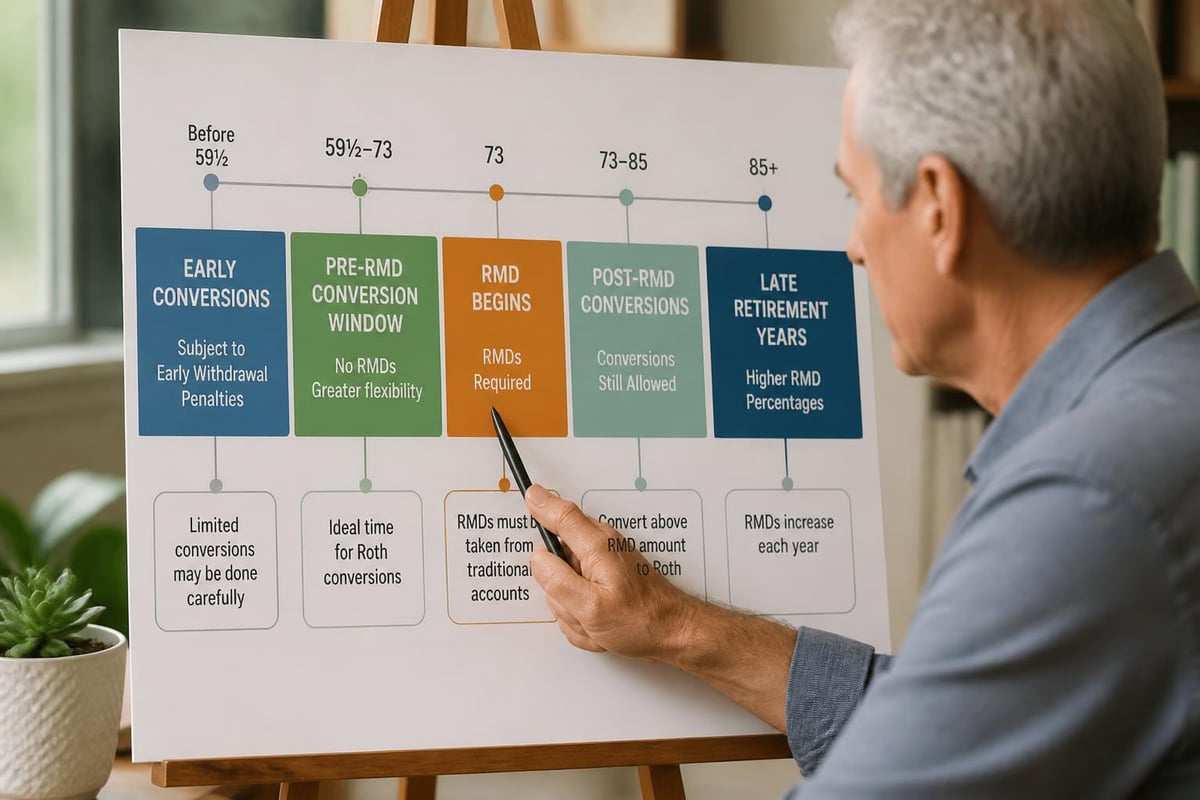
Before RMDs begin, you have maximum flexibility for conversion planning. Once RMDs start, you must first withdraw your required amount before converting any additional funds. This RMD cannot be converted and must be included in your taxable income regardless of any conversion activity.
The elimination of RMDs for Roth IRA owners creates another compelling reason for conversions. Traditional IRAs force distributions based on your life expectancy, regardless of whether you need the funds. These mandatory withdrawals create ongoing tax liability and can push you into higher brackets. Roth IRAs face no such requirement during the owner's lifetime, allowing assets to grow tax-free indefinitely.
Legacy Planning Considerations
Estate planning objectives often drive conversion decisions. When you leave traditional retirement accounts to beneficiaries, they inherit the tax burden along with the assets. Most non-spouse beneficiaries must now empty inherited IRAs within ten years, potentially facing significant tax consequences if they're in their peak earning years.
Conversely, inherited Roth IRAs provide tax-free income to beneficiaries, though the ten-year distribution rule still applies. For those with substantial retirement assets who don't need all their funds for living expenses, conversions represent a way to prepay taxes at their current rate, leaving a more valuable inheritance. This approach works particularly well when the account owner is in a lower tax bracket than their beneficiaries.
Medicare Premium and Other Collateral Impacts
Beyond direct tax implications, roth conversions can trigger unexpected consequences that affect your overall financial picture. Modified Adjusted Gross Income (MAGI) determines Medicare Part B and Part D premiums for those enrolled in Medicare. A large conversion that significantly increases your MAGI can result in substantially higher premiums two years later due to Medicare's two-year lookback period.
The IRMAA thresholds create specific income levels where premiums jump noticeably. Strategic conversion planning must account for these thresholds to avoid inadvertently triggering higher healthcare costs that offset the conversion's benefits. For 2026, careful planning around these income levels becomes essential for anyone aged 63 or older who will be subject to Medicare premiums within the two-year window.
| Medicare Impact | Income Threshold | Premium Increase |
|---|---|---|
| Standard premium | Below threshold | No increase |
| IRMAA Tier 1 | Moderate MAGI increase | First surcharge level |
| IRMAA Tier 2 | Higher MAGI increase | Second surcharge level |
| Maximum surcharge | Highest income levels | Substantial premium |
Additionally, conversion income can affect the taxation of Social Security benefits. Higher provisional income may cause a greater portion of your Social Security to become taxable, creating a cascading tax effect. These interconnected impacts demonstrate why detailed financial planning guidance proves invaluable when evaluating conversion strategies.
Partial Conversions and Bracket Management
Rather than converting your entire traditional IRA balance, partial conversions offer a more nuanced approach. This strategy involves converting specific dollar amounts designed to achieve particular objectives while managing tax consequences. Many financial professionals recommend this technique as it provides greater control and flexibility.
Benefits of partial conversions:
- Maintain consistent tax bracket positioning
- Spread tax liability across multiple years
- Adjust strategy based on changing circumstances
- Respond to market conditions opportunistically
The concept of "filling up" a tax bracket involves calculating exactly how much income you can recognize before entering the next bracket tier. For instance, if you have $30,000 of available space in the 22% bracket, you might convert precisely that amount, ensuring you don't inadvertently push into the 24% bracket unnecessarily.
Market volatility presents another consideration for partial conversions. During market downturns, when account values have declined, converting depreciated assets allows you to pay taxes on a lower value while maintaining the same number of shares. If the market recovers, that growth occurs tax-free within the Roth account.
Professional Guidance and Personalized Analysis
Given the complexity and permanence of roth conversion decisions, professional guidance typically proves valuable. Questions to evaluate before making a conversion decision highlight the need for comprehensive analysis that considers your complete financial picture.
Tax professionals and financial advisors can model various scenarios, projecting the long-term impact of different conversion strategies. This analysis should incorporate your expected income trajectory, anticipated tax law changes, retirement spending needs, and estate planning objectives. Software tools can run projections showing after-tax wealth accumulation under different conversion scenarios.
The challenge with conversion advice lies in avoiding overly simplistic recommendations. Some advisors suggest blanket strategies without proper customization. Vague advice about Roth conversions can lead to suboptimal decisions. Effective planning requires detailed, math-driven analysis specific to your situation.
Documentation and Record-Keeping
Proper documentation of roth conversions ensures smooth management and accurate tax reporting. You'll receive Form 1099-R showing the distribution from your traditional account and Form 5498 documenting the Roth contribution. Maintaining organized records of conversion dates, amounts, and tax payments creates a clear audit trail.
For those executing multiple conversions over several years, tracking becomes even more important. You need to monitor cumulative conversion amounts, total taxes paid, and the performance of converted assets. This information helps you evaluate the strategy's effectiveness and make informed decisions about future conversions.

Special Conversion Opportunities
Certain situations create particularly advantageous conversion opportunities that may not recur. Job loss or early retirement, as mentioned earlier, represents one such scenario. Business owners selling their company might face one high-income year followed by several lower-income years, creating a unique planning window.
Similarly, market corrections present tactical opportunities. When your traditional IRA balance has declined due to market conditions, converting during the downturn means paying taxes on a reduced value. This approach can be especially effective with stock holdings expected to recover, as the rebound happens within the tax-free Roth environment.
Recent retirees often encounter a "sweet spot" for conversions between their retirement date and when they begin Social Security benefits or reach RMD age. This period may span several years where income is relatively low, creating substantial conversion capacity at favorable tax rates. Maximizing this window through systematic annual conversions can significantly enhance retirement tax efficiency.
Backdoor Roth Strategies
High earners face income limitations on direct Roth IRA contributions. However, there are no income limits on conversions, leading to the popular "backdoor Roth" strategy. This involves making non-deductible contributions to a traditional IRA and then immediately converting to a Roth. While conceptually straightforward, the strategy requires careful attention to the pro-rata rule and existing pre-tax IRA balances.
The pro-rata rule states that conversions must proportionally include pre-tax and after-tax dollars based on all your traditional IRA balances. This means if you have substantial existing traditional IRA funds, a backdoor conversion cannot isolate just the after-tax contribution, potentially creating unexpected tax consequences. Planning around this requires comprehensive evaluation of all IRA holdings.
Analyzing Breakeven Timeframes
Understanding your breakeven point helps frame the conversion decision in concrete terms. The breakeven period represents how long you need to hold the converted Roth assets before the tax-free growth compensates for the upfront tax cost. This calculation depends on several variables including tax rate differential, investment returns, and withdrawal timing.
Generally, longer timeframes favor conversions because they provide more years for tax-free compounding to overcome the initial tax payment. If you need to access funds within five years, conversions become less attractive. Conversely, if you're planning a 20 or 30-year time horizon, the compounding effect of tax-free growth becomes substantial.
Various checklists and evaluation tools can help you work through these calculations. While online calculators provide basic estimates, truly accurate breakeven analysis requires assumptions about future tax rates, investment performance, and withdrawal patterns, all of which involve uncertainty.
Factors affecting breakeven analysis:
- Current marginal tax rate versus projected retirement rate
- Expected rate of return on investments
- Years until distributions begin
- State tax considerations for conversions versus distributions
- Estate planning transfer goals
State Tax Considerations
While federal tax implications typically dominate conversion discussions, state taxes can significantly impact the analysis. Some states don't tax retirement income, creating potential opportunities for strategic conversions. If you plan to relocate from a high-tax state to a no-tax or low-tax state in retirement, delaying conversions until after the move could prove beneficial.
Conversely, if you currently reside in a state without income tax but plan to retire in a high-tax jurisdiction, executing conversions now might make sense. The geographic arbitrage opportunity exists when your conversion tax rate differs from your distribution tax rate due to state tax differences.
A few states offer specific exemptions or preferential treatment for retirement income, further complicating the analysis. Understanding both your current state's treatment of conversions and your intended retirement state's treatment of Roth distributions helps optimize the decision. Comprehensive tax planning strategies should incorporate these state-level considerations alongside federal tax analysis.
Common Conversion Mistakes to Avoid
Even well-intentioned savers sometimes make critical errors when executing roth conversions. Using retirement account funds to pay the conversion tax represents perhaps the most significant mistake. This approach reduces the amount that can continue growing tax-free and may trigger additional penalties if you're under age 59½.
Another common error involves failing to plan for the tax payment. The conversion creates a tax liability due with your return, not withholding that automatically covers the bill. Ensure you have adequate non-retirement assets set aside to handle the tax burden, or arrange for proper withholding when processing the conversion.
Timing mistakes also occur frequently. Converting late in the year leaves little time to adjust if circumstances change or to implement tax planning strategies that could offset the conversion income. Additionally, converting without considering upcoming major expenses or income changes can lead to regret when unexpected financial needs arise.
Mistakes to avoid:
- Converting amounts too large for your tax bracket
- Failing to coordinate with Medicare premium thresholds
- Ignoring the impact on Social Security taxation
- Not maintaining adequate emergency reserves after paying conversion taxes
- Converting during temporarily high-income years
Strategic roth conversion planning requires balancing immediate tax costs against long-term benefits while accounting for your unique financial circumstances, goals, and risk tolerance. The complexity of these decisions and their permanent nature make personalized, professional analysis particularly valuable. Brookwood Investment Group offers comprehensive retirement planning services that evaluate conversion opportunities within the context of your complete financial picture, helping you make informed decisions aligned with your long-term objectives.
